
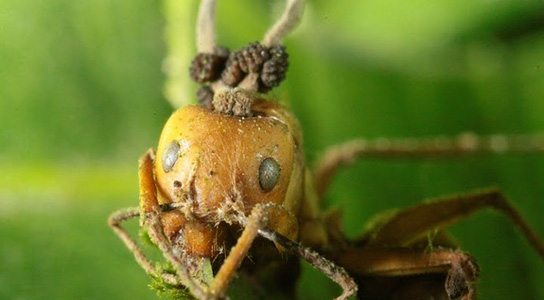
The zombie-ant fungus is part of the Ophiocordyceps genus, and its strange way of infecting worker ants’ heads and controlling them to distribute more spores has been well documented in scientific literature.
Fossil evidence suggests that this infection has been occurring for at least 48 million years. Research seems to indicate that different species of fungi might specialize in infecting different groups of ants worldwide. Closer examination of the infected ant corpses revealed that these fungi are often parasitized by other fungi.
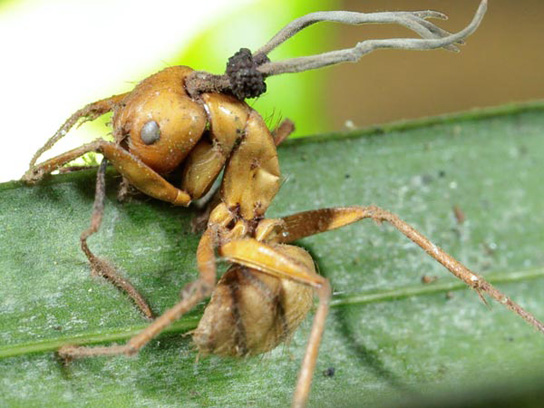
Ophiocordyceps fungi depend on ants to reproduce and spread. Infected ants behave like zombies, walking randomly and displaying convulsions that make them fall down and preclude them from returning to the dry tree canopy.
While the manipulated individual may still look like an ant, it represents a fungal genome expressing fungal behavior through the body of an ant, researchers noted previously.
A nerve toxin spurred on by the fungus seems to be partly to blame. The ants’ heads are already full of fungal cells. Eventually, the ant will clamp down onto a leaf, roughly 25 cm off the forest floor, which is optimal for the fungus’ later stage in which it ejects spores onto the soil directly below. The bites are synchronized near noon (possibly cued by clock genes in the fungus) and usually occur in a north-northwestern orientation.
The fungus also causes atrophy in its victim’s muscles, specifically around its mandibles. The atrophy causes the ant’s body to have lockjaw, allowing the fungus to propagate.
At this stage, the fungus has proliferated extensively through the ant’s body. Ants die within six hours of their final bite. Two or three days later, a fungal stalk will emerge from the back of the ant’s head. After maturing for a few weeks, the stalk’s head will shoot spores into the soil below.
The fungus capitalizes on the ants’ social behavior. The ants best known for being infected are tree-dwelling carpenter ants found in Brazil and Thailand, but the fungus is thought to be broadly distributed in tropical areas around the globe.
There could be tens or even hundreds of different Ophiocordyceps fungi species. This hint at biodiversity and specialization could indicate that there are a lot more fungi than expected. This could also imply that the fungus has been infecting ants before the current continents drifted apart.
The zombie-ant fungus is not the end of the parasitizing line. It meets its own death at the work of yet another parasite. A secondary fungus, a hyperparasite, can cover the original fungus and its stalk, preventing the fungus from ejecting its spores. The second-level parasite seems to sterilize the spores and these hyperparasites aren’t growing on anything else but the specific parasitizing fungi.
This could explain why the zombie-ant fungus has been so successful over the long term since it could severely damage an ant colony. The presence of a hyperparasite could curb infection rates and keep it in check, creating a sort of equilibrium, and keeping it from completely destroying ant colonies.
There are also small insects laying their eggs into the infected ant corpses. Their larvae can eat the growing fungus.
Discovering more about both the fungus and the ant behavior and signaling dynamics could add to research about pest control for agriculture. “Lots of the pure discoveries we make have great import for food security and the challenges farmers in tropical countries face from insects and fungi that infect their crops.”
Never miss a breakthrough: Join the SciTechDaily newsletter.
Follow us on Google and Google News.
3 Comments
That is crazy. I wonder if it spreads to people because I know a lot of people that wander round like a zombie! The zombie-ant fungus is simply amazing, isn’t mother nature just a wonder!
Probably fentanyl. similar but not the same
I have been more disgusted. Not often. Can’t think just now just when.