
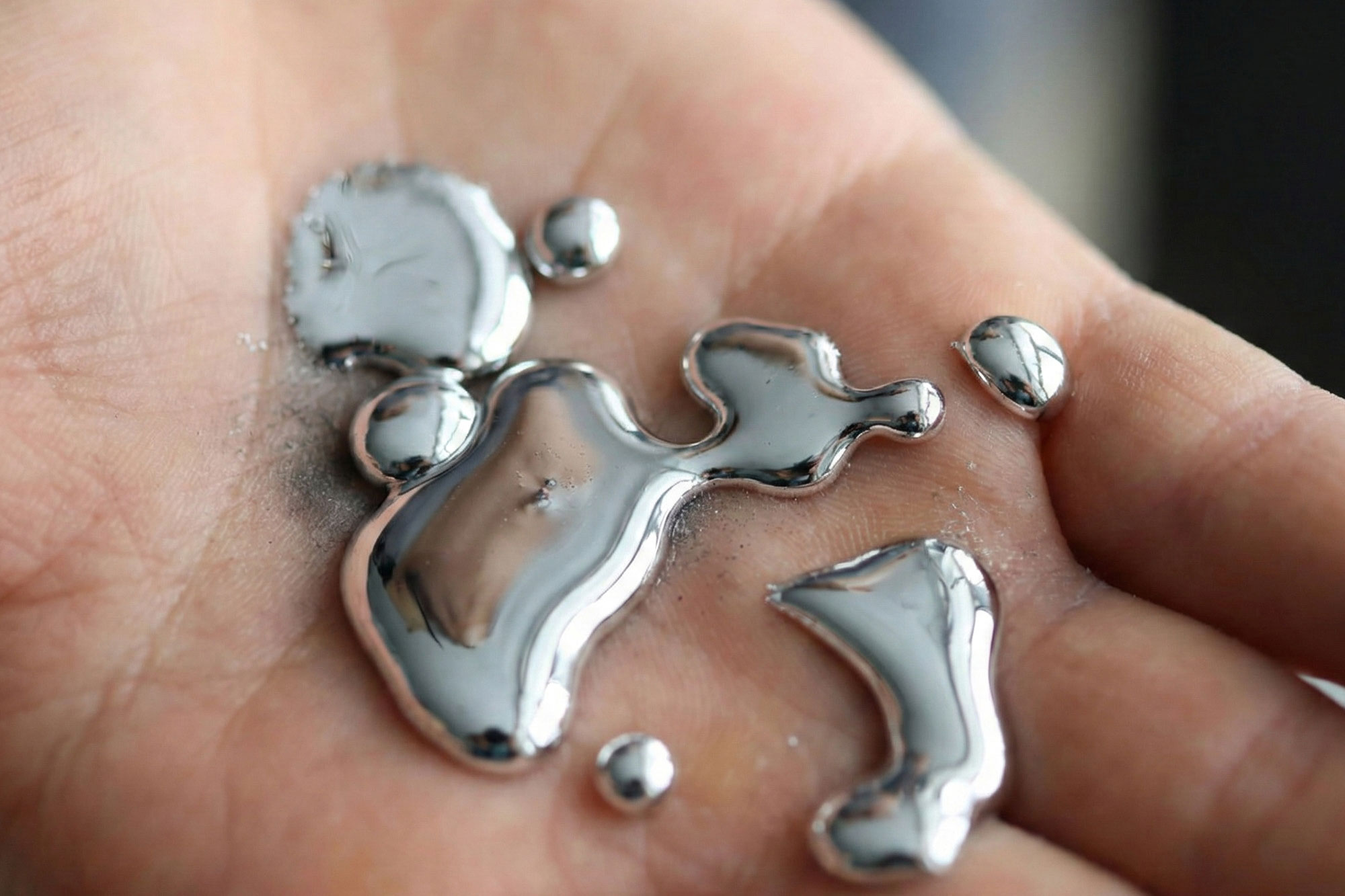
Gallium has revealed unexpected behavior that challenges decades-old assumptions about its liquid structure.
A metal that can melt in your hand has just surprised scientists again.
Gallium, first identified in 1875, already stands out for its strange behavior. It melts at about 30°C (86°F), meaning it can liquefy in a warm room or even in a cup of tea. It is widely used in semiconductors, LEDs, and solar panels, yet its liquid form has remained poorly understood despite decades of research.
Now, scientists at the University of Auckland say they have resolved a long-running mystery about how gallium behaves once it melts, overturning a key assumption that has shaped the field for more than 30 years.
A Metal That Defies Expectations
At the atomic level, gallium does not behave like a typical metal. In its solid state, atoms pair into dimers and form covalent bonds, sharing electrons in a way more common in nonmetals. It is also less dense as a solid than as a liquid, similar to ice floating on water.
For years, researchers believed these covalent bonds persisted in liquid gallium and explained its unusual properties.
The new study shows the opposite.
Using large-scale simulations that track atomic motion in detail, the team found that these bonds vanish right at the melting point. Then, unexpectedly, they begin to reappear as the temperature increases further.
This reversal helps explain a long-standing puzzle. When gallium melts, it conducts electricity better, with its resistivity dropping. As the liquid heats up, resistivity rises again in a nonlinear way. The researchers link this to the shifting role of bonding, with increasing structural organization emerging again at higher temperatures.
They point to entropy, or disorder, as the key factor. When bonds break during melting, disorder rises sharply, stabilizing the liquid and lowering the melting point.
“Thirty years of literature on the structure of liquid gallium has had a fundamental assumption that is evidently not true,” says Professor Nicola Gaston of the University of Auckland and the MacDiarmid Institute.
Why Gallium Matters
Gallium is central to a growing class of materials known as liquid metals, which are being explored for next-generation technologies.
Because it stays liquid at relatively low temperatures, gallium can dissolve other metals, forming alloys used in catalysis, energy systems, and advanced manufacturing. These materials can even form `self-assembling structures’, where disordered atoms spontaneously organize into useful patterns.
A better understanding of how gallium behaves across temperatures could help scientists design liquid metal systems with more precise electrical, thermal, and chemical properties. That has implications for batteries, flexible electronics, and high-efficiency catalysts.
The breakthrough came when Dr Steph Lambie revisited decades of experimental data and combined it with advanced simulations to reconcile conflicting results. The study was published in Materials Horizons.
Order Hidden in a Liquid Surface
In a follow-up study, also published in Materials Horizons, the same research group turned to another long-standing question. Does liquid gallium have any real structure at its surface, or is it completely disordered?
Liquids are usually defined by constant atomic motion and randomness. But using machine learning and large-scale simulations, the team found that gallium’s surface is not entirely chaotic. Instead, it forms subtle but measurable geometric patterns.
They showed that this ordering extends across about three atomic layers at the surface and does not fade into a true bulk liquid state until roughly 8.5 angstroms (about 0.85 nanometers). Within these layers, atoms arrange into two distinct shells around a central atom, with distances of about 3 Å (0.3 nanometers) and 5.4 Å (0.54 nanometers), forming patterns with a degree of angular symmetry.
The study also found that a thin oxide layer strengthens this surface order, making the structure more tightly organized. In contrast, adding a single bismuth atom disrupts the pattern, breaking down the ordered arrangement and making the local structure more like the disordered bulk liquid.
Together, these results show that even in a fluid state, gallium can exhibit hidden layers of organization. Understanding and controlling this behavior could be key to improving liquid metal technologies, where surface properties often determine performance.
For a material that melts in your hand, gallium continues to challenge expectations, revealing that even in apparent disorder, there can be surprising levels of structure.
References:
“Resolving decades of debate: the surprising role of high-temperature covalency in the structure of liquid gallium” by Stephanie Lambie, Krista G. Steenbergen and Nicola Gaston, 24 June 2024, Materials Horizons.
DOI: 10.1039/D4MH00244J
“Discerning order from chaos: characterising the surface structure of liquid gallium” by Krista G. Steenbergen, Stephanie Lambie and Nicola Gaston, 26 November 2024, Materials Horizons.
DOI: 10.1039/D4MH01415D
Never miss a breakthrough: Join the SciTechDaily newsletter.
Follow us on Google and Google News.
3 Comments
nobody cares
… They’re called m&m’s…. Duh
Interrogate possibility of quantum effects upon the formation of the shells observed; a deeper process might well be observed to quantify what is actually happening.