
Close Menu
    Facebook X (Twitter) Instagram
    SciTechDaily
    • Biology
    • Chemistry
    • Earth
    • Health
    • Physics
    • Science
    • Space
    • Technology
    Facebook X (Twitter) Pinterest YouTube RSS
    SciTechDaily
    Home»Chemistry»Gearing Up Nanoscale Machines: Molecular-Scale Gear Trains for Transmitting Rotational Force
    Chemistry

    Gearing Up Nanoscale Machines: Molecular-Scale Gear Trains for Transmitting Rotational Force

    By Nara Institute of Science and TechnologyMarch 30, 2021No Comments3 Mins Read
    Facebook Twitter Pinterest Telegram LinkedIn WhatsApp Email Reddit
    Share
    Facebook Twitter LinkedIn Pinterest Telegram Email Reddit
    Star-Shape Molecule As Gear Prototype
    Star-shape molecule as gear prototype. The top arm has a different chemical structure to follow the rotation. Credit: Gwénaël Rapenne (NAIST and UPS)

    Researchers at Nara Institute of Science and Technology, Japan, in partnership with research teams at University Paul Sabatier, France, are advancing the science of molecular-scale gear trains for transmitting rotational force.

    Gear trains have been used for centuries to translate changes in gear rotational speed into changes in rotational force. Cars, drills, and basically anything that has spinning parts use them. Molecular-scale gears are a much more recent invention that could use light or a chemical stimulus to initiate gear rotation. Researchers at Nara Institute of Science and Technology (NAIST), Japan, in partnership with research teams at University Paul Sabatier, France, report in a new study published in Chemical Science a means to visualize snapshots of an ultrasmall gear train — an interconnected chain of gears — at work.

    NAIST project leader Professor Gwénaël Rapenne has devoted his career to fabricating molecular-scale mechanical devices, such as wheels and motors. Researchers recently designed a cogwheel for a molecular gear train but currently have no means to visualize the gears in action.

    “The most straightforward way to monitor the motion of molecular gears is through static scanning tunneling microscopy images. For these purposes, one of the teeth of the cogwheels must be either sterically or electrochemically distinct from the other teeth,” explains Rapenne.

    Pentaporphyrinic Molecular Gear
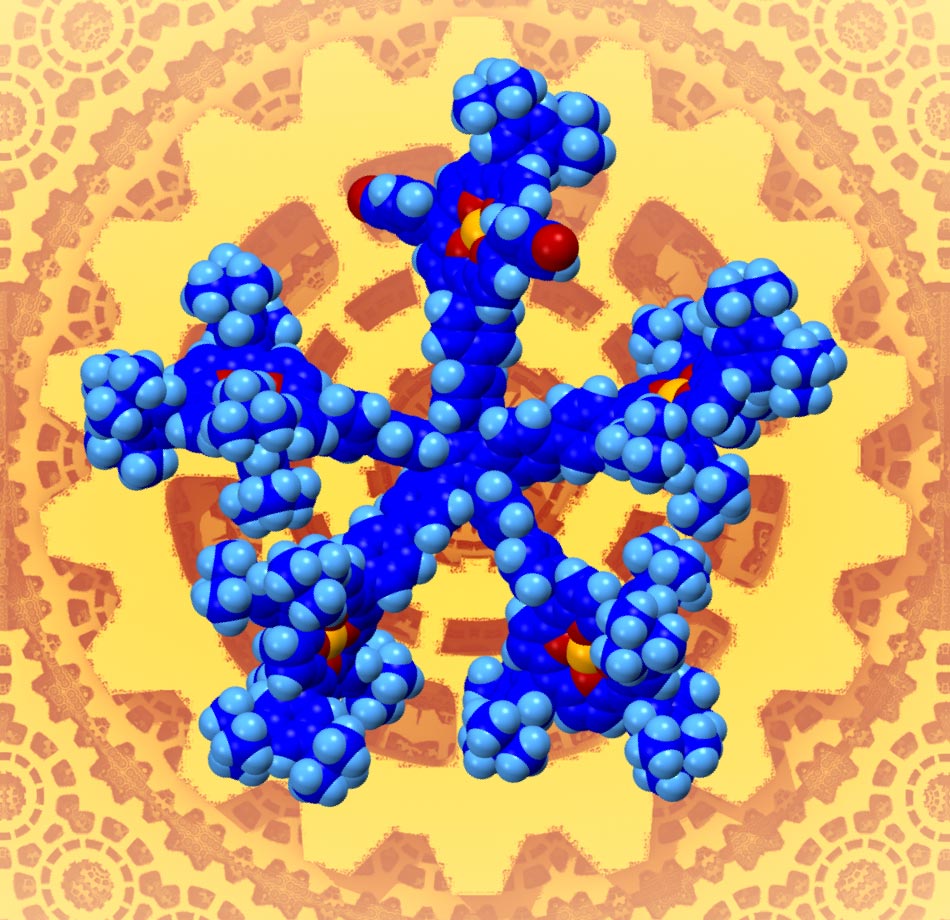
    A 5 nm-large pentaporphyrinic molecular gear. Credit: Gwénaël Rapenne (NAIST and UPS)

    Designing the Ideal Molecular Gear

    The researchers first created a molecular cogwheel comprising five paddles, where one paddle is a few carbon atoms longer than the other four paddles. However, as they showed last year, differences in paddle length disrupt the coordinated motion along the gear train. Thus, differences in paddle electrochemistry are a more promising design approach but synthetically more challenging.

    “We used computational studies to predict whether electron-withdrawing units or metal chemistry could tailor the electronic properties of a paddle, without changing paddle size,” says Rapenne. Such tailored properties are important because one can observe them as differences in contrast by using scanning tunneling microscopy, and thereby facilitate static imaging.

    “Our pentaporphyrinic cogwheel prototypes contained one paddle with either a cyanophenyl substituent or a zinc — rather than nickel — metal center,” explains Rapenne. “Various spectroscopy techniques confirmed the architectures of our syntheses.”

    How can researchers use these cogwheels? Imagine shining a highly focused beam of light, or applying a chemical stimulus, to one of the gears to initiate a rotation. By so doing, one could rotate a series of cogwheels in a coordinated manner as in a conventional gear train, but on a molecular scale which consists in the ultimate miniaturizatio of devices. “We now have the means to visualize such rotations,” notes Rapenne.

    By using this development to carry out single-molecule mechanics studies, Rapenne is optimistic that the broad research community will have a powerful new design for integrated nanoscale machines. “We’re not there yet, but are working collaboratively to make it happen as soon as possible,” he says.

    Reference: “Desymmetrised pentaporphyrinic gears mounted on metallo-organic anchors” by Seifallah Abid, Yohan Gisbert, Mitsuru Kojima, Nathalie Saffon-Merceron, Jérôme Cuny, Claire Kammerer and Gwénaël Rapenne, 18 February 2021, Chemical Science.
    DOI: 10.1039/D0SC06379G

    Never miss a breakthrough: Join the SciTechDaily newsletter.
    Follow us on Google and Google News.

    Materials Science Nanotechnology Nara Institute of Science and Technology Popular
    Share. Facebook Twitter Pinterest LinkedIn Email Reddit

    Related Articles

    Polymer-Eating Enzymes Make “Biodegradable” Plastics Truly Compostable

    What Happens Between the Sheets? Extremely-Promising Superconductor Surprises Everyone

    Exotic “Blinking” Crystals May Convert CO2 Into Fuels, Power Quantum Computers

    Elusive New Liquid Phase Found by Scientists After a Century of Searching

    Fast, Colorful 3D Printing by Mimicking Chameleons at the Nanoscale

    New Way to Split and Sum Photons With Silicon Is Breakthrough for Quantum Computing, Solar Energy

    New Technology Can Instantly Identify Airborne Chemicals – Down to Parts-Per-Billion

    Unique Particles – With Stickiness of Gecko Feet – Formed by Harnessing Chaos

    Powerful New Electronics Could Be Created at the Edge of Chaos

    Leave A Reply Cancel Reply

    • Facebook
    • Twitter
    • Pinterest
    • YouTube

    Don't Miss a Discovery

    Subscribe for the Latest in Science & Tech!

    Trending News

    Scientists Discover 132-Million-Year-Old Dinosaur Tracks on South Africa’s Coast

    Scientists Uncover the Secret Ingredient Behind the Spark That May Have Started Life on Earth

    Physicists Observe Matter in Two Places at Once in Mind-Bending Quantum Experiment

    Stanford Scientists Discover Hidden Brain Circuit That Fuels Chronic Pain

    New Study Reveals Why Ozempic Works Better for Some People Than Others

    Climate Change Is Altering a Key Greenhouse Gas in a Way Scientists Didn’t Expect

    New Study Suggests Gravitational Waves May Have Created Dark Matter

    Scientists Discover Why the Brain Gets Stuck in Schizophrenia

    Follow SciTechDaily
    • Facebook
    • Twitter
    • YouTube
    • Pinterest
    • Newsletter
    • RSS
    SciTech News
    • Biology News
    • Chemistry News
    • Earth News
    • Health News
    • Physics News
    • Science News
    • Space News
    • Technology News
    Recent Posts
    • Astronomers Solve Decades-Long Mystery About Saturn’s Spin – “Something Strange Was Happening”
    • Scientists Uncover Strange New State of Matter Inside Uranus and Neptune
    • The Crown Jewel of Dentistry? Breakthrough Tech Could Transform Tooth Repair
    • The Surprising Non-Medical Factor That Determines Cancer Survival
    • Python Blood Could Hold the Secret to Weight Loss Without Side Effects
    Copyright © 1998 - 2026 SciTechDaily. All Rights Reserved.
    • Science News
    • About
    • Contact
    • Editorial Board
    • Privacy Policy
    • Terms of Use

    Type above and press Enter to search. Press Esc to cancel.