
Close Menu
    Facebook X (Twitter) Instagram
    SciTechDaily
    • Biology
    • Chemistry
    • Earth
    • Health
    • Physics
    • Science
    • Space
    • Technology
    Facebook X (Twitter) Pinterest YouTube RSS
    SciTechDaily
    Home»Space»Dwarf Galaxy M60-UCD1 – The Densest Galaxy
    Space

    Dwarf Galaxy M60-UCD1 – The Densest Galaxy

    By Harvard-Smithsonian Center for AstrophysicsSeptember 13, 2013No Comments3 Mins Read
    Facebook Twitter Pinterest Telegram LinkedIn WhatsApp Email Reddit
    Share
    Facebook Twitter LinkedIn Pinterest Telegram Email Reddit
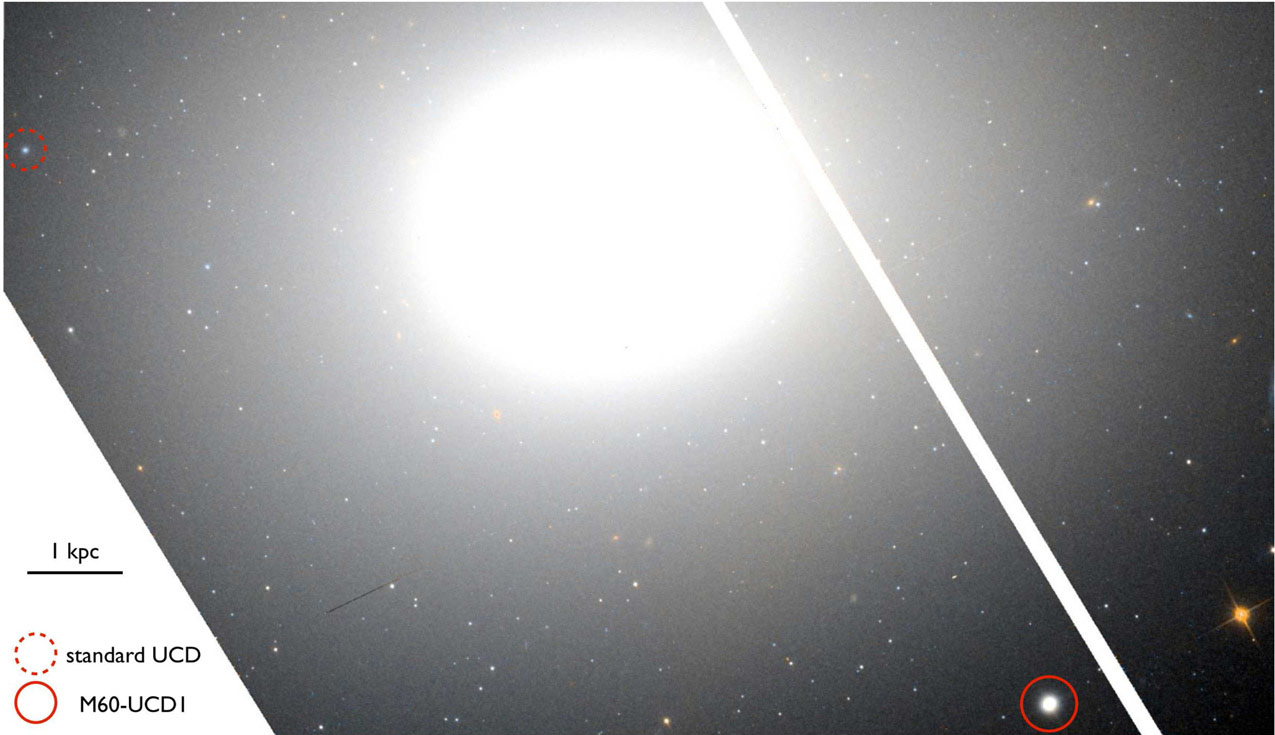
    Dwarf Galaxy M60 UDC1 The Densest Galaxy
    A Hubble image of the central region of the galaxy M60, showing at its outskirts the small dwarf galaxy M60-UDC1 (inside the red circle). This dwarf is found to be the galaxy with the highest known density of stars (a more typical dwarf galaxy is shown inside the dotted red circle. The diagonal white streak is an artifact). Credit: NASA HST; J. Strader

    In a newly published study, astronomers detail the discovery of an ultra-compact dwarf galaxy, called M60-UCD1, that has a stellar mass density of over one hundred stars per cubic light-year, making it the densest known galaxy.

    Our nearest neighbor star, Proxima Centauri, is about 4.2 light-years away. This distance is typical (on average) between stars (or gravitationally bound stellar systems) in the Milky Way and similar galaxies. In terms of density, there are about 0.02 stars per cubic light-year in the general neighborhood of the Sun. At the other extreme of stellar density, a globular cluster – a spherical collection of as many as a million stars orbiting a galaxy – can have an average of over ten stars per cubic light-year, and even higher densities near its center. Astronomers are trying to understand what limits the density of stellar neighborhoods, if and how the average densities differ in different sized galaxies, and the relationship of stellar densities to the sizes of the supermassive black holes at galaxy centers.

    A dwarf galaxy is small in both size and mass, with 100-1000 times fewer stars than the Milky Way. Astronomers interested in stellar densities are naturally curious about the densities in such small systems. CfA astronomers Pepi Fabbiano and Nelson Caldwell and their colleagues spotted a strange dwarf galaxy on the outskirts of a much larger galaxy, Messier 60, about sixty million light-years away (that is, in our cosmic vicinity). This dwarf is only about 80 light-years in radius (compared with our Milky Way’s radius of tens of thousands of light-years), but the scientists determined that it has a stellar mass of density of over one hundred stars per cubic light-year, making it the densest known galaxy.

    The astronomers used the Chandra X-ray Observatory to reveal an X-ray source at the dwarf galaxy’s center. The source could be either a nuclear supermassive black hole or perhaps a pair of binary stars emitting X-rays – additional observations are needed to resolve the issue. The authors point out that if the central object is a nuclear black hole, it is likely that this dwarf galaxy was once a much larger galaxy that collided with another galaxy. It was stripped of most of its matter in the interaction but its nucleus, left relatively unaffected, remained behind to consolidate the remnants into the dense system seen today. While it is always fascinating to discover new extrema in the cosmic zoo, these results also shed light on processes that affect galaxy evolution and the properties of dense stellar systems.

    Reference: “The Densest Galaxy” by Jay Strader, Anil C. Seth, Duncan A. Forbes, Giuseppina Fabbiano, Aaron J. Romanowsky, Jean P. Brodie, Charlie Conroy, Nelson Caldwell, Vincenzo Pota, Christopher Usher and Jacob A. Arnold, 30 August 2013, The Astrophysical Journal Letters.
    DOI: 10.1088/2041-8205/775/1/L6
    arXiv:1307.7707 

    Never miss a breakthrough: Join the SciTechDaily newsletter.
    Follow us on Google and Google News.

    Astronomy Astrophysics Harvard-Smithsonian Center for Astrophysics
    Share. Facebook Twitter Pinterest LinkedIn Email Reddit

    Related Articles

    X-Ray Emission From Mysterious Dark Matter

    Analyzing Dust Storm Sequences on Mars

    Intriguing Remains of a Rare Stellar Explosion Discovered in Milky Way Center

    Puzzling Astrophysics of Quasars in the Early Universe

    Four Exoplanets – Including a Super-Earth Planet – Discovered by High School Students

    Massive Rotating Stars in the Pleiades Cluster

    Astronomers Discover First Cloudless, Jupiter-Like Planet – “Smoking Gun Evidence”

    Chandra X-ray Observatory Studies Extraordinary Magnetar [Video]

    Chandra Studies Extraordinary Magnetar: Fastest Spinning and Possibly the Youngest Magnetar Known

    Leave A Reply Cancel Reply

    • Facebook
    • Twitter
    • Pinterest
    • YouTube

    Don't Miss a Discovery

    Subscribe for the Latest in Science & Tech!

    Trending News

    Monster Storms on Jupiter Unleash Lightning Beyond Anything on Earth

    Scientists Create “Liquid Gears” That Spin Without Touching

    The Simple Habit That Could Help Prevent Cancer

    Millions Take These IBS Drugs, But a New Study Finds Serious Risks

    Scientists Unlock Hidden Secrets of 2,300-Year-Old Mummies Using Cutting-Edge CT Scanner

    Bread Might Be Making You Gain Weight Even Without Eating More Calories

    Scientists Discover Massive Magma Reservoir Beneath Tuscany

    Europe’s Most Active Volcano Just Got Stranger – Here’s Why Scientists Are Rethinking It

    Follow SciTechDaily
    • Facebook
    • Twitter
    • YouTube
    • Pinterest
    • Newsletter
    • RSS
    SciTech News
    • Biology News
    • Chemistry News
    • Earth News
    • Health News
    • Physics News
    • Science News
    • Space News
    • Technology News
    Recent Posts
    • Sharks Are Overheating as Warming Oceans Push Them to the Edge
    • Scientists Discover Plants “Scream” – We Just Couldn’t Hear Them Until Now
    • 25-Year Study Uncovers Hidden Paths and Early Warning Signs of Blood Cancer
    • Not Just Snoring – New Research Reveals Sleep Apnea May Be Damaging Your Muscles
    • Scientists Discover a Surprising Reason Intermittent Fasting Extends Life
    Copyright © 1998 - 2026 SciTechDaily. All Rights Reserved.
    • Science News
    • About
    • Contact
    • Editorial Board
    • Privacy Policy
    • Terms of Use

    Type above and press Enter to search. Press Esc to cancel.