
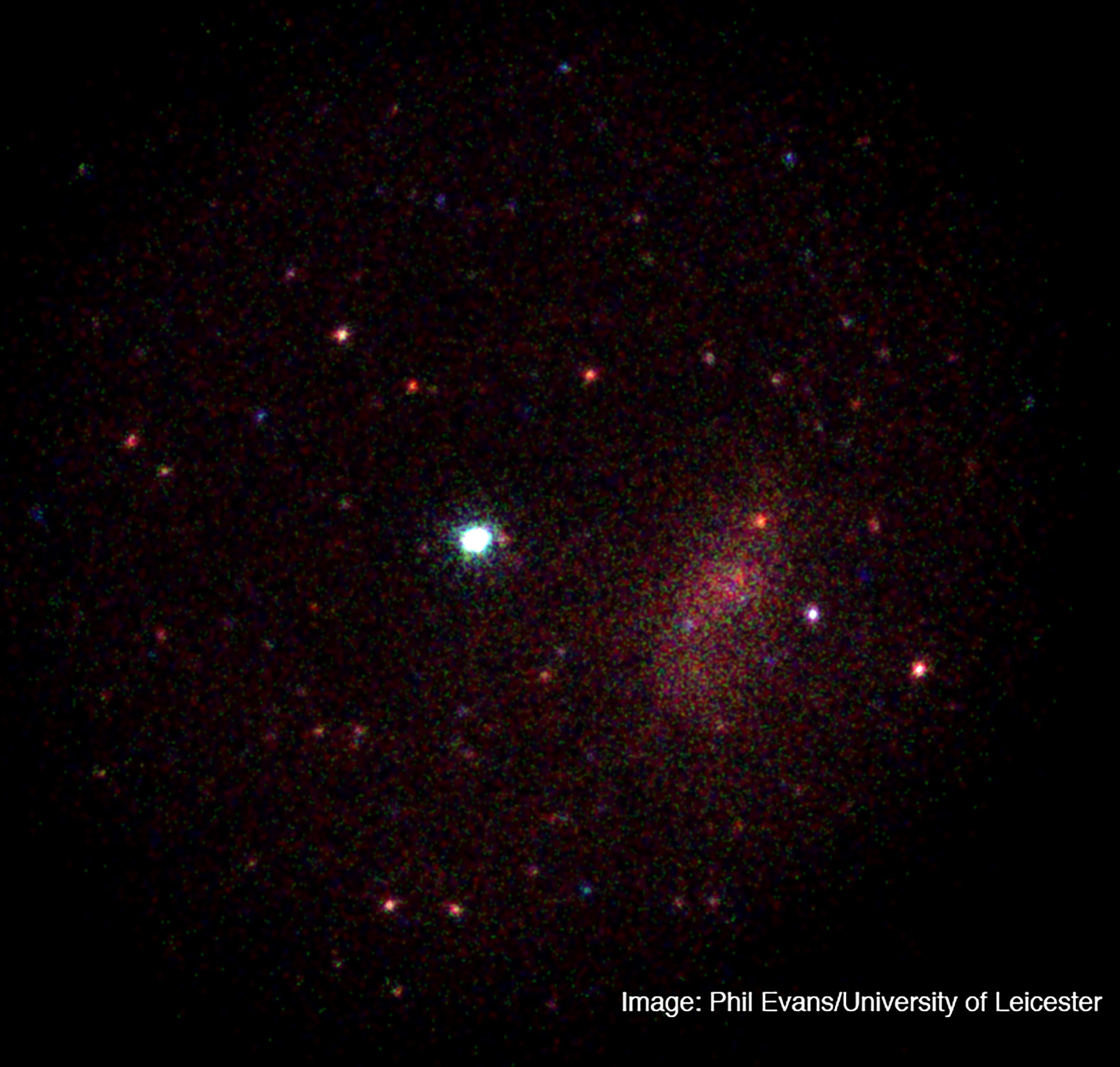
New international research reveals that rare gamma-ray bursts, which can last for hours, can be explained as standard explosions occurring in a region with a low density of matter that is located behind a cloud of dust when viewed from Earth.
University Park, Pennsylvania – Next week in St. Petersburg, Russia, scientists on an international team that includes Penn State astronomers will present a paper that provides a simple explanation for mysterious ultra-long gamma-ray bursts — a very rare form of the most powerful explosions in the universe.
“The recent discovery of ultra-long gamma-ray bursts raised questions about whether some new physics is required to explain them, but our work suggests a much simpler explanation,” said David Burrows, a Penn State professor of astronomy and astrophysics. “Our analysis reveals that these rare gamma-ray bursts, which can last for hours, can be explained as standard explosions occurring in a region with a low density of matter that is located behind a cloud of dust when viewed from Earth.”
Dick Willingale, an astronomer at the University of Leicester and a co-author of the study, said, “Not only is this result significant scientifically, but it shows the importance of international collaborations to build observatories, and of sharing information between those observatories.”
Burrows is the lead scientist for the X-Ray Telescope on board the Swift satellite — one of two space observatories that the scientists used to collect data from the gamma-ray burst named GRB 130925A, which they observed last year while the energy from its explosion streamed toward Earth for more than five hours. Swift is a NASA-led collaboration with Penn State in the United States, the University of Leicester and University College-London in the United Kingdom, and the Italian space agency and Brera Observatory in Italy. The scientists also observed the ultra-long gamma-ray burst with the U.S./Russian satellite Konus-Wind. “We could not have reached our conclusions without the Swift and Konus teams working together,” Willingale said.
Burrows said it is not surprising that some gamma-ray bursts occur in a low-density region, nor is it surprising when one occurs behind a dust cloud. “Our analysis of the observations from the two observatories shows that these two conditions existing simultaneously can explain our observations of the ultra-long gamma-ray burst GRB 130925A,” Burrows said. “One reason that these results are satisfying is that scientists generally prefer to find the simplest explanations for mysterious phenomena,” he said.
Science and flight operations for Swift are controlled by Penn State from the Mission Operations Center at the University Park campus. The principal investigator of the Swift mission is Neil Gehrels at NASA’s Goddard Space Flight Center, who also is an adjunct professor of astronomy and astrophysics at Penn State. In addition to its X-Ray Telescope, Swift also carries an Ultraviolet/Optical Telescope for which Michael Siegel, a research associate at Penn State, is the lead scientist; and a Burst Alert Telescope, for which Scott Barthelmy at NASA’s Goddard Space Flight Center in Greenbelt, Maryland, is the lead scientist. These instruments have been providing vital measurements of the afterglows of the gamma-ray bursts since Swift was launched in November 2004. John Nousek, professor of astronomy and astrophysics at Penn State, is the director of the Penn State Mission Operations Center for Swift.
Never miss a breakthrough: Join the SciTechDaily newsletter.
Follow us on Google and Google News.