
Close Menu
    Facebook X (Twitter) Instagram
    SciTechDaily
    • Biology
    • Chemistry
    • Earth
    • Health
    • Physics
    • Science
    • Space
    • Technology
    Facebook X (Twitter) Pinterest YouTube RSS
    SciTechDaily
    Home»Space»Astronomers Confirm a Reverse Shock in Gamma Ray Burst 130427A
    Space

    Astronomers Confirm a Reverse Shock in Gamma Ray Burst 130427A

    By Harvard-Smithsonian Center for AstrophysicsDecember 3, 2013No Comments4 Mins Read
    Facebook Twitter Pinterest Telegram LinkedIn WhatsApp Email Reddit
    Share
    Facebook Twitter LinkedIn Pinterest Telegram Email Reddit
    Astronomers Confirm Reverse Shock in a Gamma Ray Burst
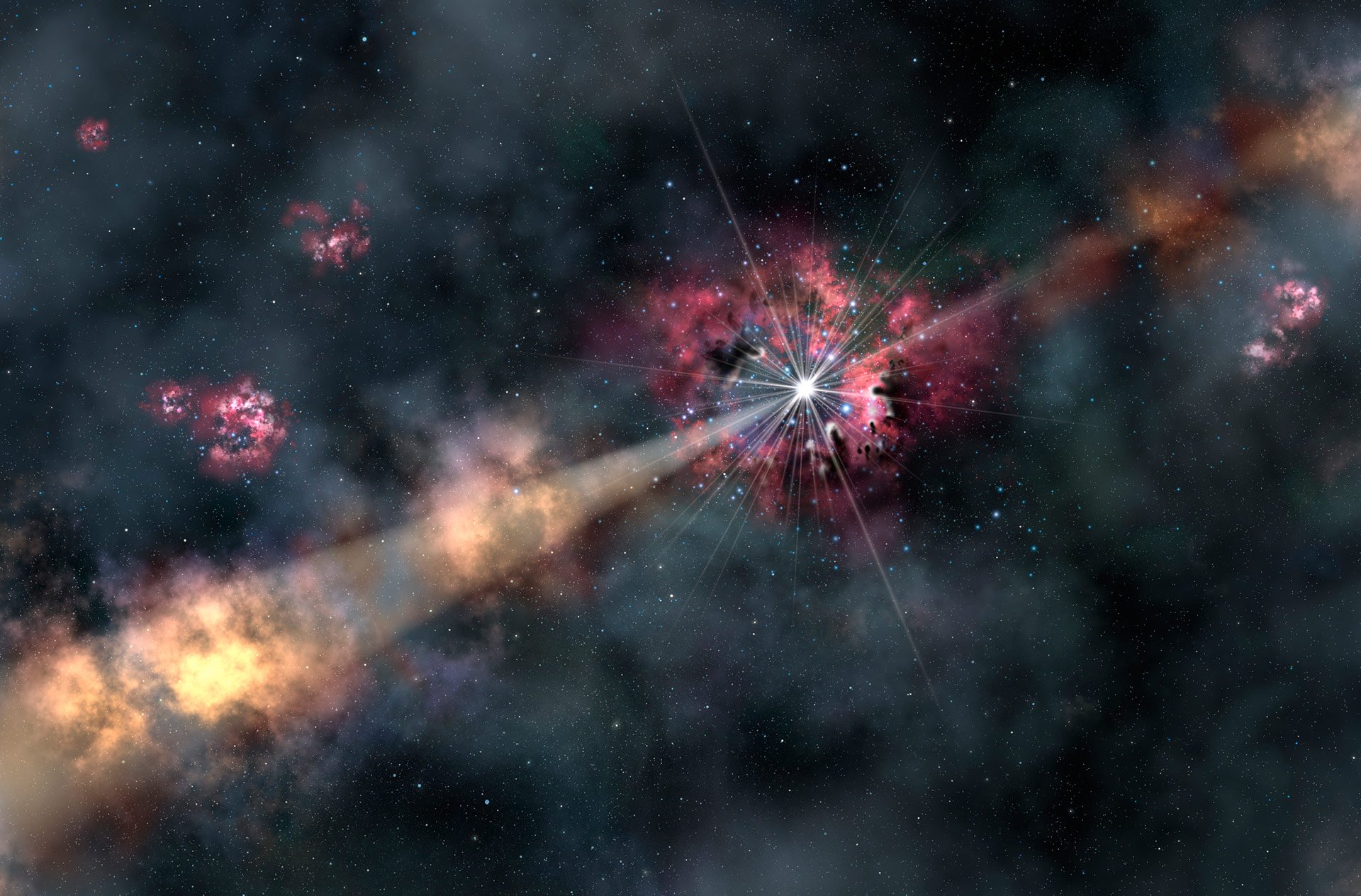
    An artist’s depiction of a gamma-ray burst, the most powerful explosive event in the universe. The bursts can produce both forward and reverse shocks as the ejecta slam into the circumstellar material, and measurements of an April 2013 burst taken at wavelengths stretching from the radio to the X-ray, all during the brief lifetime of the burst, find for the first time convincing evidence for the effects of the reverse shock. Credit: Gemini Observatory/AURA, artwork by Lynette Cook

    Using data from radio and millimeter observations of GRB 130427A, CfA astronomers have confirmed the signature of the reverse shock in GRB 130427A, and determined the characteristic velocity of the ejecta as being 99.997% of the speed of light.

    Gamma-ray bursts (GRBs) are the brightest events in the known universe. These flashes of high-energy light occur about once a day, randomly, from around the sky. While a burst is underway, it is many millions of times brighter than an entire galaxy. Astronomers are anxious to decipher their nature not only because of their dramatic energetics, but also because their tremendous brightnesses enables them to be seen across cosmological distances and times, providing windows into the young universe.

    The somewhat longer lasting variety of GRB is associated with the death of massive stars. The details of these bursts reflect the nature of the progenitor stars, the structure of the explosion environment, and the composition of the ejecta. Even after the explosion ends, the powerful ejecta generate an afterglow that can be analyzed as the particles plow into the circumstellar material around the progenitor star. Studies of the afterglow find two light signatures: one produced when a forward moving shock slams into the material, and a second kind resulting when a backward moving shock (the “reverse shock”) is produced (roughly similar to the way a water wave, encountering an obstacle, spawns a backward moving wave). Both the forward and reverse shocks reveal different details of the cataclysm; the reverse shock is a particularly valuable probe of particle velocities in the burst.

    Although in the past there have been some diagnostic hints found of a reverse shock in the radiation, the conclusions were indecisive because they lacked a full decomposition of the radiation into both its forward and reverse components. Each of these components radiates over a very broad band of wavelengths, with each kind of shock characterized by a distinct intensity peak at a different wavelength band. One problem has been that observations over the full range from optical to radio are needed to sort things out, but there is very little time during a burst to collect all the data.

    CfA astronomers Tanmoy Laskar, Edo Berger, Bevin Zauderer, Raffaella Margutti, Alicia Soloderberg, Sayan Chakraborti, Ragnhild Lunnan, and Ryan Chornock and two colleagues present extensive observations of a burst that occurred on April 27. They obtained data from radio and submillimeter wavelengths through the infrared, optical, ultraviolet, and X-rays, and all in the short period from 0.67 days to 12 days after the burst. Their careful analysis convincingly finds the signature of the reverse shock, and determines the characteristic velocity of the ejecta as being 99.997% of the speed of light – very fast indeed. This benchmark dataset offers a so-far unique view of the reverse shock, helps to confirm theoretical models, and illustrates to power of detailed, multi-wavelength modeling of GRBs.

    Reference: “A Reverse Shock in GRB 130427A” by T. Laskar, E. Berger, B. A. Zauderer, R. Margutti, A. M. Soderberg, S. Chakraborti, R. Lunnan, R. Chornock, P. Chandra and A. Ray, 7 October 2013, The Astrophysical Journal.
    DOI: 10.1088/0004-637X/776/2/119
    arXiv:1305.2453

    Never miss a breakthrough: Join the SciTechDaily newsletter.
    Follow us on Google and Google News.

    Astronomy Astrophysics Gamma Ray Harvard-Smithsonian Center for Astrophysics
    Share. Facebook Twitter Pinterest LinkedIn Email Reddit

    Related Articles

    Astronomers Study Enduring ‘Radio Rebound’ from Gamma-Ray Burst 161219B

    New Model Supports Connection Between Gamma Ray Bursts and Supernovae

    Astronomers Identify a Signature of Dark Matter Annihilation

    VERITAS Detects Gamma Rays from Distant Galaxy PKS 1441+25

    Shocks in a Distant Gamma-Ray Burst Help Reveal Two General Types of GRBs

    Astronomers Reveal “Missing-Link” in the Supernova-GRB Connection

    Researchers Study Mysterious Gamma Ray Source with No Known Counterpart

    New Research Shows Fast Radio Bursts Might Come From Nearby Stars

    Origins of Type Ia Supernovae

    Leave A Reply Cancel Reply

    • Facebook
    • Twitter
    • Pinterest
    • YouTube

    Don't Miss a Discovery

    Subscribe for the Latest in Science & Tech!

    Trending News

    Millions Take These IBS Drugs, But a New Study Finds Serious Risks

    Scientists Unlock Hidden Secrets of 2,300-Year-Old Mummies Using Cutting-Edge CT Scanner

    Bread Might Be Making You Gain Weight Even Without Eating More Calories

    Scientists Discover Massive Magma Reservoir Beneath Tuscany

    Europe’s Most Active Volcano Just Got Stranger – Here’s Why Scientists Are Rethinking It

    Alzheimer’s Symptoms May Start Outside the Brain, Study Finds

    Millions Take This Popular Supplement – Scientists Discover a Concerning Link to Heart Failure

    The Universe Is Expanding Too Fast and Scientists Can’t Explain Why

    Follow SciTechDaily
    • Facebook
    • Twitter
    • YouTube
    • Pinterest
    • Newsletter
    • RSS
    SciTech News
    • Biology News
    • Chemistry News
    • Earth News
    • Health News
    • Physics News
    • Science News
    • Space News
    • Technology News
    Recent Posts
    • Simple Blood Test May Predict Alzheimer’s Years Before Brain Scans Show Signs
    • Scientists Say Adding This Unusual Seafood to Your Diet Could Reverse Signs of Aging
    • U.S. Waste Holds $5.7 Billion Worth of Crop Nutrients
    • Scientists Say a Hidden Structure May Exist Inside Earth’s Core
    • Doctors Surprised by the Power of a Simple Drug Against Colon Cancer
    Copyright © 1998 - 2026 SciTechDaily. All Rights Reserved.
    • Science News
    • About
    • Contact
    • Editorial Board
    • Privacy Policy
    • Terms of Use

    Type above and press Enter to search. Press Esc to cancel.