
Close Menu
    Facebook X (Twitter) Instagram
    SciTechDaily
    • Biology
    • Chemistry
    • Earth
    • Health
    • Physics
    • Science
    • Space
    • Technology
    Facebook X (Twitter) Pinterest YouTube RSS
    SciTechDaily
    Home»Health»Study Shows Oxytocin Improves Brain Function in Children with Autism
    Health

    Study Shows Oxytocin Improves Brain Function in Children with Autism

    By Karen N. Peart, Yale UniversityDecember 3, 20133 Comments3 Mins Read
    Facebook Twitter Pinterest Telegram LinkedIn WhatsApp Email Reddit
    Share
    Facebook Twitter LinkedIn Pinterest Telegram Email Reddit
    Oxytocin Improves Brain Function in Children with Autism
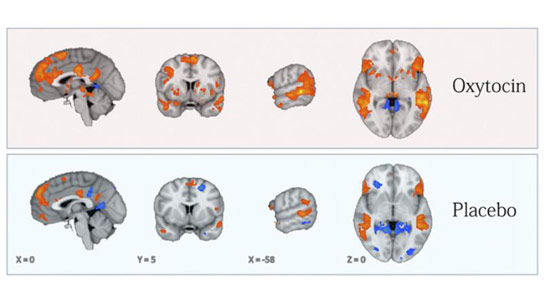
    In both panels, the orange map indicates regions where activity was greater during Eyes vs. Vehicles judgments and the blue map indicates the reverse (P < 0.05, corrected; K ≥ 729mm3). (Upper) OT visits are depicted. (Lower) Placebo visits are depicted. Credit: Ilanit Gordon, et al.

    A new study from Yale University is the first study to evaluate the impact of oxytocin on brain function in children with autism spectrum disorders, finding that a single spray of oxytocin improves brain function in children with autism.

    A single dose of the hormone oxytocin, delivered via nasal spray, has been shown to enhance brain activity while processing social information in children with autism spectrum disorders, Yale School of Medicine researchers report in a new study published in the December 2 issue of Proceedings of the National Academy of Sciences.

    “This is the first study to evaluate the impact of oxytocin on brain function in children with autism spectrum disorders,” said first author Ilanit Gordon, a Yale Child Study Center adjunct assistant professor, whose colleagues on the study included senior author Kevin Pelphrey, the Harris Professor in the Child Study Center, and director of the Center for Translational Developmental Neuroscience at Yale.

    Gordon, Pelphrey, and their colleagues conducted a double-blind, placebo-controlled study of 17 children and adolescents with autism spectrum disorders. The participants, between the ages of 8 and 16.5, were randomly given either oxytocin spray or a placebo nasal spray during a task involving social judgments. Oxytocin is a naturally occurring hormone produced in the brain and throughout the body.

    “We found that brain centers associated with reward and emotion recognition responded more during social tasks when children received oxytocin instead of the placebo,” said Gordon. “Oxytocin temporarily normalized brain regions responsible for the social deficits seen in children with autism.”

    Gordon said oxytocin facilitated social attunement, a process that makes the brain regions involved in social behavior and social cognition activate more for social stimuli (such as faces) and activate less for non-social stimuli (such as cars).

    “Our results are particularly important considering the urgent need for treatments to target social dysfunction in autism spectrum disorders,” Gordon added.

    Other authors on the study include Brent C. Vander Wyk, Randi H. Bennett, Cara Cordeaux Zagoory-Sharon, James F. Leckman, and Ruth Feldman.

    The study was funded by a Harris Family Professorship to Pelphrey; a Lee Foundation Postdoctoral Award to Gordon; and a grant from the Binational Science Foundation to Feldman, Pelphrey, Gordon, and Leckman.

    Reference: “Oxytocin enhances brain function in children with autism” by Ilanit Gordon, Brent C. Vander Wyk, Randi H. Bennett, Cara Cordeaux, Molly V. Lucas, Jeffrey A. Eilbott, Orna Zagoory-Sharon, James F. Leckman, Ruth Feldman and Kevin A. Pelphrey, 2 December 2013, Proceedings of the National Academy of Sciences.
    DOI: 10.1073/pnas.1312857110


    Never miss a breakthrough: Join the SciTechDaily newsletter.
    Follow us on Google and Google News.

    Autism Spectrum Disorder Brain Activity Neurology Neuroscience Yale University
    Share. Facebook Twitter Pinterest LinkedIn Email Reddit

    Related Articles

    Yale Researchers Show Sedative Combats Virus That Causes Birth Defects

    Brain Disruption Shows That Mental Illnesses Have Biological Similarities

    UCLA Researchers Image Abnormal Brain Proteins in Retired NFL Players

    Test for Alzheimer’s May Be Undermining Drug Trials

    Smoking Rots the Brain & Lowers Cognitive Performance

    Neural Connection Between Infant Stress & Depression in Teenage Girls

    GATA1 Plays a Role in the Loss of Connections Between Neurons and in Symptoms of Depression

    Understanding Inhibitory Neuron Activation Could Shed Light on Neurological Disorders

    Imbalance Between Neuronal Excitation and Inhibition May Account for Seizure Susceptibility in Angelman Syndrome

    3 Comments

    1. katesisco on December 4, 2013 11:29 am

      The NYT article went into more detail and the best effect is on the mild cases, the other having almost no effect and the article cautioned against larger doses as lab studies show the opposite as the animals became even more aggressive.

      Reply
    2. Madanagopal.V.C on December 6, 2013 2:42 am

      It is true that autistic children responds more for non-social objects more than social figures and faces. This experiment exposes the effect of Oxytocin spray to enhance their attention of social figures withdrawing their attention from non-social objects. If the continued use of OT spray with the children can improve their behavior it is well and good. Thank You.

      Reply
    3. Aditya on December 11, 2013 4:47 am

      Essentially speaking, doctors diagnose autism based on officially issued guidelines, although these parameters can vary somewhat from one country to the next. Patients will usually be assessed during an interview, and more often than not, parents and even teachers might be asked to complete a questionnaire relating to a child’s behavior.

      Reply
    Leave A Reply Cancel Reply

    • Facebook
    • Twitter
    • Pinterest
    • YouTube

    Don't Miss a Discovery

    Subscribe for the Latest in Science & Tech!

    Trending News

    These Toads Are Surviving a Deadly Fungus – Scientists May Finally Know Why

    These Brain Cells May Explain Why We Eventually Have To Sleep

    Tomatoes Contain an Invisible Ingredient With Surprising Effects on Liver Health

    World’s First Heat-Powered Cooling System Turns Waste Heat Into Cold

    Antarctica Gained a Record 695 Billion Tons of Ice in Just Two Years

    Don’t Miss: A Brilliant Venus and Glowing Harvest Moon Light Up the Sky

    New Twist on the Einstein Problem Reveals Unexpected Physics

    JWST Captures Stunning Evidence of How Supermassive Black Holes Feed

    Follow SciTechDaily
    • Facebook
    • Twitter
    • YouTube
    • Pinterest
    • Newsletter
    • RSS
    SciTech News
    • Biology News
    • Chemistry News
    • Earth News
    • Health News
    • Physics News
    • Science News
    • Space News
    • Technology News
    Recent Posts
    • Scientists Discover a Hidden Defect That Could Explain Why IBD Keeps Coming Back
    • Millions Take Blood Pressure Drugs, but Many May Be Missing Their Heart-Protective Benefits
    • Could Alien Life Be Conscious in Ways We Can’t Imagine?
    • Scientists Develop a Fruit Wash That Removes Pesticide Residues and Keeps Produce Fresh Longer
    • Scientists May Have Finally Explained Why Astronauts Get Constipated in Space
    Copyright © 1998 - 2026 SciTechDaily. All Rights Reserved.
    • Science News
    • About
    • Contact
    • Editorial Board
    • Privacy Policy
    • Terms of Use

    Type above and press Enter to search. Press Esc to cancel.