
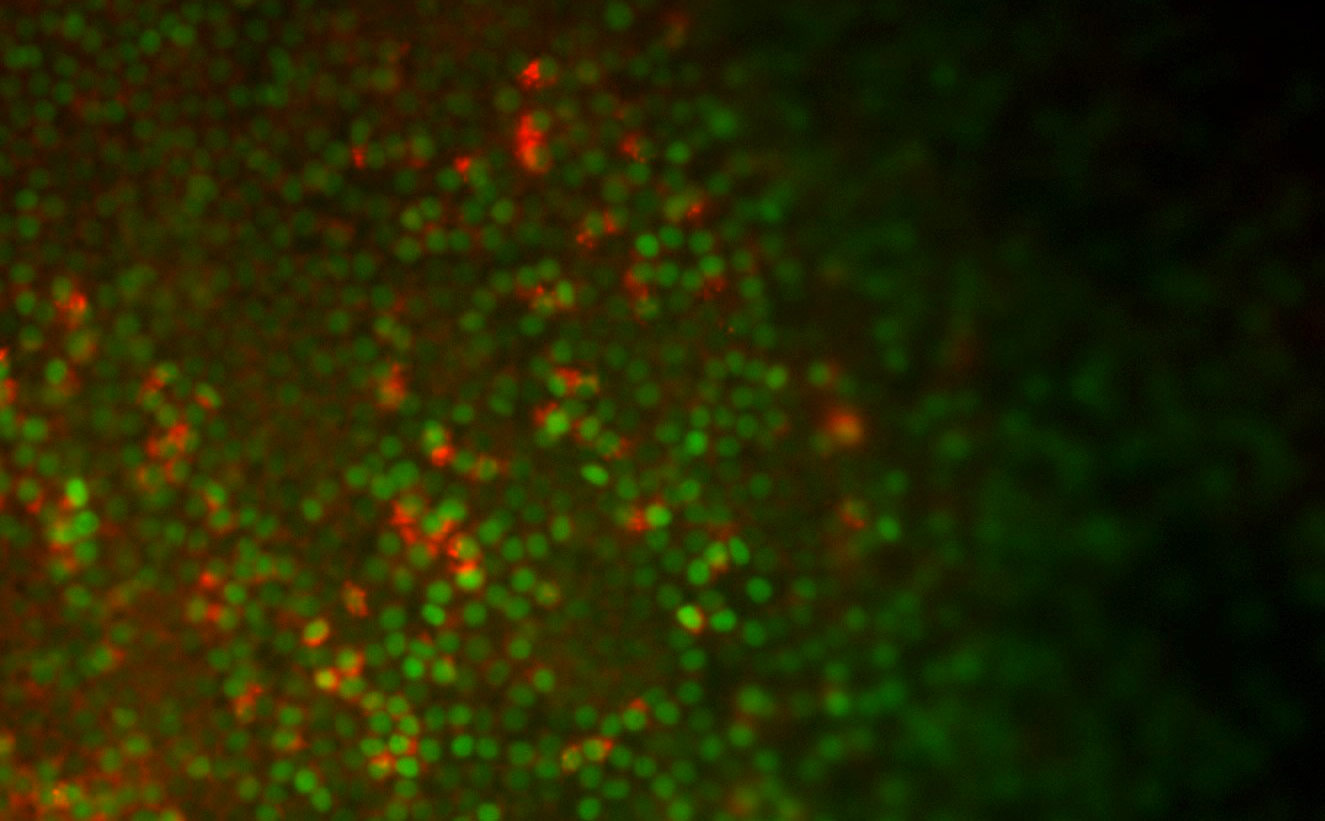
In a newly published study, researchers from the Columbia University Medical Center detail how they successfully converted human stem cells into functional lung and airway cells for the first time.
For the first time, scientists have succeeded in transforming human stem cells into functional lung and airway cells. The advance, reported by Columbia University Medical Center (CUMC) researchers, has significant potential for modeling lung disease, screening drugs, studying human lung development, and, ultimately, generating lung tissue for transplantation. The study was published today in the journal Nature Biotechnology.
“Researchers have had relative success in turning human stem cells into heart cells, pancreatic beta cells, intestinal cells, liver cells, and nerve cells, raising all sorts of possibilities for regenerative medicine,” said study leader Hans-Willem Snoeck, MD, PhD, professor of medicine (in microbiology & immunology) and affiliated with the Columbia Center for Translational Immunology and the Columbia Stem Cell Initiative. “Now, we are finally able to make lung and airway cells. This is important because lung transplants have a particularly poor prognosis. Although any clinical application is still many years away, we can begin thinking about making autologous lung transplants—that is, transplants that use a patient’s own skin cells to generate functional lung tissue.”
The research builds on Dr. Snoeck’s 2011 discovery of a set of chemical factors that can turn human embryonic stem (ES) cells or human induced pluripotent stem (iPS) cells into anterior foregut endoderm—precursors of lung and airway cells. (Human iPS cells closely resemble human ES cells but are generated from skin cells, by coaxing them into taking a developmental step backwards. Human iPS cells can then be stimulated to differentiate into specialized cells—offering researchers an alternative to human ES cells.)
In the current study, Dr. Snoeck and his colleagues found new factors that can complete the transformation of human ES or iPS cells into functional lung epithelial cells (cells that cover the lung surface). The resultant cells were found to express markers of at least six types of lung and airway epithelial cells, particularly markers of type 2 alveolar epithelial cells. Type 2 cells are important because they produce surfactant, a substance critical to maintain the lung alveoli, where gas exchange takes place; they also participate in repair of the lung after injury and damage.
The findings have implications for the study of a number of lung diseases, including idiopathic pulmonary fibrosis (IPF), in which type 2 alveolar epithelial cells are thought to play a central role. “No one knows what causes the disease, and there’s no way to treat it,” says Dr. Snoeck. “Using this technology, researchers will finally be able to create laboratory models of IPF, study the disease at the molecular level, and screen drugs for possible treatments or cures.”
“In the longer term, we hope to use this technology to make an autologous lung graft,” Dr. Snoeck said. “This would entail taking a lung from a donor; removing all the lung cells, leaving only the lung scaffold; and seeding the scaffold with new lung cells derived from the patient. In this way, rejection problems could be avoided.” Dr. Snoeck is investigating this approach in collaboration with researchers in the Columbia University Department of Biomedical Engineering.
“I am excited about this collaboration with Hans Snoeck, integrating stem cell science with bioengineering in the search for new treatments for lung disease,” said Gordana Vunjak-Novakovic, PhD, co-author of the paper and Mikati Foundation Professor of Biomedical Engineering at Columbia’s Engineering School and professor of medical sciences at Columbia University College of Physicians and Surgeons.
The paper is titled, “Highly efficient generation of airway and lung epithelial cells from human pluripotent stem cells.”
Reference: “Efficient generation of lung and airway epithelial cells from human pluripotent stem cells” by Sarah X L Huang, Mohammad Naimul Islam, John O’Neill, Zheng Hu, Yong-Guang Yang, Ya-Wen Chen, Melanie Mumau, Michael D Green, Gordana Vunjak-Novakovic, Jahar Bhattacharya and Hans-Willem Snoeck, 1 December 2013, Nature Biotechnology.
DOI: 10.1038/nbt.2754
The other contributors are Sarah X.L. Huang, Mohammad Naimul Islam, John O’Neill, Zheng Hu, Yong-Guang Yang, Ya-Wen Chen, Melanie Mumau, Michael D. Green, and Jahar Bhattacharya (all at CUMC).
Columbia University has filed for a patent relating to the generation of lung and airway epithelium from human pluripotent stem cells and uses thereof. The authors declare no other financial or other conflicts of interest.
The study was supported by startup funds from CUMC and the New York Stem Cell Foundation.
Never miss a breakthrough: Join the SciTechDaily newsletter.
Follow us on Google and Google News.