
Close Menu
    Facebook X (Twitter) Instagram
    SciTechDaily
    • Biology
    • Chemistry
    • Earth
    • Health
    • Physics
    • Science
    • Space
    • Technology
    Facebook X (Twitter) Pinterest YouTube RSS
    SciTechDaily
    Home»Space»Researchers Discover Over 600 “Red Nugget” Galaxy Candidates
    Space

    Researchers Discover Over 600 “Red Nugget” Galaxy Candidates

    By Harvard-Smithsonian Center for AstrophysicsSeptember 13, 2013No Comments3 Mins Read
    Facebook Twitter Pinterest Telegram LinkedIn WhatsApp Email Reddit
    Share
    Facebook Twitter LinkedIn Pinterest Telegram Email Reddit
    Hubble Reveals Red Nugget Galaxies
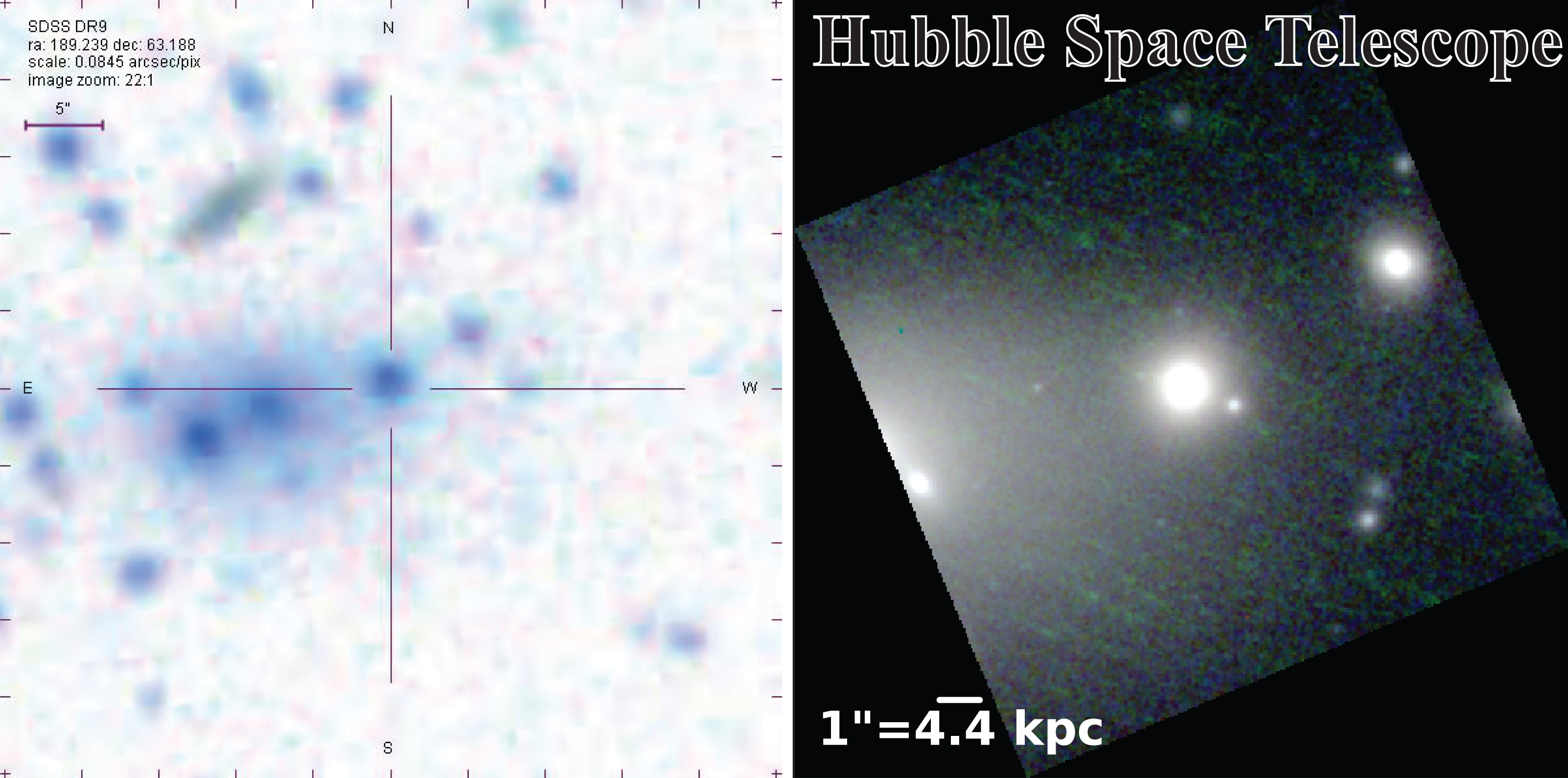
    These images highlight the most massive of the newly discovered compact galaxies known as “red nuggets.” The photo at left from the Sloan Digital Sky Survey shows that the galaxy is so small it appears starlike. The higher resolution photo at right from the Hubble Space Telescope reveals the object’s true, extended shape. Credit: SDSS (left), NASA (right)

    Using the Sloan Digital Sky Survey database, researchers discovered more than 600 “red nugget” galaxy candidates located at distances of 2.5 to 5.7 billion light-years from Earth.

    Cambridge, Massachusetts – In 2005 the Hubble Space Telescope spotted unusually small galaxies densely packed with red stars in the distant, young universe. They were nicknamed “red nuggets,” not only because they are small and red but also their existence challenged current theories of galaxy formation, making them precious in astronomers’ eyes.

    Since no “red nuggets” were seen nearby, astronomers wondered why they had disappeared over time. New research shows that they didn’t disappear completely. In fact, they were simply hidden within the data of previous surveys.

    Astronomers now realize these newfound compact galaxies could represent a missing link between distant “red nuggets” and nearby elliptical galaxies. They may light the evolutionary path to show how compact galaxies age over time and reveal whether they become the “seeds” for the monster ellipticals we see today.

    To find them, astronomer Ivana Damjanov (Harvard-Smithsonian Center for Astrophysics) and her colleagues searched databases from the Sloan Digital Sky Survey. The “red nugget” galaxies are so small that they appear like stars in photographs from ground-based telescopes. However, their spectra give away their true nature.

    “Looking for ‘red nuggets’ in the Sloan Digital Sky Survey was like panning a riverbed, washing away silt and mud to uncover bits of gold,” says Damjanov.

    By sifting through the Sloan data, the team dug up more than 600 “red nugget” candidates. They are located at distances of 2.5 to 5.7 billion light-years from Earth.

    Damjanov then investigated the Hubble Space Telescope database to find photos of the patches of sky where those objects were located. Serendipitous images of nine targets confirmed that they are as compact as more distant “red nugget” galaxies. The most massive weighs up to 10 times more than the Milky Way, but are up to 10 times smaller than our galaxy. As a result, they’re called compact, massive galaxies.

    “We think there are more of these red nuggets, or compact galaxies, hidden in the universe, waiting to be discovered,” says co-author Ho Seong Hwang (Smithsonian Astrophysical Observatory).

    The team’s future plans include using the Hubble Space Telescope to investigate more of these compact, massive galaxies to answer questions like: Where do they live, near other galaxies or in the intergalactic void? What is their internal structure?

    Damjanov, a Menzel Fellow at the Harvard College Observatory, is the lead author on the paper, which has been accepted for publication in The Astrophysical Journal Letters. Her co-authors are Igor Chilingarian, Ho Seong Hwang, and Margaret Geller (Smithsonian Astrophysical Observatory).

    Headquartered in Cambridge, Massachusetts, the Harvard-Smithsonian Center for Astrophysics (CfA) is a joint collaboration between the Smithsonian Astrophysical Observatory and the Harvard College Observatory. CfA scientists, organized into six research divisions, study the origin, evolution, and ultimate fate of the universe.

    Reference: “Discovery of Nine Intermediate Redshift Compact Quiescent Galaxies in the Sloan Digital Sky Survey” by Ivana Damjanov, Igor Chilingarian, Ho Seong Hwang and Margaret J. Geller, 18 September 2013, The Astrophysical Journal Letters.
    DOI: 10.1088/2041-8205/775/2/L48
    arXiv:1309.2948

    Never miss a breakthrough: Join the SciTechDaily newsletter.
    Follow us on Google and Google News.

    Astronomy Astrophysics Harvard-Smithsonian Center for Astrophysics Hubble Space Telescope
    Share. Facebook Twitter Pinterest LinkedIn Email Reddit

    Related Articles

    Giant Cosmic Cotton Ball: A Dark Matter Deficient Galaxy

    How Habitable Are Planets That Orbit Red Dwarfs – The Most Common Type of Stars in the Galaxy?

    Astronomers View Light Show Associated With Gravitational Waves

    Astronomers Measure “Heartbeats” of a Distant Galaxy’s Stars

    Astronomers Discover Companions of Millisecond Pulsars

    Magnetic Winds From a Young Star in the Orion Nebula

    Hubble Reveals GJ1214b is a Waterworld Enshrouded by a Steamy Atmosphere

    SN Primo Is Farthest Type Ia Supernova Discovered

    Hubble Observes Rare Blue Stars in Andromeda’s Core

    Leave A Reply Cancel Reply

    • Facebook
    • Twitter
    • Pinterest
    • YouTube

    Don't Miss a Discovery

    Subscribe for the Latest in Science & Tech!

    Trending News

    New “Nanozyme Hypothesis” Could Rewrite the Story of Life’s Origins

    Anatomy Isn’t Finished: The Human Body Still Holds Secrets

    “Pretty Close to Home”: The Hidden Earthquake Threat Beneath Seattle

    The Surprising Reason You Might Want To Sleep Without a Pillow

    Scientists Say This Natural Hormone Reverses Obesity by Targeting the Brain

    35-Million-Year-Old Mystery: Strange Arachnid Discovered Preserved in Amber

    Is AI Really Just a Tool? It Could Be Altering How You See Reality

    JWST Reveals a “Forbidden” Planet With a Baffling Composition

    Follow SciTechDaily
    • Facebook
    • Twitter
    • YouTube
    • Pinterest
    • Newsletter
    • RSS
    SciTech News
    • Biology News
    • Chemistry News
    • Earth News
    • Health News
    • Physics News
    • Science News
    • Space News
    • Technology News
    Recent Posts
    • Scientists Finally Crack the 100-Million-Year Evolutionary Mystery of Squid and Cuttlefish
    • This Algae Could One Day Pull Microplastics out of Your Drinking Water
    • Scientists Can Now Read Your Body Clock From a Single Hair
    • Beyond “Safe Levels”: Study Challenges What We Know About Pesticides and Cancer
    • Researchers Have Found a Dietary Compound That Increases Longevity
    Copyright © 1998 - 2026 SciTechDaily. All Rights Reserved.
    • Science News
    • About
    • Contact
    • Editorial Board
    • Privacy Policy
    • Terms of Use

    Type above and press Enter to search. Press Esc to cancel.