
Close Menu
    Facebook X (Twitter) Instagram
    SciTechDaily
    • Biology
    • Chemistry
    • Earth
    • Health
    • Physics
    • Science
    • Space
    • Technology
    Facebook X (Twitter) Pinterest YouTube RSS
    SciTechDaily
    Home»Space»Giant Cosmic Cotton Ball: A Dark Matter Deficient Galaxy
    Space

    Giant Cosmic Cotton Ball: A Dark Matter Deficient Galaxy

    By Harvard-Smithsonian Center for AstrophysicsOctober 11, 20214 Comments4 Mins Read
    Facebook Twitter Pinterest Telegram LinkedIn WhatsApp Email Reddit
    Share
    Facebook Twitter LinkedIn Pinterest Telegram Email Reddit
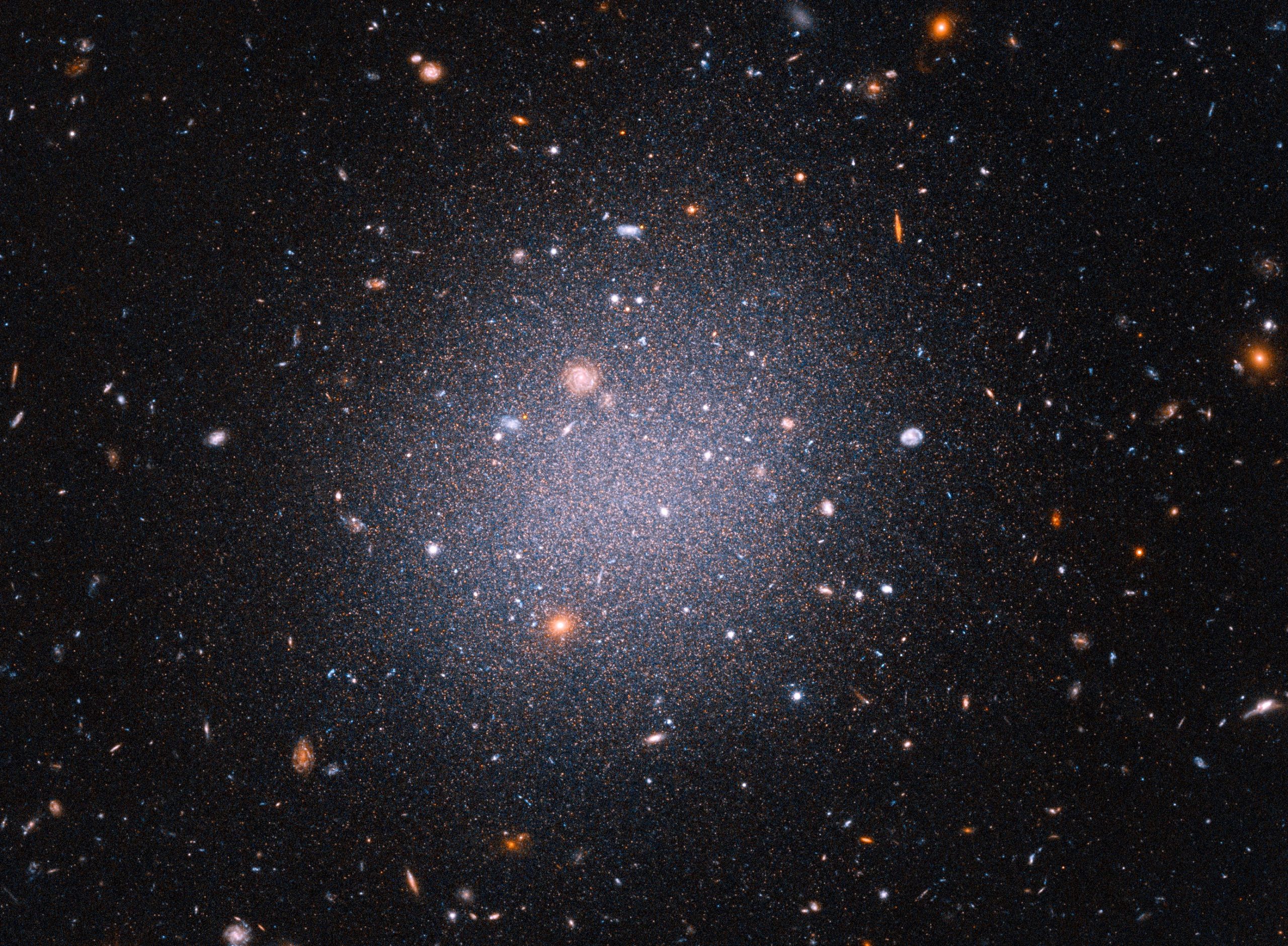
    NGC1052-DF2
    This deep  Hubble Space Telescope image reveals the diffuse dwarf galaxy NGC2052-DF2, an unusual “see-through” galaxy. The giant cosmic cotton ball is so diffuse and its ancient stars so spread out that distant galaxies in the background can be seen through it. Astronomers measured the luminosities of faint stars at the tip of the red giant branch in this galaxy to improve the accuracy of its distance and to conclude that, in agreement with earlier studies, it does appear to be very deficient in dark matter. Credit: Science: NASA, ESA, STScI, Zili Shen (Yale), Pieter van Dokkum (Yale), Shany Danieli (IAS) Image Processing: Alyssa Pagan (STScI)

    NGC 1052-DF2’s true distance confirms its puzzling absence of dark matter.

    The galaxy NGC 1052-DF2 resides in a field of galaxies about sixty-five million light-years away. Its low mass, only about two hundred million solar-masses, makes it a “dwarf” and its size, about fifteen thousand light-years in diameter, places it in the regime of ultra-diffuse galaxies. It is also distinguished by hosting a large population of luminous globular clusters.

    Two years ago, a second, similar faint dwarf galaxy was found near it, and the relative motions of these two galaxies strongly suggest they have very little or no dark matter; for comparison, in the Milky Way (a normal galaxy) the dark matter contains nearly ten times more mass than the stellar matter.

    Astronomers also noted that, if these mass and motion measurements are accurate, they might be used to test and reject (or confirm) one long-standing alternate theory of gravity to Einstein’s. But first, the distance to the galaxy needs to be known more accurately and precisely, since the values for many of the galaxy’s properties like motion, luminosity, and inferred mass rely on the assumed distance.

    Using Red Giant Stars as Cosmic Yardsticks

    CfA astronomer Charlie Conroy was a member of a team of astronomers that determined a new distance for the galaxy. Rather than rely on its velocity/redshift to get the distance, a value that might be confused by its local motion within the group of galaxies, they derived the distance using the brightness of faint red giant stars at the tip of the red giant branch, a standard and well-established method when the stars are bright enough to be accurately studied.

    As a low-mass star burns through nearly all of its hydrogen and starts to fuse helium in its core, the transition is accompanied by a shrinking in size, a rapid rise in the core temperature, a shift towards a bluer color, and an abrupt decrease in luminosity. This rapid change in brightness is readily apparent in optical and near-infrared wavelengths; the absolute luminosities of those stars can then be determined and, from their apparent luminosities, their distance calculated.

    The astronomers used forty orbits of the Hubble Space Telescope to measure the brightness of the red giant stars in NGC 1052-DF2 and from that data to determine their distance: 72.7 million light-years plus or minus 5%.

    This new distance confirms the unusual characteristics of the galaxy including its puzzling dearth of dark matter and that its globular clusters are exceptionally luminous (in fact the new distance makes them even more luminous). The result also means the data will not be suitable for tests of the proposed alternative theory of gravity.

    For more on this discovery:

    • Cosmic Mystery Deepens: Oddball “See-Through” Galaxy’s Missing Dark Matter
    • Strange Ghostly Galaxies Lacking Dark Matter Confirmed by Hubble Data

    Reference: “A Tip of the Red Giant Branch Distance of 22.1 ± 1.2 Mpc to the Dark Matter Deficient Galaxy NGC 1052–DF2 from 40 Orbits of Hubble Space Telescope Imaging” by Zili Shen, Shany Danieli, Pieter van Dokkum, Roberto Abraham, Jean P. Brodie, Charlie Conroy, Andrew E. Dolphin, Aaron J. Romanowsky, J. M. Diederik Kruijssen and Dhruba Dutta Chowdhury, 9 June 2021, The Astrophysical Journal Letters.
    DOI: 10.3847/2041-8213/ac0335

    Never miss a breakthrough: Join the SciTechDaily newsletter.
    Follow us on Google and Google News.

    Astronomy Astrophysics Dark Matter Harvard-Smithsonian Center for Astrophysics Hubble Space Telescope
    Share. Facebook Twitter Pinterest LinkedIn Email Reddit

    Related Articles

    44 Hidden Stars Revealed: Gravitational Lensing Unlocks the Secrets of the Dragon Arc

    “Amazingly Lucky” Gravitational Lens Reveals New Insights Into Dark Matter and Dark Energy

    Hubble Unmasks Universe’s “Invisible Glue” – Stellar Motions Reveal Dark Matter Secrets

    Astrophysicists Reveal Largest-Ever Suite of Universe Simulations – How Gravity Shaped the Distribution of Dark Matter

    Strange Ghostly Galaxies Lacking Dark Matter Confirmed by Hubble Data

    How Habitable Are Planets That Orbit Red Dwarfs – The Most Common Type of Stars in the Galaxy?

    Our Giant Universe: Hubble Spots Massive Galaxy Cluster With a Wealth of Exciting Possibilities

    New All-Sky Map of Milky Way’s Outer Reaches Released – Could Offer a New Test of Dark Matter Theories

    X-Ray Emission From Mysterious Dark Matter

    4 Comments

    1. John Campbell on October 11, 2021 2:35 pm

      “Dark Matter deficiency”. AKA- A lack of angular momentum.

      Reply
    2. BibhutibhusanPatel on October 11, 2021 8:15 pm

      Dark matter is a good substitute for blank and does no harm to any calculation.The factual distance so matches to Hubble constant.

      Reply
    3. Qweedo Snarfenberger on October 15, 2021 12:22 pm

      Maybe we need to take a closer look at our theory of gravity instead of postulating the presence or lack of dark matter, the existence of which has never been confirmed. We obviously don’t fully understand gravity yet.

      Reply
    4. Gorge Zarate on October 20, 2021 8:23 am

      It looks alot like a galaxy that had its super massive black hole was thrown out and with a lack of a black holes gravity it can’t form what we see in normal galaxies that has a super massive black holes

      Reply
    Leave A Reply Cancel Reply

    • Facebook
    • Twitter
    • Pinterest
    • YouTube

    Don't Miss a Discovery

    Subscribe for the Latest in Science & Tech!

    Trending News

    New Study Reveals Why Ozempic Works Better for Some People Than Others

    Climate Change Is Altering a Key Greenhouse Gas in a Way Scientists Didn’t Expect

    New Study Suggests Gravitational Waves May Have Created Dark Matter

    Scientists Discover Why the Brain Gets Stuck in Schizophrenia

    Scientists Engineer “Tumor-Eating” Bacteria That Devour Cancer From Within

    Even “Failed” Diets May Deliver Long-Term Health Gains, Study Finds

    NIH Scientists Discover Powerful New Opioid That Relieves Pain Without Dangerous Side Effects

    Collapsing Plasma May Hold the Key to Cosmic Magnetism

    Follow SciTechDaily
    • Facebook
    • Twitter
    • YouTube
    • Pinterest
    • Newsletter
    • RSS
    SciTech News
    • Biology News
    • Chemistry News
    • Earth News
    • Health News
    • Physics News
    • Science News
    • Space News
    • Technology News
    Recent Posts
    • This 15,000-Year-Old Discovery Changes What We Know About Early Human Creativity
    • 35-Million-Year-Old Mystery: Strange Arachnid Discovered Preserved in Amber
    • Revolutionary Gas Turbine Generates Power Without Air Compression
    • Is AI Really Just a Tool? It Could Be Altering How You See Reality
    • JWST Reveals a “Forbidden” Planet With a Baffling Composition
    Copyright © 1998 - 2026 SciTechDaily. All Rights Reserved.
    • Science News
    • About
    • Contact
    • Editorial Board
    • Privacy Policy
    • Terms of Use

    Type above and press Enter to search. Press Esc to cancel.