
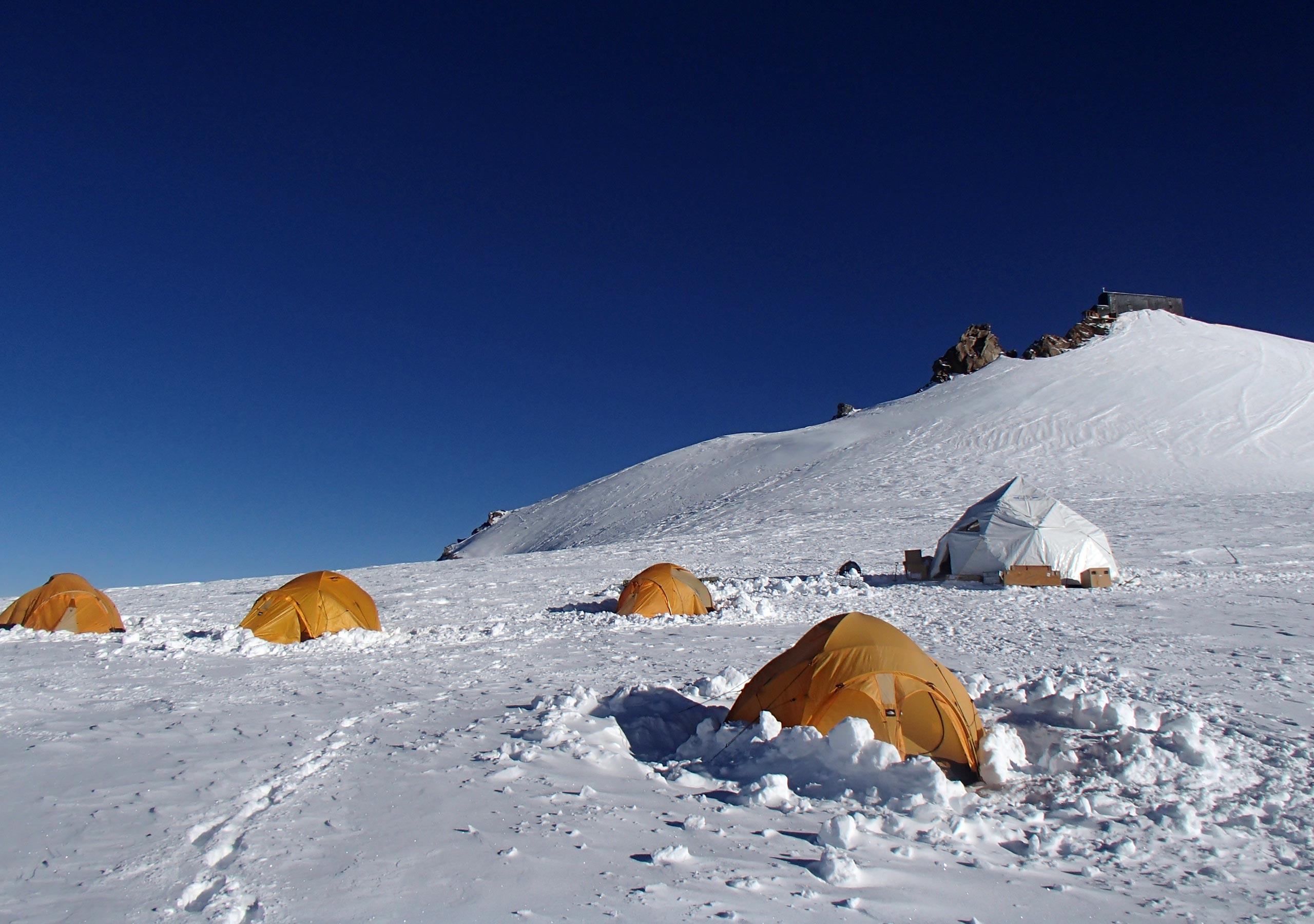
Evidence preserved in glaciers provides continuous climate and vegetation records during major historical events.
Europe’s past prosperity and failure, driven by climate changes, has been revealed using thousand-year-old pollen, spores, and charcoal particles fossilized in glacial ice. This first analysis of microfossils preserved in European glaciers unveils earlier-than-expected evidence of air pollution and the roots of modern invasive species problems.
A new study analyzed pollen, spores, charcoal, and other pollutants frozen in the Colle Gnifetti glacier on the Swiss and Italian border. The research found changes in the composition of these microfossils corresponded closely with known major events in climate, such as the Little Ice Age and well-established volcanic eruptions.
The work was published in Geophysical Research Letters, which publishes high-impact, short-format reports with immediate implications spanning all Earth and space sciences.
The industrialization of European society also appeared clearly in the microfossil record and, in some cases, showed up sooner than expected. Pollen from the introduction of non-native crops was found to go back at least 100 years ago and pollution from the burning of fossil fuels shows up in the 18th century, about 100 years earlier than expected.
Pairing Ice Core Records with Historical Sources
Existing historical sources such as church records or diaries record conditions during major events like droughts or famines. However, studying data from the glaciers contributes to the understanding of climate and land use surrounding such events, providing non-stop context for them with evidence from a large land area. Precisely identifying the timing of these events can help scientists better understand current climate change.
“The historical sources that were available before, I don’t think [the sources] got the full picture of the environmental context,” said Sandra Brugger, a paleoecologist at the Desert Research Institute in Nevada and lead researcher on the study. “But also, with the ice core, we couldn’t get the full picture until we started collaborating with historians on this. It needs those two sides of the coin.”
The new study analyzed microfossils frozen in two 82- and 75-meter-long (269- and 246-foot-long) ice cores pulled from the Colle Gnifetti glacier, which are the first two ice cores from the continent of Europe studied for microfossils. Similar studies have sampled ice cores in South America, Central Asia, and Greenland, but those regions lack the breadth of written historical records that can be directly correlated with the continuous microfossil data in ice cores.
Over the centuries, wind, rain, and snow carried microfossils from European lowlands, the United Kingdom, and North Africa to the exposed glacier. Ice in this glacier site dates back tens of thousands of years, and the altitude of Colle Gnifetti — 4,450 meters above sea level — means the ice was likely never subjected to melting, which would mix the layers of samples and create uncertainty in the chronology of the record.
Linking Human Activity and Climate Change
“They can actually pinpoint and identify the relationships between what’s happening on the continent with climatic records inherent in the ice,” said John Birks, a paleoecologist at the University of Bergen who was not associated with the study. “They can develop, in a stronger way, this link between human civilization and change and climate, particularly in the last thousand years or so where conventional pollen analysis is rather weak.”
Evidence of pollution due to fossil fuel combustion also appeared earlier in the chronological record than expected. The researchers found evidence of the early burning of coal in the United Kingdom around 1780, much earlier than the expected onset of industrialization around 1850, which could have implications for global climate change modeling.
The records also showed evidence of pollen from non-native European plants from 100 years ago, showing a long legacy of the existing ecological problems created by invasive species transported across continents through trade.
Reference: “Alpine Glacier Reveals Ecosystem Impacts of Europe’s Prosperity and Peril Over the Last Millennium” by S. O. Brugger, M. Schwikowski, E. Gobet, C. Schwörer, C. Rohr, M. Sigl, S. Henne, C. Pfister, T. M. Jenk, P. D. Henne and W. Tinner, 23 September 2021, Geophysical Research Letters.
DOI: 10.1029/2021GL095039
Never miss a breakthrough: Join the SciTechDaily newsletter.
Follow us on Google and Google News.
1 Comment
“… which COULD have implications for global climate change modeling.”
What would climatologists do if the English language didn’t have ambiguous words like “could, may, or possible?” They might have to actually estimate a numerical probability with an associated uncertainty!