
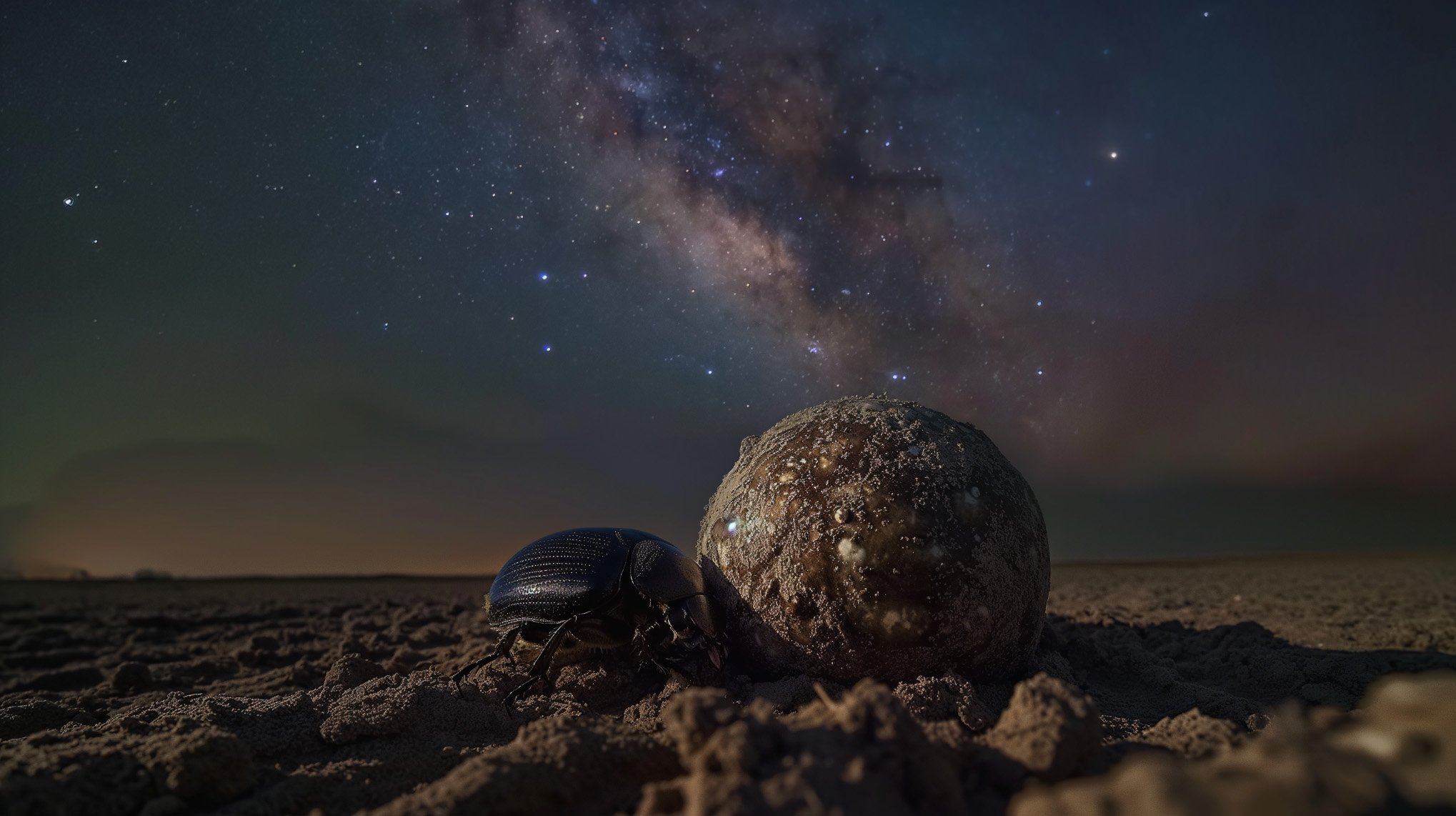
An AI sensor accurately measures the orientation of the Milky Way.
A new research study is drawing inspiration from an insect species that evolved 130 million years ago to enhance navigation systems in drones, robots, and orbiting satellites.
The dung beetle is the first known species to use the Milky Way at night to navigate, focusing on the constellation of stars as a reference point to roll balls of dung in a straight line away from their competitors.
Swedish researchers made this discovery in 2013 and a decade later, Australian engineers are modeling the same technique used by the dung beetle to develop an AI sensor that can accurately measure the orientation of the Milky Way in low light.
University of South Australia remote sensing engineer Professor Javaan Chahl and his team of PhD students have used computer vision to demonstrate that the large stripe of light that forms the Milky Way is not affected by motion blur, unlike individual stars.
The Milky Way as a Navigational Tool
“Nocturnal dung beetles move their head and body extensively when rolling balls of manure across a field, needing a fixed orientation point in the night sky to help them steer in a straight line,” Prof Chahl says. “Their tiny compound eyes make it difficult to distinguish individual stars, particularly while in motion, whereas the Milky Way is highly visible.”
UniSA Professor Javaan Chahl explains how dung beetles and the Milky Way are helping engineers improve navigation systems in drones, robots, and satellites. Credit: University of South Australia
In a series of experiments using a camera mounted to the roof of a vehicle, the UniSA researchers captured images of the Milky Way while the vehicle was both stationary and moving. Using information from those images they have developed a computer vision system that reliably measures the orientation of the Milky Way, which is the first step towards building a navigation system.
Research Outcomes and Future Directions
Their findings have been published in the journal Biomimetics.
Lead author UniSA PhD candidate Yiting Tao says the orientation sensor could be a backup method to stabilize satellites and help drones and robots to navigate in low light, even when there is a lot of blur caused by movement and vibration.
“For the next step I want to put the algorithm on a drone and allow it to control the aircraft in flight during the night,” Tao says.
The sun helps many insects to navigate during the day, including wasps, dragonflies, honeybees, and desert ants. At night, the moon also provides a reference point for nocturnal insects, but it is not always visible, hence why dung beetles and some moths use the Milky Way for orientation.
Prof Chahl says insect vision has long inspired engineers where navigation systems are concerned.
“Insects have been solving navigational problems for millions of years, including those that even the most advanced machines struggle with. And they’ve done it in a tiny little package. Their brains consist of tens of thousands of neurons compared to billions of neurons in humans, yet they still manage to find solutions from the natural world.”
Reference: “Computer Vision Techniques Demonstrate Robust Orientation Measurement of the Milky Way Despite Image Motion” by Yiting Tao, Asanka Perera, Samuel Teague, Timothy McIntyre, Eric Warrant and Javaan Chahl, 20 June 2024, Biomimetics.
DOI: 10.3390/biomimetics9070375
Never miss a breakthrough: Join the SciTechDaily newsletter.
Follow us on Google and Google News.
1 Comment
It is IMPOSSIBLE for there EASno intelligent Life on this planet 130 million years ago. You are obviously a child of the 90s education system. How sad. Despite what Scientists say and write, Mankind has Only been Alive for almost 4000years, since Adam was created by Jehovah.. your parents really shouldn have taught you what the Holy Bible says. Them or a church..
Despite the incongruous, and Errors in scientificall methods that get the dates wrong, the truth is the truth. 4000yesrs.