
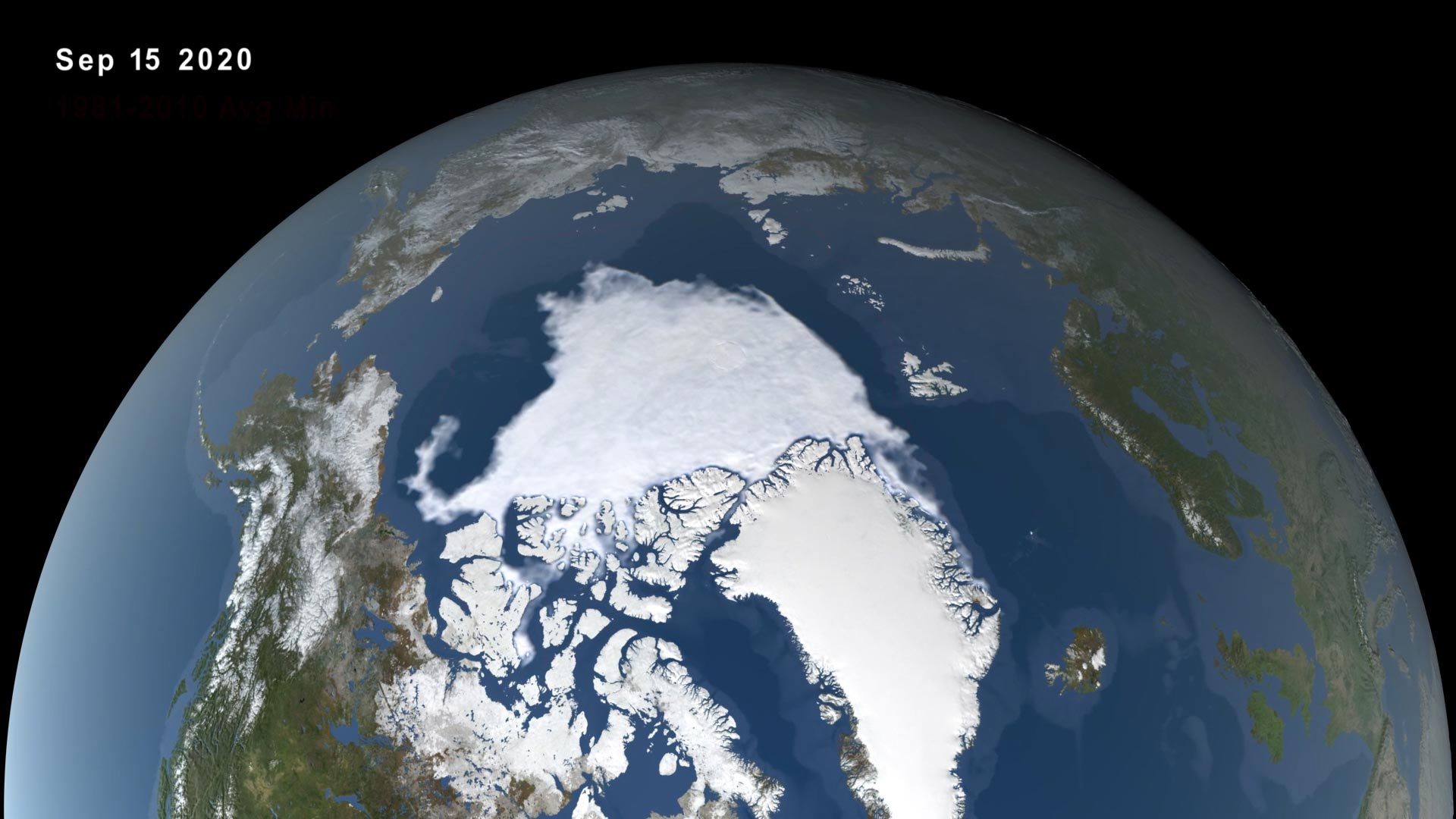
This year’s Arctic sea ice cover shrank to the second-lowest extent since modern record keeping began in the late 1970s. An analysis of satellite data by NASA and the National Snow and Ice Data Center (NSIDC) at the University of Colorado Boulder shows that the 2020 minimum extent, which was likely reached on September 15, measured 1.44 million square miles (3.74 million square kilometers).
In winter, frozen seawater covers almost the entire Arctic Ocean and neighboring seas. This sea ice undergoes seasonal patterns of change – thinning and shrinking during late spring and summer, and thickening and expanding during fall and winter. The extent of summer sea ice in the Arctic can impact local ecosystems, regional and global weather patterns, and ocean circulation. In the last two decades, the minimum extent of Arctic sea ice in the summer has dropped markedly. The lowest extent on record was set in 2012, and last year’s extent was tied for second – until this year’s.
Arctic sea ice reached its annual summer minimum extent on September 15, the second lowest minimum on record. Credit: NASA’s Goddard Space Flight Center
A Siberian heat wave in spring 2020 began this year’s Arctic sea ice melt season early, and with Arctic temperatures being 14 to 18 degrees Fahrenheit (8 to 10 degrees Celsius) warmer than average, the ice extent kept declining. The 2020 minimum extent was 958,000 square miles (2.48 million square kilometers) below the 1981-2010 average of yearly minimum extents, and 2020 is only the second time on record that the minimum extent has fallen below 1.5 million square miles (4 million square kilometers).
“It was just really warm in the Arctic this year, and the melt seasons have been starting earlier and earlier,” said Nathan Kurtz, a sea ice scientist at NASA’s Goddard Space Flight Center in Greenbelt, Maryland. “The earlier the melt season starts, the more ice you generally lose.”
Thin ice also melts quicker than thicker floes. Dramatic drops in sea ice extent in 2007 and 2012, along with generally declining summer extent, has led to fewer regions of thick, multi-year ice that has built up over multiple winters. In addition, a recent study showed that warmer water from the Atlantic Ocean, which is typically deep below the colder Arctic waters, is creeping up closer to the bottom of the sea ice and warming it from below.
Animation of Arctic sea ice extent from the March 5, 2020 maximum to the September 15, 2020 minimum, 30-year average extents in yellow. Credit: NASA’s Scientific Visualization Studio
There are cascading effects in the Arctic, said Mark Serreze, director of NSIDC. Warmer ocean temperatures eat away at the thicker multiyear ice, and also result in thinner ice to start the spring melt season. Melt early in the season results in more open water, which absorbs heat from the Sun and increases water temperatures.
“As the sea ice cover extent declines, what we’re seeing is we’re continuing to lose that multiyear ice,” Serreze said. “The ice is shrinking in the summer, but it’s also getting thinner. You’re losing extent, and you’re losing the thick ice as well. It’s a double whammy.”
The second-lowest extent of sea ice on record is just one of many signs of a warming climate in the north, he said, pointing to the Siberian heat waves, forest fires, hotter-than-average temperatures over the Central Arctic, and the thawing permafrost that led to a Russian fuel spill.
Read Arctic Sea Ice Reaches Second-Lowest Minimum on Record for more on this topic.
Never miss a breakthrough: Join the SciTechDaily newsletter.
Follow us on Google and Google News.
6 Comments
The depth of the ice is a far more important. It’s thinner and thinner by the day. 15 years from now is the dead line for the north pole ice. From there is no turning back, temperature will increase like hell itself. Do not stand quite now, every action counts, time is ticking, it’s do or die.
Discount the fear-mongering. Ice melts, ice returns. One hundred years ago, newspaper headlines reported scientists’ fears that the Arctic was becoming a “temperate zone” after Arctic sea ice began disappearing. Forty years does not a climate make. The planet has been warming for 8,000 years. Orbital mechanics suggest that that warming is about to end, or should have already ended.
It may be that anthropogenic emissions are prolonging the current benign climate, contratrend. Increased CO2 has led to an estimated 30 percent increase in agricultural production since 1900; more plants means more CO2 recycling, higher humidity due to more transpiration, more food for an expanding population. These are the upsides to slowly rising sea levels. Climate change is the norm — climate stability is a myth.
Sorry Richie, never during any previous interglacial has the north polar ice completely disappeared. We have potentially less than a decade before the first blue ocean event, and if you know your physics, that will be curtains for any effective human chance of mitigating climate change. The slowdown of the jet stream will create chaos in weather patterns in the northern hemisphere. Massive crop failures in Europe, north America and Russia. Accelerated melting of the Greenland ice sheet. Shutting down the mid-atlantic conveyor. Abrupt releases of methane from clathrates on the continental shelf and accelerated release of methane from land based permafrost. When the only thing with permanent ice cover in the arctic is Greenland what do you think will be the focal point of the jet stream? What do you think will happen when warm salty water traveling north meets no resistance from cold fresh arctic water.? What do you think governments will do when grain crops fail catastrophically and simultaneously on two or even three continents? Carry on with your denial, but don’t say you weren’t warned!
So it’s still more ice than in 2012? That must have been the turning point then.
As we are passing the point of no return, it’s really, really late to be playing the willful ignorance card. It really is.
“Orbital mechanics suggest that that warming is about to end, or should have already ended.” Does that explain why it keeps getting warmer.