
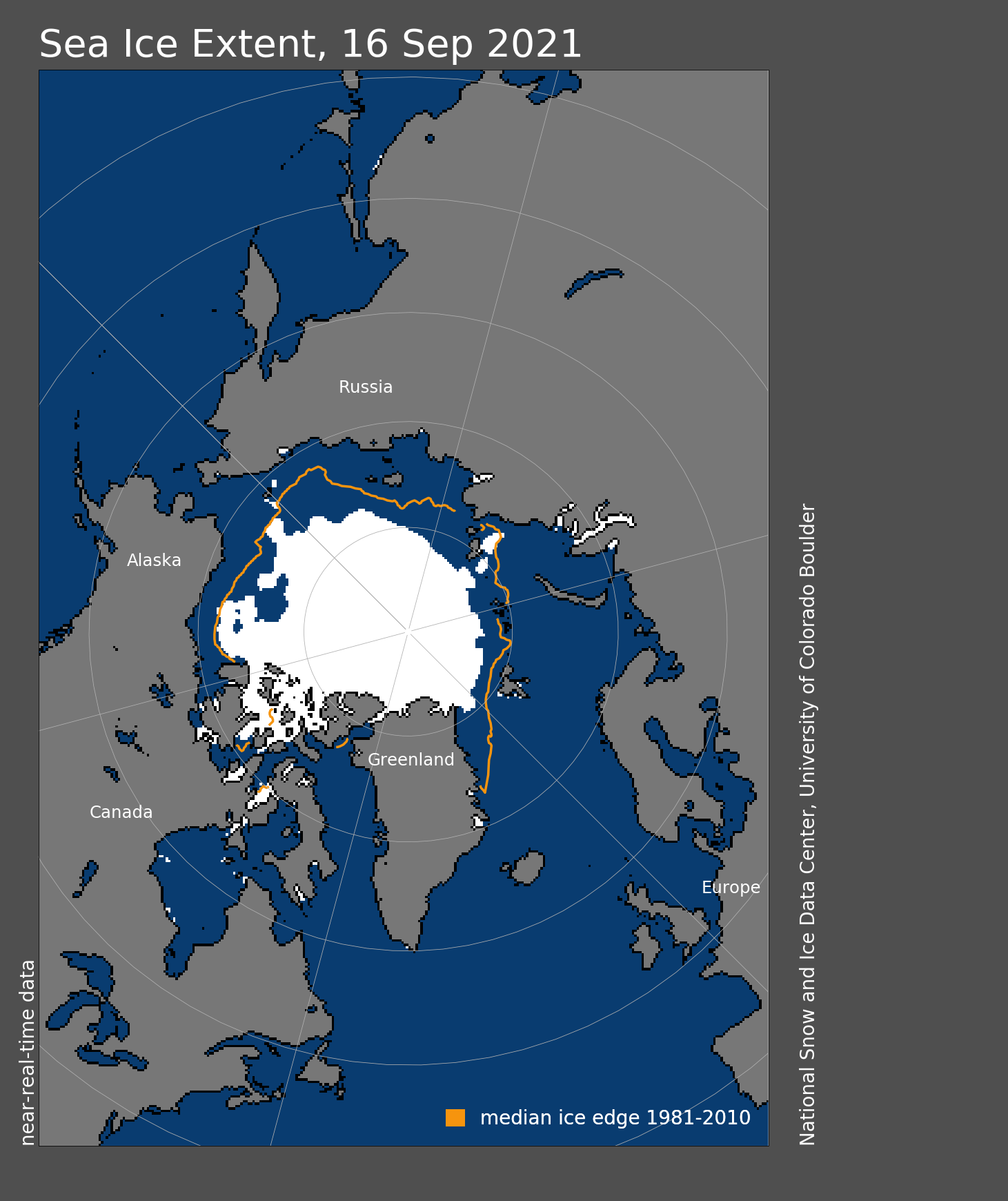
Arctic sea ice reached its minimum extent on September 16, 2021, at 4.72 million square kilometers (1.82 million square miles). Credit: NASA’s Goddard Space Flight Center
On September 16, Arctic sea ice likely reached its annual minimum extent of 4.72 million square kilometers (1.82 million square miles). The 2021 minimum is the twelfth lowest in the nearly 43-year satellite record. The last 15 years are the lowest 15 sea ice extents in the satellite record. The amount of multi-year ice (ice that has survived at least one summer melt season), is one of the lowest levels in the ice age record, which began in 1984.
In the Antarctic, sea ice extent is now falling rapidly, but it is still too early to assume that the maximum has been reached. The maximum for Antarctic sea ice typically occurs in late September or early October. However, Antarctic sea ice extent is highly variable near the maximum because of storms acting to expand or compact the extended ice edge.
Please note that this is a preliminary announcement. Changing winds or late-season melt could still reduce the Arctic ice extent, as happened in 2005 and 2010. NSIDC scientists will release a full analysis of the Arctic melt season, and discuss the Antarctic winter sea ice growth, in early October.
Overview of conditions
On September 16, sea ice reached its annual minimum extent of 4.72 million square kilometers (1.82 million square miles) (Figure 1). In response to the setting sun and falling temperatures, ice extent has begun rising and will continue to rise through autumn and winter. However, a shift in wind patterns or a period of late season melt could still push the ice extent lower.
The minimum extent was reached two days later than the 1981 to 2010 median minimum date of September 14. The interquartile range of minimum dates is September 11 to September 19.

Conditions in context
This year’s minimum set on September 16 was 1.33 million square kilometers (514,000 square miles) above the record minimum extent in the satellite era, which occurred on September 17, 2012 (Figure 2). It is also 1.50 million square kilometers (579,000 square miles) below the 1981 to 2010 average minimum extent, which is equivalent to twice the size of Texas.
In the 43-year-satellite record, 15 of the lowest minimums have all occurred in the last 15 years.
Multiyear ice extent is one of the lowest on record. First-year-ice coverage increased dramatically since last year, jumping from 1.58 million square kilometers (610,000 square miles) to 2.71 million square kilometers (1.05 million square miles). The increase in total extent from last year’s minimum to this year’s is hence comprised of first-year ice.
The overall, downward trend in the minimum extent from 1979 to 2021 is 13.0 percent per decade relative to the 1981 to 2010 average. The loss of sea ice is about 80,600 square kilometers (31,100 square miles) per year, equivalent to losing the size of the state of South Carolina or the country of Austria annually.
Fifteen lowest minimum Arctic sea ice extents (satellite record, 1979 to present)
| RANK | YEAR | MINIMUM ICE EXTENT | DATE | |
|---|---|---|---|---|
| IN MILLIONS OF SQUARE KILOMETERS | IN MILLIONS OF SQUARE MILES | |||
| 1 | 2012 | 3.39 | 1.31 | Sept. 17 |
| 2 | 2020 | 3.82 | 1.47 | Sept. 16 |
| 3 | 2007 2016 2019 | 4.16 4.17 4.19 | 1.61 1.61 1.62 | Sept. 18 Sept. 10 Sept. 18 |
| 6 | 2011 | 4.34 | 1.68 | Sept. 11 |
| 7 | 2015 | 4.43 | 1.71 | Sept. 9 |
| 8 | 2008 2010 | 4.59 4.62 | 1.77 1.78 | Sept. 19 Sept. 21 |
| 10 | 2018 2017 | 4.66 4.67 | 1.80 1.80 | Sept. 23 Sept. 13 |
| 12 | 2021 | 4.72 | 1.82 | Sept. 16 |
| 13 | 2014 2013 | 5.03 5.05 | 1.94 1.95 | Sept. 17 Sept. 15 |
| 15 | 2009 | 5.12 | 1.98 | Sept. 13 |
Values within 40,000 square kilometers (15,000 square miles) are considered tied. The 2020 value has changed from 3.74 to 3.82 million square kilometers (1.47 million square miles) when final analysis data updated near-real-time data. The 2020 date of minimum also changed from September 15 to September 16.
See also:
- NASA: 2021 Arctic Summer Sea Ice Is 12th-Lowest on Record
- Arctic Sea Ice Extent 26% Greater Than Last Year – But Still 12th-Lowest on Record
Never miss a breakthrough: Join the SciTechDaily newsletter.
Follow us on Google and Google News.
3 Comments
Of course, the satellite record is too short to draw any climatological conclusions: the mid-2oth century cooling cycle ended about the time satellites began providing global data. That said, this year’s Arctic ice minimum is way up from the record low set 10 years ago, while Antarctica’s (winter) average temp was the lowest in 40 years, per the New York Times. Is the Milankovich cycle asserting itself?
This is the THIRD time that this ‘news’ has been reported on since September 23rd. My original criticisms have not been addressed. Does this repetition have anything to do with the COP 26 meeting planned for next month? Surely there is other Earth news worthy of being posted!
You humans are doomed! Read why at https://www.facebook.com/ron.mccune.3