
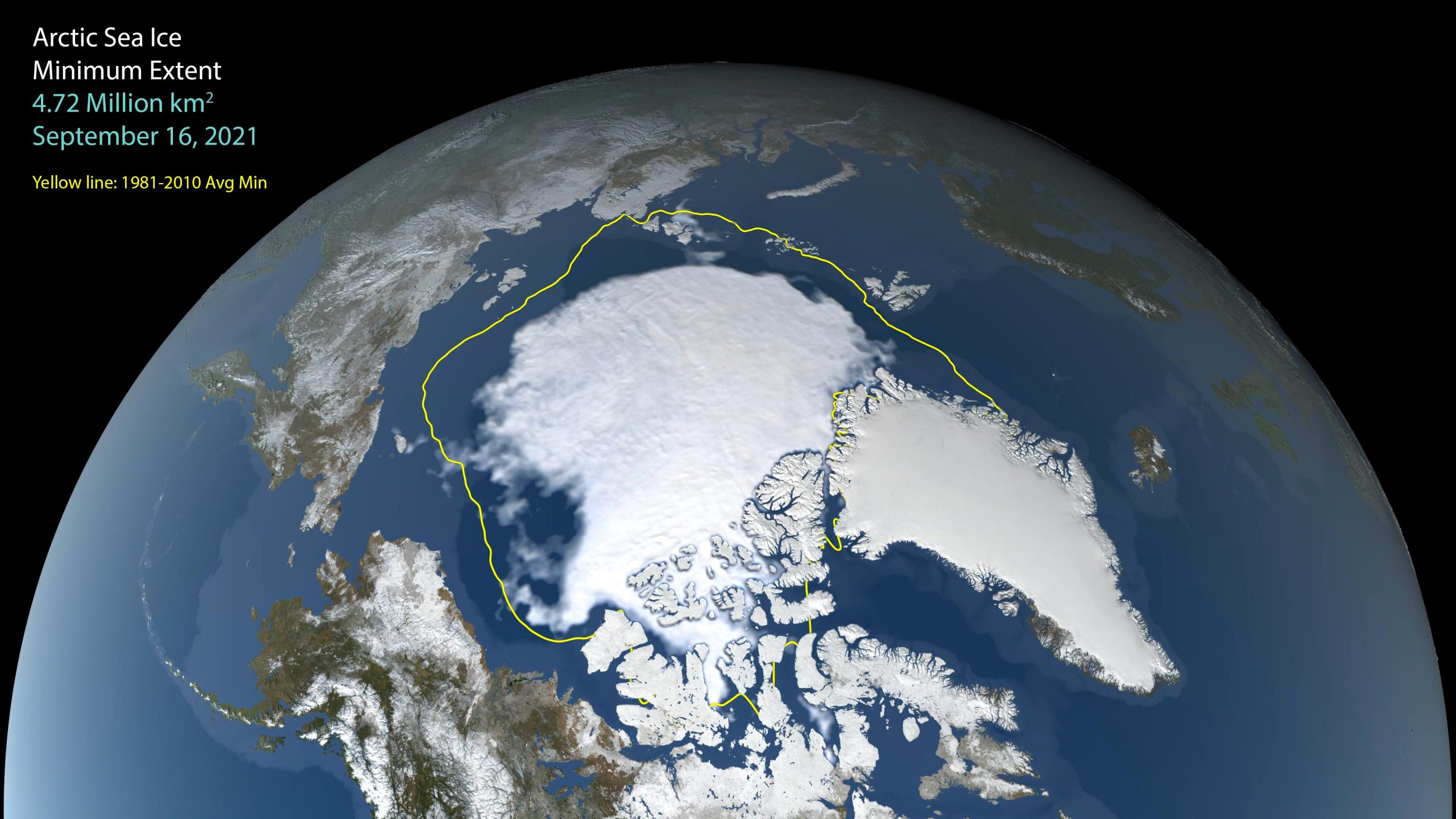
Arctic sea ice reached its 2021 minimum on Sept. 16, marking the 12th-lowest extent on record.
Sea ice in the Arctic appears to have hit its annual minimum extent on September 16, after waning in the 2021 Northern Hemisphere spring and summer. The summertime extent is the 12th-lowest in the satellite record, according to scientists at the NASA-supported National Snow and Ice Data Center and NASA.
This year, the minimum extent of Arctic sea ice dropped to 4.72 million square kilometers (1.82 million square miles). Sea ice extent is defined as the total area in which ice concentration is at least 15%.
The average September minimum extent record shows significant declines since satellites began measuring consistently in 1978. The last 15 years (2007 to 2021) are the lowest 15 minimum extents in the 43-year satellite record.
This visualization, created at NASA’s Goddard Space Flight Center in Greenbelt, Maryland, shows data provided by the Japan Aerospace Exploration Agency (JAXA), acquired by the Advanced Microwave Scanning Radiometer 2 (AMSR2) instrument aboard JAXA’s Global Change Observation Mission 1st-Water “SHIZUKU” (GCOM-W1) satellite.
Satellite-based passive microwave images of the sea ice have provided a reliable tool for continuously monitoring changes in the Arctic ice since 1979. Every summer the Arctic ice cap melts down to what scientists call its “minimum” before colder weather begins to cause ice cover to increase. An analysis of satellite data by NASA and the National Snow and Ice Data Center (NSIDC) at the University of Colorado Boulder shows that the 2021 minimum extent, which was likely reached on September 16, measured 1.82 million square miles (4.72 million square kilometers).
The Japan Aerospace Exploration Agency (JAXA) provides many water-related products derived from data acquired by the Advanced Microwave Scanning Radiometer 2 (AMSR2) instrument aboard the Global Change Observation Mission 1st-Water “SHIZUKU” (GCOM-W1) satellite. Two JAXA datasets used in this animation are the 10-km daily sea ice concentration and the 10 km daily 89 GHz Brightness Temperature.
In this animation, the daily Arctic sea ice and seasonal land cover change progress through time, from the yearly maximum ice extent on March 21 2021, through its minimum on September 16, 2021. Over the water, Arctic sea ice changes from day to day showing a running 3-day minimum sea ice concentration in the region where the concentration is greater than 15%. The blueish white color of the sea ice is derived from a 3-day running minimum of the AMSR2 89 GHz brightness temperature. The yellow boundary shows the minimum extent averaged over the 30-year period from 1981 to 2010. Over the terrain, monthly data from the seasonal Blue Marble Next Generation fades slowly from month to month. The faint circle that appears periodically close to the pole is an artifact of the visualization process, and does not represent a real feature.
[Update] An earlier version had the units reversed on the image caption. This has been fixed.
Never miss a breakthrough: Join the SciTechDaily newsletter.
Follow us on Google and Google News.
3 Comments
“The last 15 years (2007 to 2021) are the lowest 15 minimum extents in the 43-year satellite record.”
That sounds pretty bad! Until one takes into consideration that there are 11 years lower than this year, and this year is a considerable improvement over last year, which was the 2nd lowest. Nowhere does the article even suggest that the situation is improving. Only the negative spin is presented. Maybe this year is a fluke and next will again set an actual record. We’ll have to wait to find out. However, the people writing the press release have done what they probably set out to do: Create more scary fodder for the public and those promoting action at COP 26 — if it takes place.
An objective piece would have shown a graph of those last, all important 15 years, and noted if there was any kind of a trend other than the obvious significant improvement over last year. It would have remarked that the ice coverage is back within the -2 sigma range for the 1981-2010 average and similar to the 2010 minimum behavior. Is it any wonder that skeptics feel that there is an agenda taking precedence over objectivity?
Readers who are interested in unbiased facts might want to look at this interactive graph:
https://nsidc.org/arcticseaicenews/charctic-interactive-sea-ice-graph/
“the extent of the ice was 4.72 million square miles (1.82 million square kilometers)” The caption for the image has the units reversed.
Thank you! This has been corrected.