
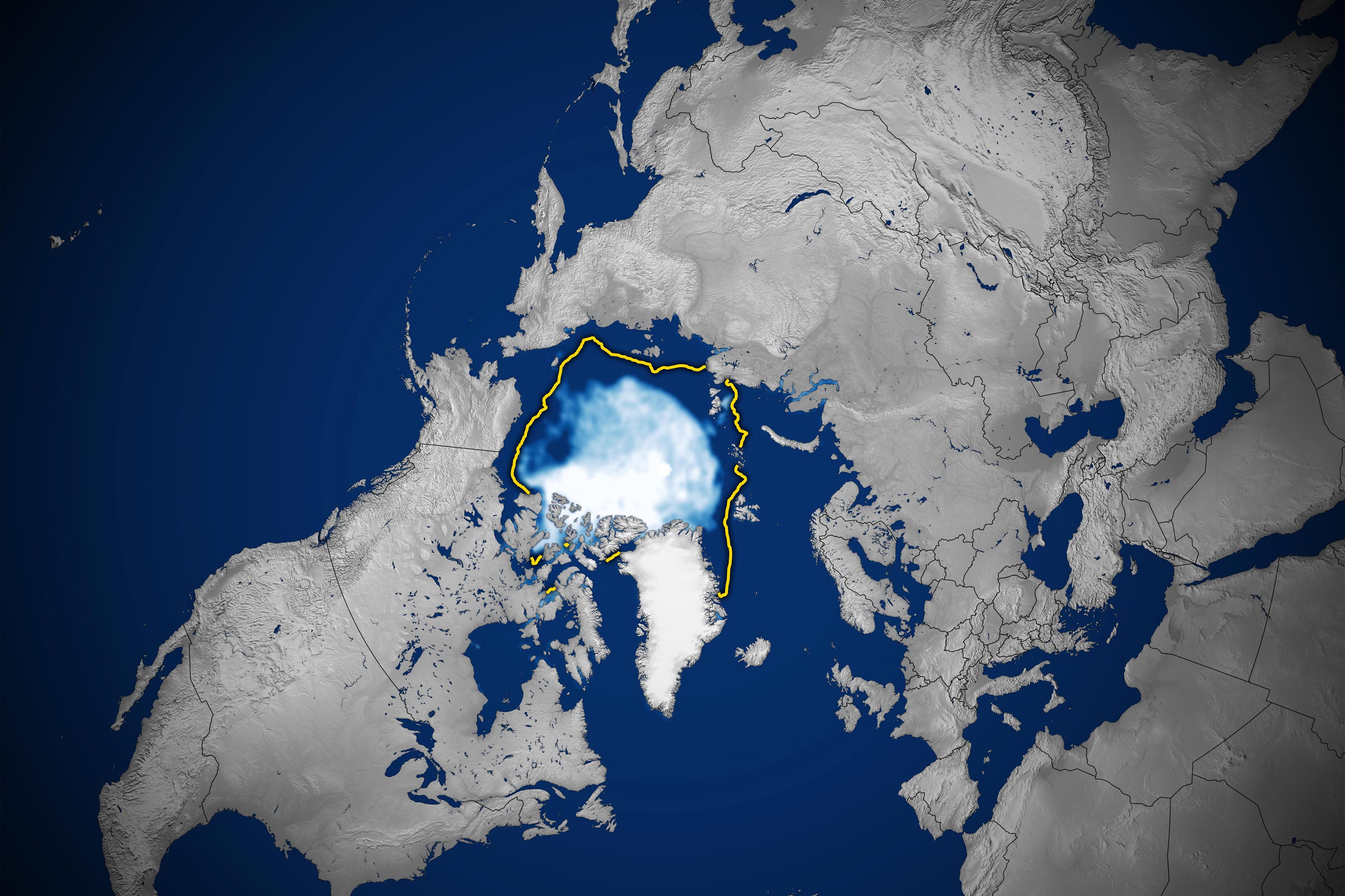
Sea ice covered more area this summer compared to recent years, but it was also much thinner.
Sea ice in the Arctic Ocean and neighboring basins appears to have hit its annual minimum extent on September 16, 2021, after waning in the spring and summer. The summertime extent is the twelfth lowest in the satellite record, according to scientists at the National Snow and Ice Data Center and NASA.
The map at the top of this page shows the sea ice extent on September 16, 2021. The ice extent (white) on that day—defined as the total area in which the ice concentration is at least 15 percent—measured 4.72 million square kilometers (1.82 million square miles)—higher than in recent years. Sea ice extents in 2020 and 2019 were the second and third lowest on record at 3.74 million square kilometers (1.44 million square miles) in 2020 and 4.14 million (1.6 million square miles) in 2019.
Arctic Storms and Clouds Slowed Melting
Less sea ice melted in 2021 even as the planet as a whole was warmer than usual—with new temperature records in North America and Eurasia, drought in the U.S. West, and episodes of intense melting on Greenland’s ice sheet. But farther north, conditions stayed generally cool and stormy across the Arctic Ocean. For much of the summer, low pressure over the Arctic brought cloudy skies, which limits the amount of sunlight that can reach the ice and spur melting. Storms can also spread the ice out, slowing the decline of its extent.
Such differences from place to place and year to year are to be expected. “I don’t see any inconsistency with the Arctic sea ice extent not breaking any records this year despite global temperatures being high,” said Claire Parkinson, a sea ice scientist at NASA’s Goddard Space Flight Center. “The key is that the Earth is large and there are differences regionally.”
“We don’t expect sea ice to be lower every year,” added Walt Meier, a sea ice researcher at the National Snow and Ice Data Center, “just like we don’t expect temperatures to be warmer everywhere on Earth every year even with global warming.”
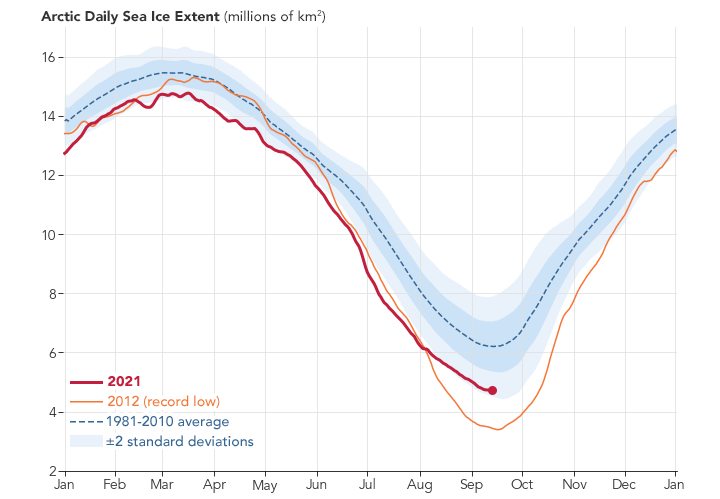
Long-term trends are more important than any single year, and those trends are still pointing strongly downward. The 15 lowest minimum extents in the 43-year satellite record have all occurred in the past 15 years (2007 to 2021).
Younger, Thinner Ice Dominates
Sea ice is also trending younger and thinner; that is, there is less multi-year ice that survives a summer season and thickens over the subsequent winter. According to Meier, data show that sea ice this summer contained the second-lowest amount of multi-year ice on record.
Parkinson and Meier think that this summer, plenty of ice was close to disappearing but never quite reached that point—maintaining extent but not thickness. “There does appear to be a fair amount of ice in the Beaufort and Chukchi Seas that seems to have gotten quite thin,” Meier said, “but there just wasn’t quite enough energy through the summer to melt it out completely.”
NASA Earth Observatory images by Joshua Stevens, using data from the National Snow and Ice Data Center. Story by Kathryn Hansen and Roberto Molar Candanosa/NASA’s Earth Science News Team.
Never miss a breakthrough: Join the SciTechDaily newsletter.
Follow us on Google and Google News.
4 Comments
We don’t expect sea ice to be lower every year, just like we don’t expect temperatures to be warmer everywhere on Earth every year even with global warming.”
Why not? If CO2 is evenly distributed in the atmosphere, it should be warming the atmosphere everywhere, equally, all the time. Given that warming, how can ice extent grow?
“Long-term trends are more important than any single year, and those trends are still pointing strongly downward. The 15 lowest minimum extents in the 43-year satellite record have all occurred in the past 15 years (2007 to 2021).”
How do they justify claiming that “those trends are still pointing strongly downward” when this was was only 12th instead of 1st? Why only 15 years if the “long-term trend” is more important than an single year?
On a planet billions of years in age, 43 years isn’t sufficient data to even be considered a trend. Its the equivalent of taking a random day temperature in the UK, and stating that will be the temperature every day of the year. You’ll be wrong the first night.
If CO2 is such an issue, why does temperature fall away at the same rate with altitude as it’s done for the last 100 years?
From the previous almost identical article four days ago:
“The last 15 years (2007 to 2021) are the lowest 15 minimum extents in the 43-year satellite record.”
That sounds pretty bad! Until one takes into consideration that there are 11 years lower than this year, and this year is a considerable improvement over last year, which was the 2nd lowest. Nowhere does the article even suggest that the situation is improving. Only the negative spin is presented. Maybe this year is a fluke and next will again set an actual record. We’ll have to wait to find out. However, the people writing the press release have done what they probably set out to do: Create more scary fodder for the public and those promoting action at COP 26 — if it takes place.
An objective piece would have shown a graph of those last, all important 15 years, and noted if there was any kind of a trend other than the obvious significant improvement over last year. It would have remarked that the ice coverage is back within the -2 sigma range for the 1981-2010 average and similar to the 2010 minimum behavior. Is it any wonder that skeptics feel that there is an agenda taking precedence over objectivity?
Readers who are interested in unbiased facts might want to look at this interactive graph:
https://nsidc.org/arcticseaicenews/charctic-interactive-sea-ice-graph/