
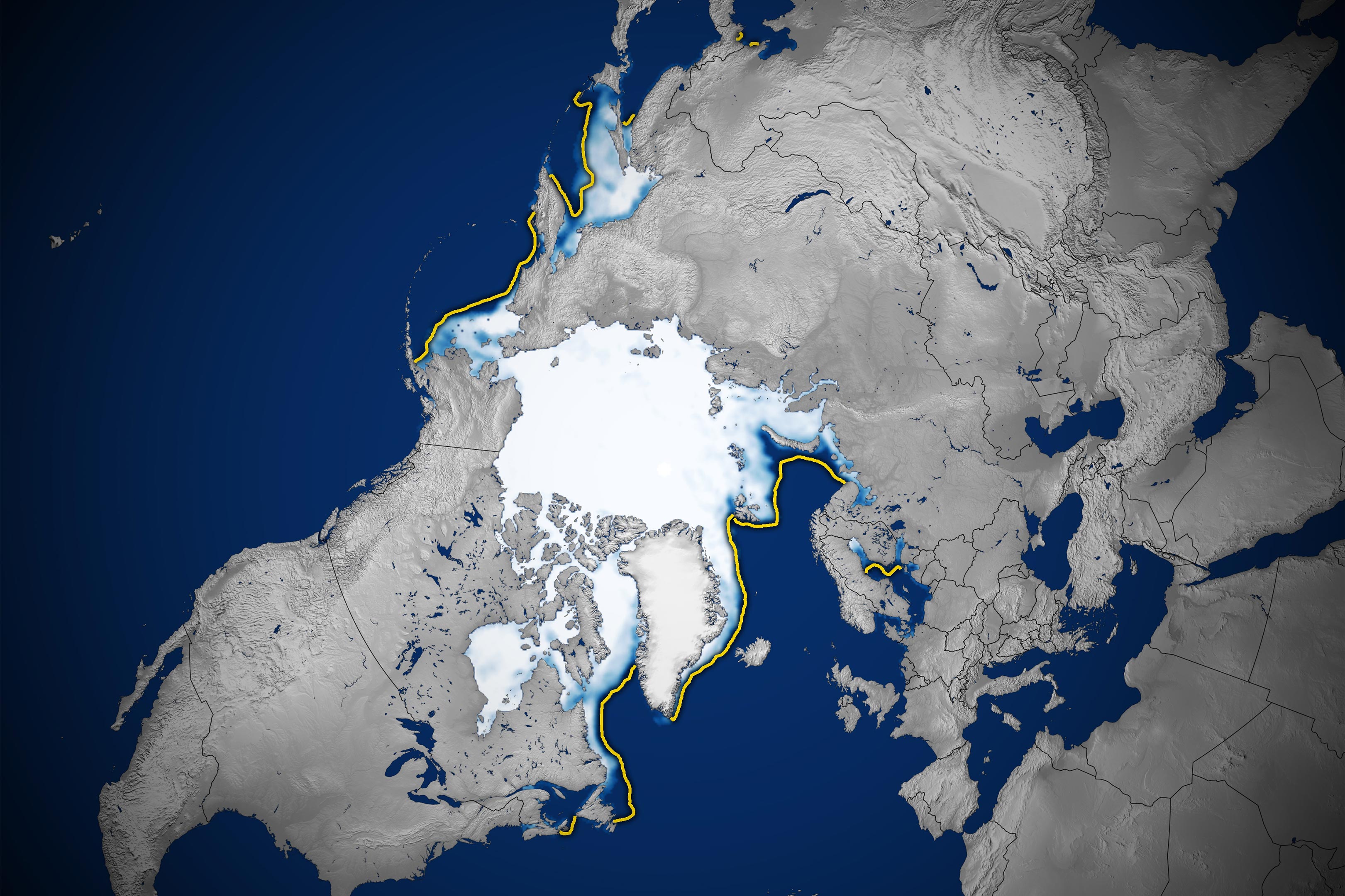
Arctic sea ice coverage in 2024 decreased to 6 million square miles, continuing a 46-year trend of shrinkage and thinning.
Sea ice at the top of the planet continued to shrink and thin in 2024. The maximum winter ice coverage in the Arctic Ocean is consistent with an ongoing 46-year decline.
Analysis of satellite observations has revealed that the total area of the Arctic Ocean covered in sea ice reached 6 million square miles (15.65 million square kilometers) on March 14. That’s 247,000 square miles (640,000 square kilometers) less ice than the average maximum extent between 1981 and 2010. Overall, the maximum winter ice coverage in the Arctic has shrunk by an area equivalent to the size of Alaska since 1979.
The map above shows the ice extent on March 14, the day of the annual maximum. To determine extent, scientists project satellite observations of sea ice onto a grid and then add up the total area of each cell that is at least 15 percent ice-covered. The yellow outline shows the median sea ice extent for February from 1981 to 2010. A median is the middle value; that is, half of the extents were larger than the yellow line and half were smaller.
The analysis is based on data collected with microwave sensors aboard the Nimbus-7 satellite, jointly operated by NASA and the National Oceanic and Atmospheric Administration (NOAA), along with satellites in the Defense Meteorological Satellite Program.
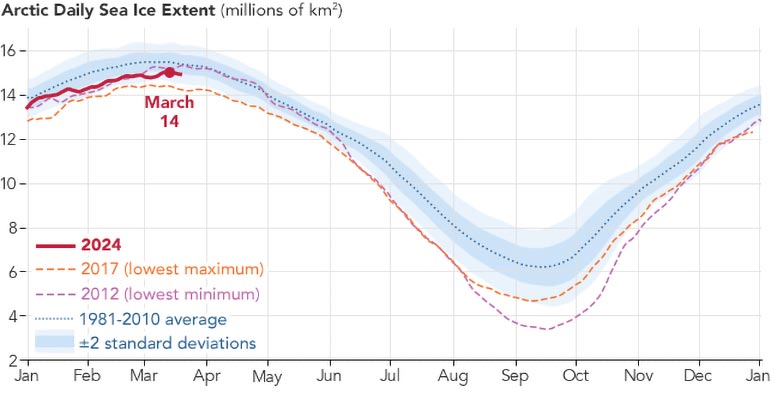
This chart shows the daily sea ice extent through mid-March 2024 (red) compared to the 2017 record low (orange) and the average extent from 1981 to 2010 (blue). This year’s Arctic ice maximum is the 14th lowest on record. Complex weather patterns make it difficult to predict what will happen in any given year.
Scientists with NASA and the National Snow and Ice Data Center (NSIDC) at the University of Colorado, Boulder, track these seasonal and annual fluctuations because sea ice shapes Earth’s polar ecosystems and plays a significant role in global climate.
“The sea ice and the snow on top of it are very reflective,” said ice scientist Linette Boisvert of NASA’s Goddard Space Flight Center. “In the summer, if we have more sea ice, it reflects the Sun’s radiation and helps keep the planet cooler.”
Conversely, shrinking ice makes Earth more susceptible to solar heating. The exposed ocean is darker and readily absorbs solar radiation, capturing and retaining that energy and ultimately contributing to warming in the planet’s oceans and atmosphere.
Sea ice around the poles is more susceptible to the weather than it was a dozen years ago. Ice thickness measurements collected with laser altimeters aboard NASA’s ICESat-2 satellite show that less ice has managed to stick around through the warmer months. This means new ice must form from scratch each year, rather than building on old ice to make thicker layers. Thinner ice, in turn, is more prone to melting than multi-year accumulations.
“The thought is that in a couple of decades, we’re going to have these essentially ice-free summers,” Boisvert said, with ice coverage reduced below 400,000 square miles (1 million square kilometers) and most of the Arctic Ocean exposed to the Sun’s warming glare.
NASA Earth Observatory images by Lauren Dauphin, using data from the National Snow and Ice Data Center. Story by James Riordon/NASA’s Earth Science News Team, adapted for Earth Observatory.
Never miss a breakthrough: Join the SciTechDaily newsletter.
Follow us on Google and Google News.
3 Comments
If the ice retreat has been happening for 46 years (at least as far as we know) then there is pretty much zero chance you can convince me it is all because of man made climate change.
We have not had that significant of an impact on the global climate for that long.
“The exposed ocean is darker and readily absorbs solar radiation, capturing and retaining that energy and ultimately contributing to warming in the planet’s oceans and atmosphere.
It is not that simple! Snow is a diffuse reflector that looks uniformly bright regardless of the viewing position or the angle of the sun, albeit there is typically a strong forward reflectance lobe as modeled by the Bi-directional Reflectance Distribution Function (BRDF). Water is, however, a specular reflector, like a mirror, where the angle of reflection is determined by the angle of incidence of solar radiation. Most importantly, the percentage of reflection is a complex (literally) function of the angle of incidence. Starting at an angle of incidence of about the latitude of the Arctic Circle, the percentage of reflectance increases rapidly to a maximum of 100% at the terminator. The result is that the reflected light is in a narrow sheaf that is not visible unless one is looking towards the sun, and at approximately the same angle as the incoming light rays. That is, the exposed water looks dark to an observer because very little light is entering the water, and what is being reflected is not observable unless the observer is in a special viewing position. However, there are many pictures available on the internet that show that the sun glint from a sun low on the horizon is brighter than the floating ice. In summary, the warming effect of transitioning from an ice-covered Arctic ocean to an open ocean is overstated by those who are unfamiliar with Fresnel’s equation for specular reflection.
https://wattsupwiththat.com/2016/09/12/why-albedo-is-the-wrong-measure-of-reflectivity-for-modeling-climate/
It’s not global warming but the ICE AGE is moving back from the poles and it’s caused by the EARTH constantly TILTING pulling on the SUNs gravitational field causing the SUN to OVERHEAT. The SUN is OVERHEATING DIFFERENT parts of the Earth based on the current tilt. It’s not caused by humans or fossil fuels or carbon. Carbon doesn’t hurt the earth. Heat cannot exist without the cold. The areas with the most carbon gets the heat forcing cold air into the areas with the least amount of carbon. This is a natural cycle of the Earth and it’s happened before as evidenced by finding human settlements in dried up rivers and ancient rivers coming back to life and our ancestors had far more technology than we have today and we can’t recreate the buildings etc that archeologist are finding. They didn’t realize that the ICE AGE is coming back because it’s going to get VERY HOT before the ICE AGE is back. The earth stores carbon using RAIN into the soil.