

Coal ash in the U.S. holds substantial rare earth elements, potentially reducing dependence on imports, with ongoing research and pilot projects working to make extraction economically viable.
Coal ash, the powdery residue left after burning coal for fuel, has accumulated across the United States for decades. New research from the University of Texas at Austin reveals that this vast supply contains enough rare earth elements to significantly strengthen the nation’s reserves without the need for additional mining.
“This really exemplifies the ‘trash to treasure’ mantra,” said co-lead author Bridget Scanlon, a research professor at UT’s Bureau of Economic Geology at the Jackson School of Geosciences. “We’re basically trying to close the cycle and use waste and recover resources in the waste, while at the same time reducing environmental impacts.”
Rare earth elements, a group of 17 critical materials, are essential for modern technology and the transition to lower-carbon energy. They are key components in solar panels, batteries, magnets, and other advanced energy technologies.
Currently, the United States depends almost entirely on imports for its rare earth supply, with about 75% coming from China. This reliance raises concerns due to global supply chain complexities and geopolitical tensions.
A Vast, Untapped Domestic Resource
The new research found that there could be as much as 11 million tons of rare earth elements in accessible coal ash in the United States, which is nearly 8 times the amount that the U.S. currently has in domestic reserves, according to the researchers.
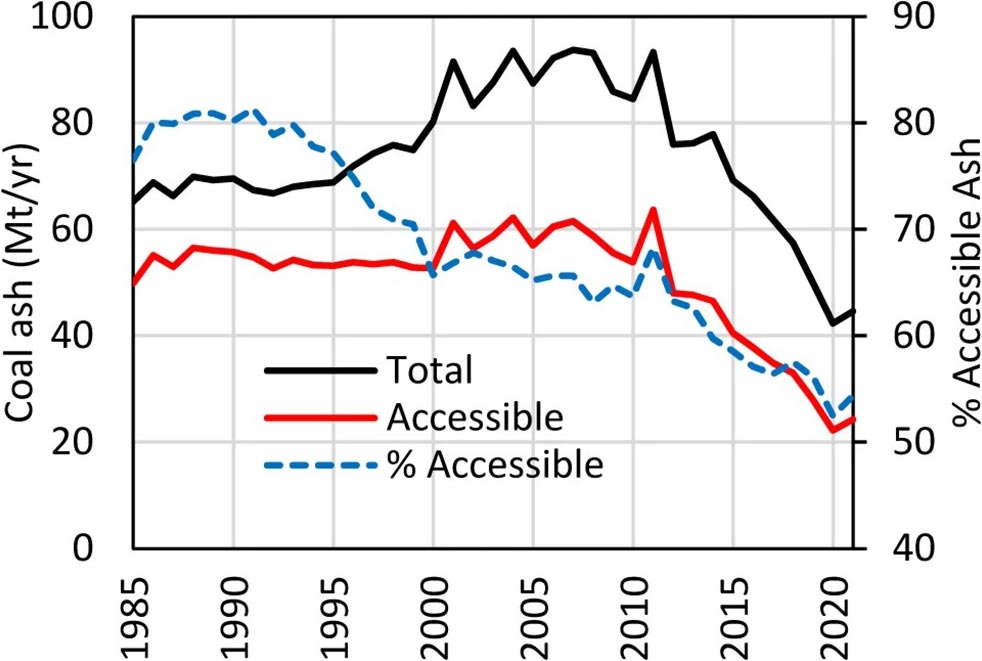
The study is the first study to tally up national coal ash resources. The researchers estimate that $8.4 billion worth of rare earth elements could be extracted from the accessible supply of coal ash.
The results were published in the International Journal of Coal Science & Technology. The U.S. Department of Energy is also applying the study’s methodology to conduct its own national assessment of coal ash resources.
Even though the level of rare earth elements in coal ash is relatively low when compared with those mined from geological deposits, the fact that the ash is readily available in large quantities makes it an attractive resource, said co-author Davin Bagdonas, a research scientist at the University of Wyoming.
“There’s huge volumes of this stuff all over the country,” Bagdonas said. “And the upfront process of extracting the (mineral host) is already taken care of for us.”
The researchers found that about 70% of the coal ash produced from 1985 to 2021 — a total of about 1,873 million tons — is potentially recoverable, with the material stored in landfills, ponds, and offsite storage areas. The rest of the coal ash has been sold and used by other industries, such as cement production and road construction.
Regional Differences in Rare Earth Element Content
Coal ash contains different levels of rare earth elements depending on where it originates. Place of origin also affects how much of the rare earth elements can be extracted.
For example, ashes from Appalachian Basin coal contain the highest amounts of rare earth elements, with an average value of 431 milligrams per kilogram. But only 30% of the rare earth elements it contains can be extracted. In contrast, coal from the Powder River Basin has the lowest average value of rare earth elements at 264 milligrams per kilogram, but it has an extractability of about 70%.

Most of the work around rare earth element extraction is still in the research phase. Bagdonas is involved with a pilot project at the National Energy Technology Lab that’s extracting rare earth elements from the Powder River Basin coal ash.
Scanlon said that the foundational data provided in this study can help with building a broader market for coal ash as a resource.
“This kind of broad reconnaissance-level analysis has never been done,” Scanlon said. “It provides a foundation for others to go into more detail.”
Chris Young, the chief strategy officer at Element USA, a company that extracts critical minerals from mineral and metallic waste, said that the study underscores the great potential of coal ash as a resource. He said the challenge now for industry is developing the workforce and operations needed to extract rare earth elements and other materials from coal ash and other mining byproducts.
“The idea of getting rare earth elements out of tailings (mining by-products) just makes a lot of sense. It’s a common-sense approach,” he said. “The challenge is to convert that common-sense approach to an economic approach.”
To that end, Element USA is in the process of moving its analytical lab and pilot equipment to Austin to leverage the mineral expertise at The University of Texas at Austin and offer critical mineral experience to students interested in critical mineral research and careers.
“We’re excited about building that relationship with The University of Texas around mineral processing and mineral separation,” Young said.
Reference: “Coal ash resources and potential for rare earth element production in the United States” by Robert C. Reedy, Bridget R. Scanlon, Davin A. Bagdonas, James C. Hower, Dennis James, J. Richard Kyle and Kristine Uhlman, 17 September 2024, International Journal of Coal Science & Technology.
DOI: 10.1007/s40789-024-00710-z
The research was funded by the U.S. Department of Energy Office of Fossil Energy and Carbon Management, and the Jackson School of Geosciences.
Never miss a breakthrough: Join the SciTechDaily newsletter.
Follow us on Google and Google News.
38 Comments
Hi Group 17, the halogens are NOT rare Earth metals. Please refer to any Periodic table of the elements.
Please go back and re-read the sentence. It wasn’t “Group 17”, it was “a group of 17”.
Coal ash is nasty stuff. Lots of arsenic, other heavy metals and other toxins including radioactive waste. Congress blocked any measurement of radioactivity, because if you don’t measure it, it is not there, right?
Are there rare earths? Sure. With the truly astronomical amounts of the waste, equivalent in mass to 1,000 Nimitz Class aircraft carriers every year for decades and decades, there would have to be. Is it concentrated enough to make this a better choice than regular mines? Doubtful.
Industry produced nonsense to make coal ash appear to be an asset, most likely.
I predict in 50 years that we will have to waste trillions of dollars to dig up this crud and vitrify it somehow making it solid blocks unable to be penetrated by water, to protect people and the environment from the toxins oozing out of this crud. We will have to spend more to clean it up than was ever received for its utility.
We need to stop burning coal, immediately.
Nice summation. You are probably very close to the truth.
LIf there is more pollutants to accelerate our global warming then we don’t need it. Already we are seeing at a rapid speed the amount of of storms we have every year. Floods, tornados, global warming increasing at alarming occurrences than we could have imagined. Please do everything we can to save our planet and not be part of the problem.
I doubt that your claim about an increase in the number of annual storms can be supported. In contrast to a few decades ago, we now have operational satellites imaging the surface, Doppler Radar tracking winds and precipitation, and far more people observing what is happening on the ground. With more people, monetary inflation, and instantaneous communication, the impact of storms may seem to be increasing. But that doesn’t mean that violent weather is increasing.
Yet we support chinese goods and they add more and more coal plants each year
I’m sure you’re not an expert on the subject, but you have an opinion. Congratulations!
I doubt the photo is of coal ash. I believe you have to have a protective layer of plastic or something. You can’t just bury that toxic crud directly in the ground. That is probably ash from a silly Biomass project.
“To that end, Element USA is in the process of moving its analytical lab and pilot equipment to Austin to leverage the mineral expertise at The University of Texas at Austin and offer critical mineral experience to students interested in critical mineral research and careers.”
Just wait until Trump and Musk defund the UoT and send half the personnel out of the country under drug and terrorist suspicions. The days when private companies could leach off the academic sector for their ideas and brains are going to come to a close.
Really? So its in academia that the knowledge is stored for safekeeping…I mean for sale to the highest bidder? If that’s the case, then there’s nothing to be concerned about since they already have the knowledge, why on Earth would they need Federal funding? Just in case the University needs some legal tender for their debt, public or private? What out Austin!! Oh and just wait til The executive branch of the federal government comes to the capital of the Great State of Texas and defends the University of Texas in Austin. No you won’t notice anything actually happened, and for God’s sake somebody flag this prick to I.C.E. and tell them he’s gonna give ice to all your children but they want ice cream …Ahhhhh Orange man bad, Musk trumps Trump …. ehhh nevermind as it appears they are playing hearts and No One cares this leftist forgot about the wad of panties in a bunch right next to that stick needs removing.
Wanna know a secret?
It’s goin’a be all right 👍🏻
Well said, Cossey. Thanks for bringing it back down to planet Earth :thumbsup:
Musk is not defunding anything, he’s not deporting, firing, nothing like that. He’s not in a position to do so and never was. All he is doing is going through government expenditures in various government organizations and doing what is called a “Zero Based Budget” –
“A zero-based budget is a budgeting method where every dollar of income is allocated to specific expenses, savings, or debt payments, ensuring that income minus expenditures equals zero at the end of the budget period. This approach requires justifying all expenses from scratch each time, rather than using the previous budget as a baseline.”
Based on that Mr Musk’s team uncover bad loans, connections, transfers or outright fraud. This OUR TAXES they’re looking thru – taxes we are forced to pay every damned year with very little accountability… DOGE is providing that accountability.
You have drank way to much of the orange goo boyo.
I don’t trust Trump or Elon Musk. I believe Elon will use whatever money he can get his hands on to fund his projects. He nor Trump give a damn about our climate or the citizens of the US. They will invade every aspect of American business if they think it will benefit them.
You can read minds? What other super powers do you have?
This is my concern as well, great point
Great job explaining whats going on in washington to the brain dead Trump and Musk hating people.
Not sure what’s worse; the infestation by the ‘work from home’ harpies, or the droning of the ‘ blah-blah-blah Musk’ harpies.
Seniors who are dependant on Social Security, which Musk has described as a Ponzi scheme, might not feel so reassured.
I’m retired and I consider Social Security to be a Ponzi scheme as well. I had no choice in participating (nor did my employers) and there are many other investments that would have returned MUCH more than Social Security, even without the forced contributions from my employers. Social Security only pays me about 10% of what a couple of small pensions pay me for each year of employment. It is a poor use of my contributions.
Lmao! He got rich on government grants. Now he calls it wasteful spending. What a hypocrite! Just that one piece of info is enough for me to say DONT TRUST HIM! Except the koolaide drinkers do.
You have a vivid imagination. The University of Texas doesn’t operate under control of the Executive Branch of the federal government. It sounds like you are just using this as an opportunity to vent your irrational hatred of the political party you are not registered with.
Let me guess, it’ll be 50 years before we can economically extract the elements.
Years ago the gypsum industry started using “scrubbed” coal ash to replace gypsum in dry wall. National gypsum was one of the companies.
Really, there’s coal ash (scrubbed?) in drywall gypsum? I’m now a little bit concerned about my walls. 😳
There were some issues with Chinese-made wall board that was acidic. It was probably synthetic, and as is typical with the Chinese, they apparently didn’t have QC procedures in place to verify that all the sulfuric acid was neutralized before using it. Almost any industrial product can have problems in the absence of quality control procedures and verification. Buy American!
No, thanks. I don’t want a toxic house or school or hospital. Sure, I don’t often munch drywall typically, but heavy metals do have a way of getting in the air, if you put them in the building.
I live in an old house with thick plaster rather than drywall. It is just so superior.
I do want to build a house in the future. My plan is to use concrete board and spread a thin coat of plaster on that to reproduce that old plaster strength and quality.
You are too quick to accept an unsupported claim without looking into it. Try querying one of the AI large language models about how the wall board is made before you sign on to the claim.
Concrete has coal ash in it. Read the story as they mentioned it as one of the unrecoverable reasons.
You are misrepresenting what is happening. It is not the residual clinker and ash, commonly called ‘coal ash,’ that is being used. Instead, the process of extracting the sulfur dioxide (emitted by the pyrite and marcasite in the coal) from the flue gases (to reduce acid rain) results in the creation of calcium sulfate (synthetic gypsum) which is used. It is of higher purity than natural gypsum and solves an otherwise significant pollution problem.
Dam right
If technologically and economically feasible, what’s not to like? While there’s likely some environmental concerns, I can’t imagine they’re even close to those if REMs were to be extracted in situ on raw land.
I do hope that they find an economic use for the coal ash. I’m an advocate of solving pollution problems by “using everything but the squeal from the pig.” ‘Mindbreaker’ is right that there is more in the coal ash than just RE elements. The successful economic development of the RE elements resource may depend on extracting everything with commercial value, not just the RE’s.