
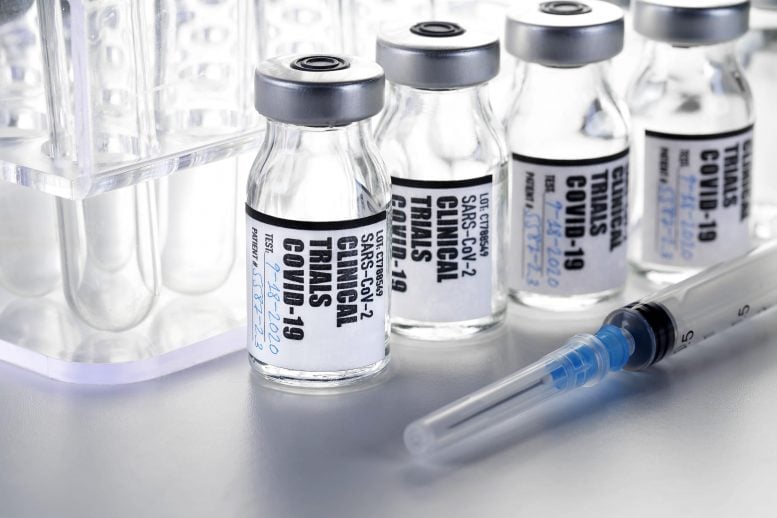
Results from the primary analysis of the ongoing phase 3 clinical trial demonstrate efficacy in preventing symptomatic COVID-19 infections and severe illness.
A peer-reviewed paper published in The New England Journal of Medicine provides data from the much-anticipated COVE study, which evaluated mRNA-1273, a vaccine candidate against COVID-19 manufactured by Moderna, Inc. Results from the primary analysis of the study, which will continue for two years, provide evidence that the vaccine can prevent symptomatic infection. Among the more than 30,000 participants randomized to receive the vaccine or a placebo, 11 of those in the vaccine group developed symptomatic COVID-19 compared to 185 participants who received the placebo, demonstrating 94.1 percent efficacy in preventing symptomatic COVID-19. Cases of severe COVID-19 occurred only in participants who received the placebo.
Brigham and Women’s Hospital served as a site for the trial as part of the COVID-19 Prevention Network (CoVPN), funded by the National Institutes of Health. In addition, Lindsey Baden, MD, an infectious diseases specialist at the Brigham and an expert in vaccine development for viral diseases, served as co-principal investigator for the study and lead author of the paper.
“Our work continues. Over the next months, we’ll have increasing amounts of data to better define how this vaccine works, but the results so far show a 94.1 percent efficacy. These numbers are compelling,” said Baden. “And, importantly, the data suggest protection from severe illness, indicating that the vaccine could have an impact on preventing hospitalizations and deaths, at least in the first several months post-vaccination.”
The study enrolled 30,420 adult participants at 99 U.S. sites, including over 600 participants enrolled at the Brigham. Eligible participants were 18 years old or older with no known history of SARS-CoV-2 infection, and whose locations or circumstances put them at appreciable risk of SARS-CoV-2 infection and/or high risk of severe COVID-19. The race and ethnicity proportions of the trial were generally representative of U.S. demographics (79 percent white; 10 percent Black or African American; 20 percent Hispanic or Latino participants).
Participants received their first injection between July 27 and October 23, 2020, followed by a second injection 28 days later. Each injection, given intramuscularly, had a volume of 0.5 mL, containing 100 μg of mRNA-1273 or saline placebo.
In the placebo group, 185 participants developed symptomatic COVID-19 illness; in the vaccine group, 11 participants did. In secondary analyses, the vaccine’s efficacy was similar across groups of key interest, including those who already had antibodies against SARS-CoV-2 at the time of enrollment (indicating previous infection with COVID-19) and among those who were 65 years of age or older. Thirty participants had severe COVID-19 — all in the placebo group.
Starting from randomization, cases of COVID-19 and severe COVID-19 were continuously monitored throughout the trial by the Data Safety Monitoring Board, empaneled by the NIAID. Participants were closely monitored for adverse events in the weeks following their injection. Investigators have collected and will continue to collect data on any serious adverse events or adverse events that require medical attention through two years post-injection.
Overall, reactions to the vaccine were mild — about half of recipients experienced fatigue, muscle aches, joint pain, and headaches, more so after the second dose. In most cases, these effects started about 15 hours after the vaccine and resolved after two days without sequelae. A similar number of adverse events were reported in the placebo and vaccine groups.
“While these results are encouraging, they are limited by the short duration of follow-up so far. Longer term data from the ongoing study may allow us to more carefully evaluate the vaccine’s efficacy among different groups, determine the impact on asymptomatic infection, understand when immunity wanes, and determine whether vaccines affect infectiousness,” said Baden. “But we shouldn’t lose sight of the progress that we have made, which shows what is possible when we come together to tackle an immensely challenging problem.”
Reference: “Efficacy and Safety of the mRNA-1273 SARS-CoV-2 Vaccine” by Lindsey R. Baden, M.D., Hana M. El Sahly, M.D., Brandon Essink, M.D., Karen Kotloff, M.D., Sharon Frey, M.D., Rick Novak, M.D., David Diemert, M.D., Stephen A. Spector, M.D., Nadine Rouphael, M.D., C. Buddy Creech, M.D., John McGettigan, M.D., Shishir Kehtan, M.D., Nathan Segall, M.D., Joel Solis, M.D., Adam Brosz, M.D., Carlos Fierro, M.D., Howard Schwartz, M.D., Kathleen Neuzil, M.D., Larry Corey, M.D., Peter Gilbert, Ph.D., Holly Janes, Ph.D., Dean Follmann, Ph.D., Mary Marovich, M.D., John Mascola, M.D., Laura Polakowski, M.D., Julie Ledgerwood, D.O., Barney S. Graham, M.D., Hamilton Bennett, M.S., Rolando Pajon, Ph.D., Conor Knightly, M.P.H., Brett Leav, M.D., Weiping Deng, Ph.D., Honghong Zhou, Ph.D., Shu Han, Ph.D., Melanie Ivarsson, Ph.D., Jacqueline Miller, M.D. and Tal Zaks, M.D. for the COVE Study Group, 30 December 2020, New England Journal of Medicine.
DOI: 10.1056/NEJMoa2035389
This project has been funded in whole or in part with Federal funds from the Office of the Assistant Secretary for Preparedness and Response, Biomedical Advanced Research and Development Authority, under Contract No. 75A50120C00034. NIAID sources of grant funding included HVTN Leadership and Operations Center UM1 AI 68614HVTN Statistics and Data Management Center UM1 AI 68635, HVTN Laboratory Center UM1 AI 68618, HPTN Leadership and Operations Center UM1 AI 68619, ACTG Leadership and Operations Center UM1 AI 68636, and IDCRC leadership group 5 UM1 AI148684-03. Dr. Baden reports grants from NIH/NIAID during the conduct of the study. Dr. Baden is a Deputy Editor at the New England Journal of Medicine.
Never miss a breakthrough: Join the SciTechDaily newsletter.
Follow us on Google and Google News.
1 Comment
Moderna continuously examines vaccinated cohorts, e.g., premised on age groups, reviewing results. Pfizer also researches its results.