
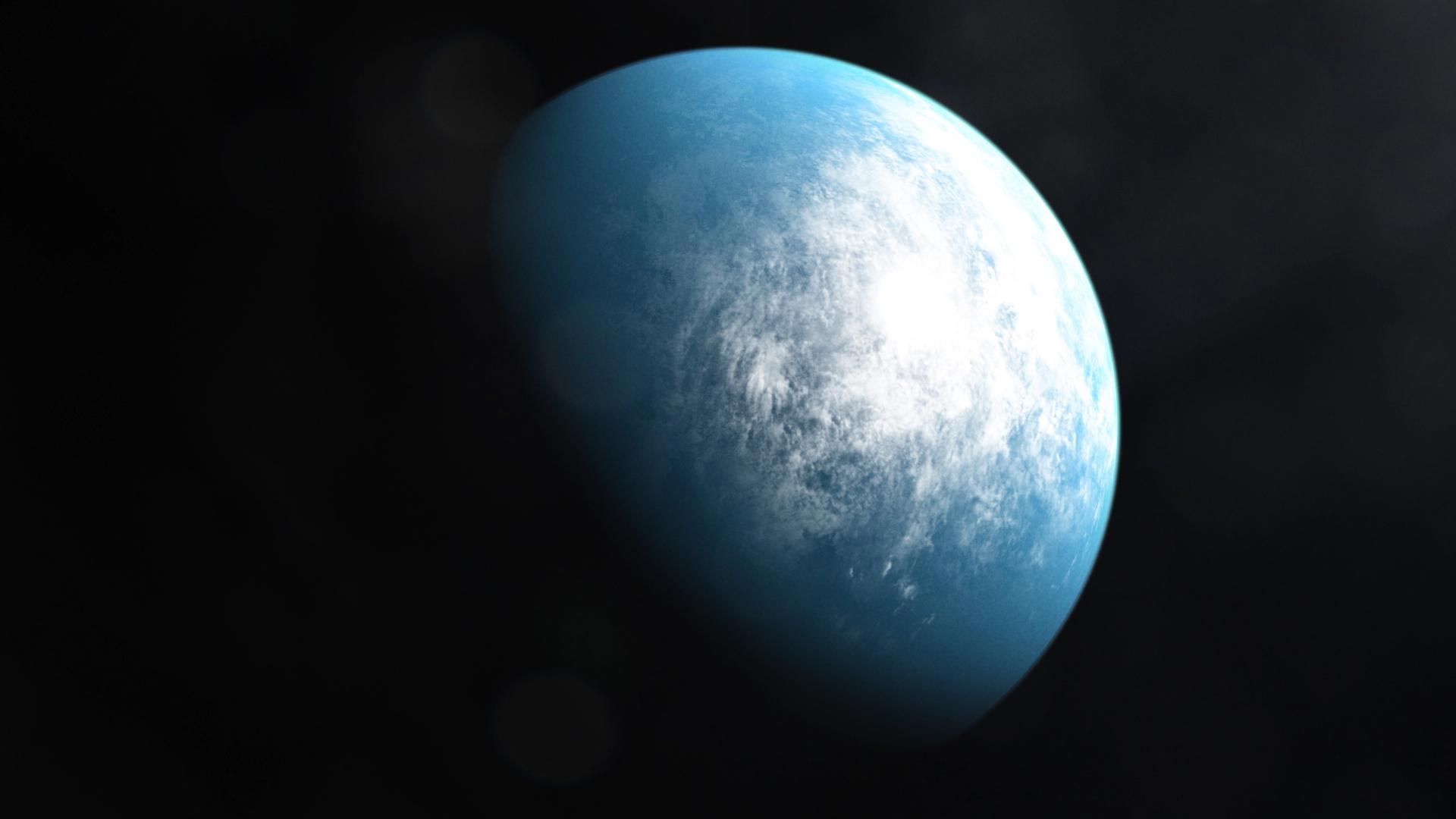
TESS, the Transiting Exoplanet Survey Satellite, was launched in 2018 with the goal of discovering small planets around the Sun’s nearest neighbors, stars bright enough to allow for follow-up characterizations of their planets’ masses and atmospheres. TESS has so far discovered seventeen small planets around eleven nearby stars that are M dwarfs — stars that are smaller than the Sun (less than about 60% of the Sun’s mass) and cooler (surface temperatures less than about 3900 kelvin). In a series of three papers that appeared together this month, astronomers report that one of these exoplanets, TOI-700d, is Earth-sized and also located in its star’s habitable zone; they also discuss its possible climate.
CfA astronomers Joseph Rodriguez, Laura Kreidberg, Karen Collins, Samuel Quinn, Dave Latham, Ryan Cloutier, Jennifer Winters, Jason Eastman, and David Charbonneau were on the teams that studied TOI-700d, one of three small planets orbiting one M dwarf star (its mass is 0.415 solar masses) located one hundred and two light-years from Earth. The TESS data analysis found the tentative sizes of the planets as being approximately Earth-sized, 1.04, 2.65 and 1.14 Earth-radii, respectively, and their orbital periods as 9.98, 16.05, and 37.42 days, respectively.
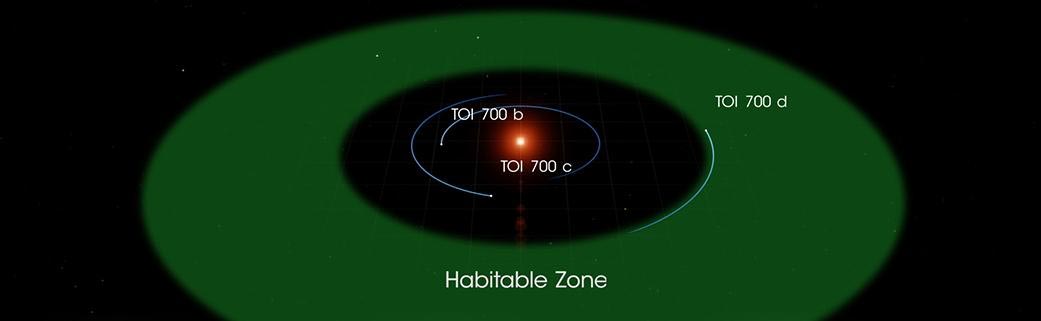
In our solar system, Mercury orbits the Sun in about 88 days; it is so close to the Sun that its temperature can reach over 400 Celsius. But because this M-dwarf star is comparatively cool the orbit of its third planet, even though much closer to the star than Mercury is to the Sun, places it in the habitable zone – the region within which the temperatures allow surface water (if any) to remain liquid when there is also an atmosphere. That makes this Earth-sized planet TOI-700d particularly interesting as a potential host for life.
The TESS detections were exciting but uncertain: the signals were faint and a small possibility remained that the TOI-700d detection was spurious. Because of the potential importance of finding a nearby Earth-sized planet in a habitable zone, the TESS scientists turned to the IRAC camera on the Spitzer Space Observatory for confirmation. Before being turned off by NASA in February 2020, the IRAC camera was by far the most sensitive near infrared camera in space.

A schematic of the planets around the nearby M dwarf star TOI-700, discovered by TESS. The third (the farthest planet from the star), TOI-700d, lies within the star’s habitable zone (shown in green). Using the IRAC camera on Spitzer, the team refined the planet’s mass as 2.1 Earth-masses and 1.14 Earth-radii. (The scale shows 0.2 astronomical units; AU being the average Earth-Sun distance.) Credit: Rodriguez et al 2020
The TESS team observed TOI-700 with IRAC in October of 2019 and January of 2020, acquiring clear detections of the planets with about twice the signal-to-noise of TESS, enough to give a 61% improvement in the planet’s orbit and to significantly refine our knowledge of its other characteristics, refining the radius as above and finding the mass to be 2.1 Earth-masses. The results, especially when compared with other planets’ properties, suggest that this planet may be rocky and likely to be “tidally locked” with one side of the planet always facing the star.
If there were liquid water on the surface of TOI-700d, the astronomers argue, there would also be water-bearing clouds in the atmosphere, and the team uses climate system models to estimate its possible properties and what more sensitive measurements might find. They conclude, however, that pending space missions, including JWST, will probably lack the sensitivity to detect atmospheric features by a factor of ten or more. Their detailed climate studies will nevertheless help astronomers constrain the kinds of telescopes and instruments that will be needed to investigate this exciting new neighbor.
NASA’s Transiting Exoplanet Survey Satellite (TESS) has discovered its first Earth-size planet in its star’s habitable zone, the range of distances where conditions may be just right to allow the presence of liquid water on the surface. Scientists confirmed the find, called TOI 700 d, using NASA’s Spitzer Space Telescope and have modeled the planet’s potential environments to help inform future observations. Credit: NASA’s Goddard Space Flight Center
References:
“The First Habitable-zone Earth-sized Planet from TESS. I. Validation of the TOI-700 System” by Emily A. Gilbert, Thomas Barclay, Joshua E. Schlieder, Elisa V. Quintana, Benjamin J. Hord, Veselin B. Kostov, Eric D. Lopez, Jason F. Rowe, Kelsey Hoffman, Lucianne M. Walkowicz, Michele L. Silverstein, Joseph E. Rodriguez, Andrew Vanderburg, Gabrielle Suissa, Vladimir S. Airapetian, Matthew S. Clement, Sean N. Raymond, Andrew W. Mann, Ethan Kruse … Benjamin J. Shappee, Mackennae Le Wood and Jennifer G. Winters, 14 August 2020, The Astronomical Journal.
DOI: 10.3847/1538-3881/aba4b2
“The First Habitable-zone Earth-sized Planet from TESS. II. Spitzer Confirms TOI-700 d” by Joseph E. Rodriguez, Andrew Vanderburg, Sebastian Zieba, Laura Kreidberg, Caroline V. Morley, Jason D. Eastman, Stephen R. Kane, Alton Spencer, Samuel N. Quinn, Ryan Cloutier, Chelsea X. Huang, Karen A. Collins, Andrew W. Mann, Emily Gilbert, Joshua E. Schlieder, Elisa V. Quintana, Thomas Barclay, Gabrielle Suissa, Ravi kumar Kopparapu … Philip S. Muirhead, Elisabeth Newton, Mark E. Rose, Joseph D. Twicken and Jesus Noel Villaseñor, 14 August 2020, The Astronomical Journal.
DOI: 10.3847/1538-3881/aba4b3
“The First Habitable-zone Earth-sized Planet from TESS. III. Climate States and Characterization Prospects for TOI-700 d” by Gabrielle Suissa, Eric T. Wolf, Ravi kumar Kopparapu, Geronimo L. Villanueva, Thomas Fauchez, Avi M. Mandell, Giada Arney, Emily A. Gilbert, Joshua E. Schlieder, Thomas Barclay, Elisa V. Quintana, Eric Lopez, Joseph E. Rodriguez and Andrew Vanderburg, 14 August 2020, The Astronomical Journal.
DOI: 10.3847/1538-3881/aba4b4
Never miss a breakthrough: Join the SciTechDaily newsletter.
Follow us on Google and Google News.
54 Comments
I like
Book now for the Grand Opening of TRUMP TOI-700d Hotel and Casino.. should be open soon .. probably before the upcoming election
Does everything have to be political?
Apparently we can’t enjoy anything without first seeing it through a political lense lol!
Arguably the greatest human find of all time and you s**t it up with political garbage. Well done.
10\4
“They conclude, however, that pending space missions, including JWST, will probably lack the sensitivity to detect atmospheric features by a factor of ten or more.”
Meanwhile a nearby planet candidate has sailed up as “a prime direct imaging target for atmospheric characterization.” Modeling of Proxima c ” indicate stellar wind dynamic pressures comparable to present-day Earth, with a slight increase (by a factor of 2) during high activity periods of the star.” [ http://astrobiology.com/2020/09/an-earth-like-stellar-wind-environment-for-proxima-centauri-c.html ]
Meaning the likely superEarth planet (> 7 Earth masses) has retained an atmosphere even if it lies around a similar, often unruly M star. The drawbacks are that at 1.44 AU it lies way outside the habitable zone. and I dunno what it means in terms of spectra [I didn’t read the paper]. Hopefully they can start working with JWST, or at least complement later observations of TOI-700d.
“They conclude, however, that pending space missions, including JWST, will probably lack the sensitivity to detect atmospheric features by a factor of ten or more.”
Meanwhile a nearby planet candidate has sailed up as “a prime direct imaging target for atmospheric characterization.” Modeling of Proxima c ” indicate stellar wind dynamic pressures comparable to present-day Earth, with a slight increase (by a factor of 2) during high activity periods of the star.” [“An Earth-like Stellar Wind Environment For Proxima Centauri c”, astrobiologyDOTcom.]
Meaning the likely superEarth planet (> 7 Earth masses) has retained an atmosphere even if it lies around a similar, often unruly M star. The drawbacks are that at 1.44 AU it lies way outside the habitable zone. and I dunno what it means in terms of spectra [I didn’t read the paper]. Hopefully they can start working with JWST, or at least complement later observations of TOI-700d.
NASA can discover as much as it can discover in the habitable zones of other star system .
How to reach them will definitely be impossible in to the present space science technology of NASA
100 light years away was an impossible dream without the aid of the creator we the believers called Him GOD the Father .
Amen, worded very well, with wisdom. Thank you for your input
We do have spaceships there crewed by clones and they dont let us see the real technology this world really has, we won’t see anti gravity for public use for another 90 years. Perpetual motion over Unity engines are real
http://www.hhoigo.com
Superstition. The flat space universe we see means it is entirely natural, so it is also erroneous.
And what relevance for astrobiology would an impossible or expensive travel have, when we can simply observe these planets?
No word if it is in a stellar system which is in a GALACTIC goldilocks zone on the surface of a galactic arm.
It’s 100 ly away, so in our close galactic neighborhood. If we’re in the galactic goldilocks zone, then so are they.
Even if those planets are paradises, so what; they’re 100+ light years away. But you know they’re just more wastes of real estate. Our part of this galaxy is nothing but garbage. What that guy said about only God and I guess Christians who made it to the Kingdom have access to all of this. Man’s or other civilizations relying on buggy, flawed natural technology will never touch anything beyond their own solar systems.
Check out my coomentGwugluud. Write me even. Epstein
Superstition. The flat space universe we see means it is entirely natural, so it is also erroneous.
And what relevance for astrobiology would an impossible or expensive travel have, when we can simply observe these planets?
What we should do is what they did last time to Earth; give Newark (my name for our new home) a good kick to set it spinning, because of course it must spin. That’s how we got this one going around, before we came with our handy 3-D printers and churned out a bunch of beasties. Plenty of clay around, best media for animals.Plant seeds were much easier to transport as is. The whole setup took about six days….remember?
Six days does not have to mean 6×24 hour days. It was the time to complete one phase of creation it could have been millions of our years. Besides according to our tradition this was not the first attempt. We live on a planet which had many series of previous creations. All in the Jewish tradition and knowledge. Epstein. See my comment.
Superstition. The flat space universe we see means it is entirely natural, so it is also erroneous.
And what relevance for astrobiology would an impossible or expensive travel have, when we can simply observe these planets?
Superstition. The flat space universe we see means it is entirely natural, so it is also erroneous.
I just don’t know what the big picture is with finding a planet like earth. Do they know something we don’t about space travel? If it turns out to be perfect…so what. We can never go there even if it’s still there at all. Unless this is just a byproduct of some other worthwhile project I dont see the point In spending time looking.
What relevance for astrobiology would an impossible or expensive travel have, when we can simply observe these planets?
yeah we need spin not a locked planet. however the BIG problem is getting there. gotta come up with plan A on that one. And the number of coincidences that had to occur here just to get even primitive life going is almost beyond belief. we not only need spin we need tilt. but not too much. another huge issue is infrastructure… there isn’t any. send robotics instead not organics. or maybe a millennium from now we’ll figure it all out but the problem there is we still won’t have the brainy power to get it done.
IS THEIR NO LIFE ON THOSE so-called NEW PLANETS?
When you know you can’t get to another planet why bother looking, its
A waste of time and money. Start looking after our own planet first. If not how do you expect to get to another planet when this one Earth will be uninhabitable soon with global warming
What relevance for astrobiology would an impossible or expensive travel have, when we can simply observe these planets?
When you know you can’t get to another planet why bother looking, its a waste of time and money. Start looking after our own planet first. If not how do you expect to get to another planet when this one Earth will be uninhabitable soon with global warming
It’s called the pursuit of scientific knowledge my friend. You can’t begin to fix a problem until you understand it. We find a world that supports life, then fix the problem of how to get there. Same as global warming. Not being able to get there, or specifically fix global warming doesn’t mean we just ignore it does it?
Why keep showing us these planets we can’t get too.
Getting our Hope’s up for nothing.
It’s not about getting to a new planet, it’s about understanding life untouched by human fingers. If we can watch TOI-700d and in doing so learn how life develops there, we can figure out how it developed here. If, by an ENORMOUS stroke of luck we can see an intelligent life develop, that would be an amazing scientific breakthrough. All is this is true even if we can’t go there and touch foreign soil ourselves.
What are they smoking these scientists evolutionists turn everything into facts and don’t ever have any evidence just I think or it looks like etc. If you don’t have the 5 must have elements of life then there is no life period nothing can survive just ask the astronomers and they’ll tell you there’s no life out there and they’ll tell you they believe in God too after their experience.
Superstition. The flat space universe we see means it is entirely natural, so it is also erroneous.
Biology is based on the evolutionary process, which is the best tested science we have. Go to NCBI, an open genome site, view the tutorials and test evolution yourself from home – there is your (and everybody else’s) evidence. A universal common ancestor has an enormous 10^2000 likelihood against all other hypotheses based on the shared genetic machinery.
Go away and take your useless god nonsense with you. All of you believers just get in the way of real science.
Listen Gixxer11 if you knew that there are more than 18000 worlds out there with life and there is a way to travel instantly to other worlds all within the scientific realm and all within the bounderies of belief in God and religion wouldn’t you bite your tounge for saying what you said. See Epstein’s comment.
Superstition. The flat space universe we see means it is entirely natural, so it is also erroneous.
And what relevance for astrobiology would an impossible or expensive travel have, when we can simply observe these planets?
Many of the world’s best living and past scientists believe in a creator. The more I learn the more my belief in God and Christ is strengthened because the system appears intelligently designed.
Yes religion and science coincide. There is is harmony and beauty by combining them. The creator loves your questions and interest in His world. See comment of Epstein.
Superstition. The flat space universe we see means it is entirely natural, so it is also erroneous.
And, while that was not apriori given – that science killed ‘gods’ – even before that it is easily seen that science and superstition is in conflict. Statistics tell us that the more functional (secure) a society is, the less religiosity its population have. The more people get education and work with science, the less religiosity you see as well – the elite scientists across the world are almost all without traces of superstition.
Cool.
A seemingly habitable planet too far away for any of us to ever actually experience. But let’s keep looking for external fixes to our problems, instead of doing the repair/fixing of our own planet and it’s problems that we are not wanting to be responsible for creating in the first place. Yayyyy
For sure space travel over giant distances is real. Already predicted in the bible called “קפיצת הדרך” eng. “Space skipping” where space is folded up and with one leap persay your there. Its was used in the past and throughout history by great Rabbis up to today in times of need. Which means the possibility to activate this in the scientific realm is real. Other future possibilities hinted to in the bible (solely through Jewish sources) are time travel to the future – altering past events- anti gravity devices – life on other planets -airplane flight(we have today) – the exact lunar cycle ( confirmed by todays space technololgy) -robots -etc. Don’t worry theres a lot of exciting inventions ahead of us.
Superstition. The flat space universe we see means it is entirely natural, so it is also erroneous.
Humanity does not deserve a virgin world like this even if we could get there. We are destroying our own natural home for greed. Maybe the reason why we can see these new worlds with powerful telescopes is to show us the world that we have destroyed we will not have a chance to destroy another one. And yes there is a God dips**t.
Rude, and superstition. The flat space universe we see means it is entirely natural, so it is also erroneous.
And what relevance for astrobiology would an impossible or expensive travel have, when we can simply observe these planets?
just because it was called space skipping doesn’t mean it has anything to do with anything extra-solar system?
I am a Christian, although I am only saying that because I want to make the point that the majority of us don’t believe the things being stated by other Christians in this forum. In proper, scholarly theology, we usually concur with science before we do the bible, as Theologians by and large interpret the bible infallibly rather than inerrantly. Not gonna get into a theology lecture on a science forum, just gonna point out that the big focus of the bible is NOT scientific or historical accuracy, but it is a series of philosophical revelations given to us by our God, and a detailed understanding of the nature of our God. Whether you believe that or not, isn’t the point of this comment. Anyway, all of that was to say, a lot of you all have given me a lot of inspiration for a high fantasy space fiction XD. Ships piloted by clones and perpetual motion machines, Christians having access to the whole Galaxy somehow, Jews knowing about advanced tech, etc. It would all make quite an interesting fantasy series.
Listen megustachu. Google the research done about by placing the Torah on computer to reveal the hidden codes of everything you can think of all revealed in laymans language or mathematical. No book can this be done with. Even your name and birth is written there. Its all true and not a fantasy! We have to work on the discoveries. When the prophets stated I will bring my people back to Israel on eagles wings – if he said an airplane do you think anyone would know what he’s talking about. He spoke the language of the times. The bible tells us the posibilites exist we have to work on them to bring them to actuality.
Superstition. The flat space universe we see means it is entirely natural, so it is also erroneous.
And, while that was not apriori given – that science killed ‘gods’ – even before that it is easily seen that science and superstition is in conflict. Statistics tell us that the more functional (secure) a society is, the less religiosity its population have. The more people get education and work with science, the less religiosity you see as well – the elite scientists across the world are almost all without traces of superstition.
This is cool but, we really shouldn’t care. The amount of money and resources used to even find these places is a massive waste. It’s cool to see, but we can’t even find a way to travel passed our own moon in a timely fashion let alone travel our own solar system. The focus needs to be on actual and efficient space travel and sustainability.
Doesn’t make sense to find another habitable planet when we can’t even get there.
I believe in the Christ our brother, Lord Jesus. By Jesus saying that “I am not from this world” is enough for me to believe in other natural worlds like ours. We need to think of him and the Almighty God as real people real beings, not spirits or Ghosts but extraterrestrials or whatever,that were here before and are coming back. Think about it. There technology could be 1000 maybe 10000 or 1000000+ years ahead of ours. Our planet suffers all because humans follows the wolf who wears a sheeps coat.
Superstition. The flat space universe we see means it is entirely natural, so it is also erroneous.
And what relevance for astrobiology would an impossible or expensive travel have, when we can simply observe these planets?
unsere erde ist nicht allein für uns menschen da ,macht -giehr, immer der erste, beste volkommen zu sein.wir sind primitieve geschöpfe……………………..
Mankind has made ways of traveling such distance, it’s a form of Rail cannon with a capsule about 8′ in size with room for 1 person inside the pressure sealed tec. In test the capsule traveled 567.8 miles in just 0.35 secs. Now making safer for humans is a fairly easy task however in order for it to leave our solar system we would have to build and operate and man this pod launcher in space.
Anything is possible with God, even the beautiful plants that are present on parts of the Moon, Mars and Titan. Undoubtedly some are living and some are fossil. Regardless, they are all a product of the MAKERS TOUCH.