
Two different studies published in the journal Nature reveal that cancers can resist destruction by drugs with the help of proteins recruited from surrounding tissues. The cancer-assisting proteins in the stromal tissue that surrounds solid tumors could help explain why some targeted drug therapies rapidly lose their potency.
Targeted cancer therapies are tailored to a cancer’s genetic makeup in a patient. They identify mutations that accelerate the growth of cancer cells, and selectively block copies of mutated proteins. Such therapies avoid the side effects of conventional chemotherapy, but their effectiveness is short-lived.
In the USA, many types of cancer are rising in prevalence, such as melanoma, which has increased by 50% in Caucasian women under 39 between 1980 and 2004. Two teams of researchers, led by Jeff Settleman of Genentech in South San Francisco, California, and Todd Golub at the Broad Institute in Cambridge, Massachusetts, started examining the cellular environment surrounding tumors.
 Settleman’s team worked on 41 human cancer cell lines, including breast, lung, and skin cancers. Out of those 41, 37 of these became desensitized to a handful of targeted drugs when they were in the presence of proteins that are usually found in the cancer’s stroma, the cancer’s supporting tissue. When these proteins were absent, the drugs worked well. Golub and his colleagues showed that these neighboring cells are likely the source of these tumor-aiding proteins.
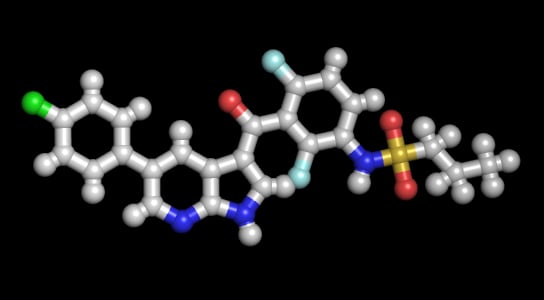
The experiments led to the discovery that a protein called hepatocyte growth factor (HGF) boosts melanoma’s resistance to treatment with vemurafenib, a targeted drug therapy. Patients with higher HGF levels are less likely to remain in remission.
This could have immediate implications in the design of clinical trials, which should combine targeted drug therapies with new drugs capable of lowering the production of proteins like HGF.
References:
“Widespread potential for growth-factor-driven resistance to anticancer kinase inhibitors” by Timothy R. Wilson, Jane Fridlyand, Yibing Yan, Elicia Penuel, Luciana Burton, Emily Chan, Jing Peng, Eva Lin, Yulei Wang, Jeff Sosman, Antoni Ribas, Jiang Li, John Moffat, Daniel P. Sutherlin, Hartmut Koeppen, Mark Merchant, Richard Neve and Jeff Settleman, 4 July 2012, Nature.
DOI: 10.1038/nature11249
“Tumour micro-environment elicits innate resistance to RAF inhibitors through HGF secretion” by Ravid Straussman, Teppei Morikawa, Kevin Shee, Michal Barzily-Rokni, Zhi Rong Qian, Jinyan Du, Ashli Davis, Margaret M. Mongare, Joshua Gould, Dennie T. Frederick, Zachary A. Cooper, Paul B. Chapman, David B. Solit, Antoni Ribas, Roger S. Lo, Keith T. Flaherty, Shuji Ogino, Jennifer A. Wargo and Todd R. Golub, 4 July 2012, Nature.
DOI: 10.1038/nature11183
Never miss a breakthrough: Join the SciTechDaily newsletter.
Follow us on Google and Google News.