
Close Menu
    Facebook X (Twitter) Instagram
    SciTechDaily
    • Biology
    • Chemistry
    • Earth
    • Health
    • Physics
    • Science
    • Space
    • Technology
    Facebook X (Twitter) Pinterest YouTube RSS
    SciTechDaily
    Home»Biology»Understanding Plants Is Key to Finding a Cure for Cancer
    Biology

    Understanding Plants Is Key to Finding a Cure for Cancer

    By Cold Spring Harbor LaboratoryJuly 2, 2022No Comments4 Mins Read
    Facebook Twitter Pinterest Telegram LinkedIn WhatsApp Email Reddit
    Share
    Facebook Twitter LinkedIn Pinterest Telegram Email Reddit
    Genetically Modified Plants Concept
    The scientists state that if they can understand unchecked plant growth, they believe they can find a cure for cancer.

    If scientists can fully understand plant growth, they might be able to find a cancer cure.

    In order to increase agricultural yields, it is important to understand how plants process light. Plants use light to determine when to grow and bloom. Plants find light using proteins called photoreceptors. However, understanding plants have impacts in fields other than agriculture.  Ullas Pedmale, an assistant professor at Cold Spring Harbor Laboratory (CSHL), and his colleagues have discovered how the proteins UBP12 and UBP13 regulate the activity of a CRY2 photoreceptor. Their finding could make new growth-control strategies apparent, with potential implications well beyond agriculture.

    There are CRY photoreceptors in both plants and people. They are connected to a number of conditions including diabetes, cancer, and several brain disorders.  CRY2 helps in regulating growth in both people and plants. Uncontrolled development in plants reduces their viability, whereas it causes cancer in humans. “If we understand growth,” Pedmale says, “we can cure cancer.”
    Plant CRY2 Protein
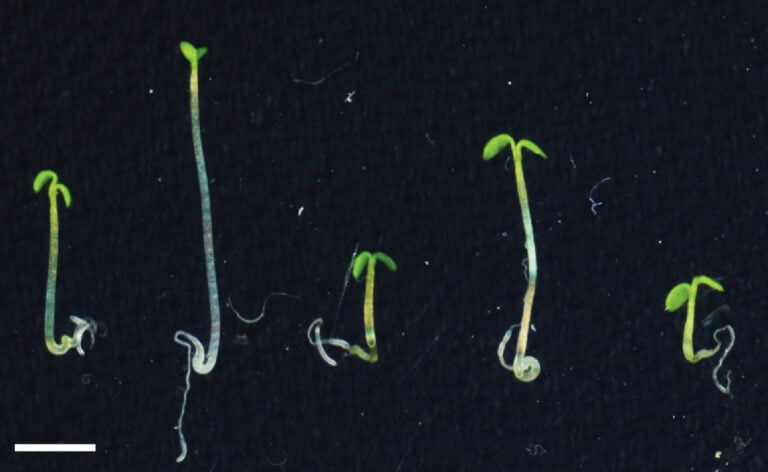
    Manipulating the levels of CRY2 and UBP12 and UBP13 proteins in Arabidopsis thaliana plants affects growth. The first plant from the left shows normal growth. The second plant is missing CRY2 and grew too much. The third plant lacked UBP12 and UBP13 and grew shorter. The fourth plant had high levels of UBP12 and UBP13, and the fifth had high levels of CRY2. Credit: Pedmale lab/CSHL, 2022

    Regulating CRY2 with UBP12 and UBP13 Proteins

    Plants need the right amount of CRY2 to know when to grow and flower. Pedmale and former postdoctoral fellow Louise Lindbäck discovered that manipulating UBP12 and UBP13 can change the amount of CRY2 in plants. They found that increasing UBP12 and UBP13 reduces CRY2 levels. This made plants think there wasn’t enough light. In response, they grew longer, abnormal stems to reach more. Pedmale says:

    “We have a way to understand growth here—and we could manipulate growth just by manipulating two proteins. We have found a way we can actually increase flower output. You need flowering for food. If there’s no flower, there is no grain, no rice, no wheat, no maize.”

    Pedmale and Lindbäck didn’t know exactly how UBP12 and UBP13 regulated CRY2. When the researchers took a closer look, they made a surprising discovery. In humans and other organisms, versions of UBP12 and UBP13 protect CRY photoreceptors from degradation. But in plants, the team saw the opposite. UBP12 and UBP13 were actually helping degrade CRY2 instead. Lindbäck, who is currently a research and developmental engineer at Nordic Biomarker in Sweden, explains:

    “From literature, it’s known that if you find an interaction like this, it will protect from degradation. Initially, we saw the opposite, and we thought, ‘okay, maybe I did something wrong,’ but then when I did it a few times, we realized, ‘okay, this is true.’ Instead of protecting CRY2, it causes CRY2 to degrade.”

    Implications for Agriculture and Cancer Research

    Pedmale hopes their discovery will help plant researchers and plant breeders improve crop yields. He also hopes his work helps inform cancer research. “My colleagues at CSHL are working hard trying to understand cancer,” he says. “We are coming at it from a different angle with plants.”

    The study was funded by the National Institutes of Health. 

    Reference: “UBP12 and UBP13 deubiquitinases destabilize the CRY2 blue light receptor to regulate Arabidopsis growth” by Louise N. Lindbäck, Yuzhao Hu, Amanda Ackermann, Oliver Artz and Ullas V. Pedmale, 13 June 2022, Current Biology. 
    DOI: 10.1016/j.cub.2022.05.046

    Never miss a breakthrough: Join the SciTechDaily newsletter.
    Follow us on Google and Google News.

    Cancer Cold Spring Harbor Laboratory Diabetes National Institutes of Health Plants Protein Tumor
    Share. Facebook Twitter Pinterest LinkedIn Email Reddit

    Related Articles

    Encouraging Tumor Growth: How Breast Cancer Causes Diabetes

    Proteins in a Cancerous Tumor’s Microenvironment Have Role in Drug Resistance

    Radio-Wave Heated Nanoparticles Trigger Insulin Production in Mice

    New Drug CD47 Could Potentially Shrink and Cure All Tumors

    Complete Structure of the “Salvia Receptor” Revealed

    Examining the Mechanism Behind Melanoma Drug Resistance

    Tyrosine Phosphatase SHP2 and Breast Cancer

    Zelboraf Nearly Doubles Median Survival Time for Patients with Metastatic Melanoma

    Researchers Discover Proteins Responsible for Cancer Cell Movement

    Leave A Reply Cancel Reply

    • Facebook
    • Twitter
    • Pinterest
    • YouTube

    Don't Miss a Discovery

    Subscribe for the Latest in Science & Tech!

    Trending News

    The Universe Is Expanding Too Fast and Scientists Can’t Explain Why

    “Like Liquid Metal”: Scientists Create Strange Shape-Shifting Material

    Early Warning Signals of Esophageal Cancer May Be Hiding in Plain Sight

    Common Blood Pressure Drug Shows Surprising Power Against Deadly Antibiotic-Resistant Superbug

    Scientists Uncover Dangerous Connection Between Serotonin and Heart Valve Disease

    Scientists Discover a “Protector” Protein That Could Help Reverse Hair Loss

    Bone-Strengthening Discovery Could Reverse Osteoporosis

    Scientists Uncover Hidden Trigger Behind Stem Cell Aging

    Follow SciTechDaily
    • Facebook
    • Twitter
    • YouTube
    • Pinterest
    • Newsletter
    • RSS
    SciTech News
    • Biology News
    • Chemistry News
    • Earth News
    • Health News
    • Physics News
    • Science News
    • Space News
    • Technology News
    Recent Posts
    • A Common Diabetes Drug May Hold the Key to Stopping HIV From Coming Back
    • Ancient “Syphilis-Like” Disease in Vietnam Challenges Key Scientific Assumptions
    • Drinking Alcohol To Cope in Your 20s Could Damage Your Brain for Life
    • Scientists Crack Alfalfa’s Chromosome Mystery After Decades of Debate
    • Ancient Ant-Plant Alliance Collapses As Predatory Wasps Move In
    Copyright © 1998 - 2026 SciTechDaily. All Rights Reserved.
    • Science News
    • About
    • Contact
    • Editorial Board
    • Privacy Policy
    • Terms of Use

    Type above and press Enter to search. Press Esc to cancel.