
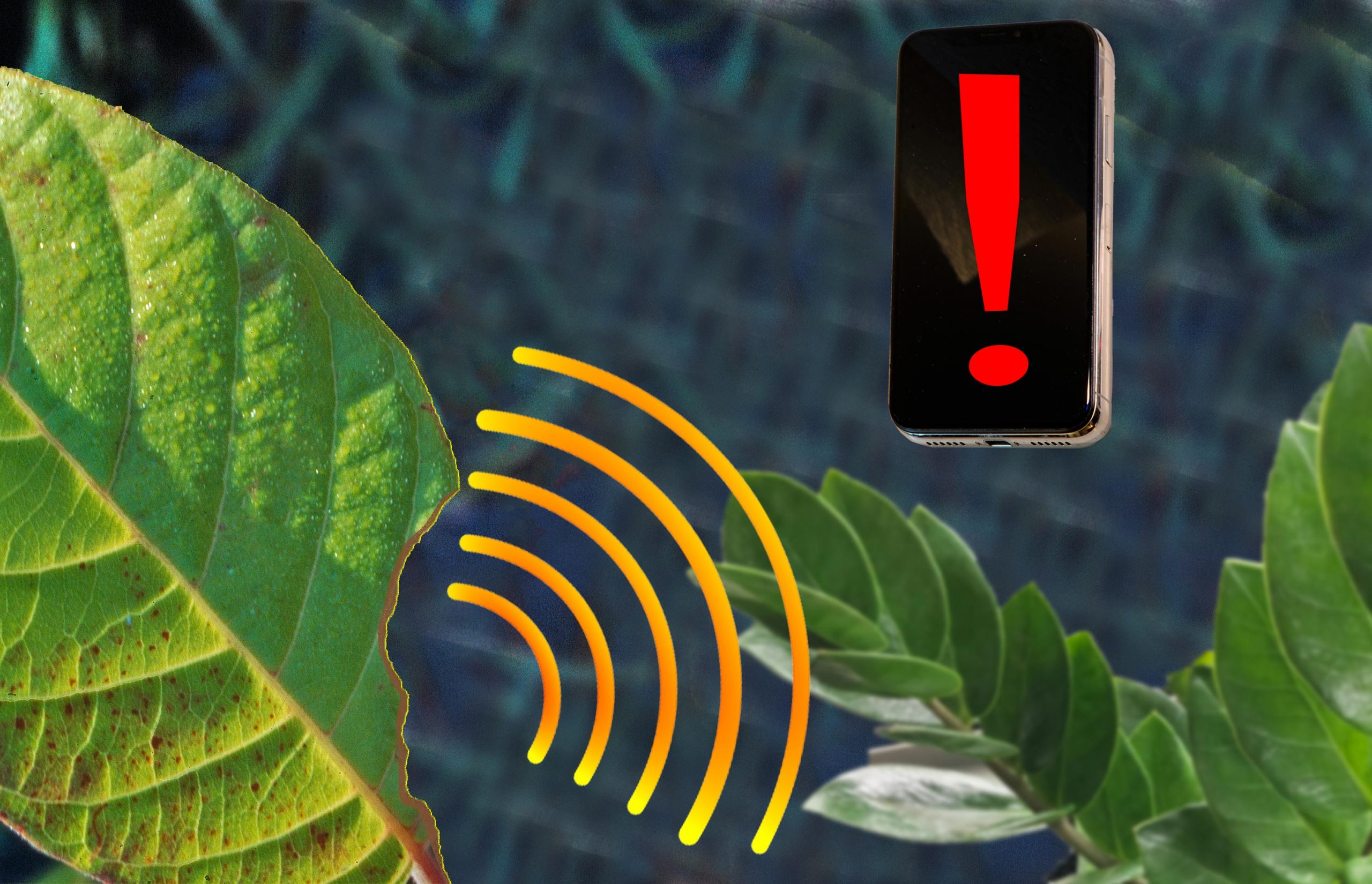
Carbon nanotubes embedded in leaves detect chemical signals that are produced when a plant is damaged.
MIT engineers have developed a way to closely track how plants respond to stresses such as injury, infection, and light damage, using sensors made of carbon nanotubes. These sensors can be embedded in plant leaves, where they report on hydrogen peroxide signaling waves.
Plants use hydrogen peroxide to communicate within their leaves, sending out a distress signal that stimulates leaf cells to produce compounds that will help them repair damage or fend off predators such as insects. The new sensors can use these hydrogen peroxide signals to distinguish between different types of stress, as well as between different species of plants.
“Plants have a very sophisticated form of internal communication, which we can now observe for the first time. That means that in real-time, we can see a living plant’s response, communicating the specific type of stress that it’s experiencing,” says Michael Strano, the Carbon P. Dubbs Professor of Chemical Engineering at MIT.
This kind of sensor could be used to study how plants respond to different types of stress, potentially helping agricultural scientists develop new strategies to improve crop yields. The researchers demonstrated their approach in eight different plant species, including spinach, strawberry plants, and arugula, and they believe it could work in many more.
Strano is the senior author of the study, which appears today in Nature Plants. MIT graduate student Tedrick Thomas Salim Lew is the lead author of the paper.
Embedded sensors
Over the past several years, Strano’s lab has been exploring the potential for engineering “nanobionic plants” — plants that incorporate nanomaterials that give the plants new functions, such as emitting light or detecting water shortages. In the new study, he set out to incorporate sensors that would report back on the plants’ health status.
Strano had previously developed carbon nanotube sensors that can detect various molecules, including hydrogen peroxide. About three years ago, Lew began working on trying to incorporate these sensors into plant leaves. Studies in Arabidopsis thaliana, often used for molecular studies of plants, had suggested that plants might use hydrogen peroxide as a signaling molecule, but its exact role was unclear.
Lew used a method called lipid exchange envelope penetration (LEEP) to incorporate the sensors into plant leaves. LEEP, which Strano’s lab developed several years ago, allows for the design of nanoparticles that can penetrate plant cell membranes. As Lew was working on embedding the carbon nanotube sensors, he made a serendipitous discovery.
“I was training myself to get familiarized with the technique, and in the process of the training, I accidentally inflicted a wound on the plant. Then I saw this evolution of the hydrogen peroxide signal,” he says.
He saw that after a leaf was injured, hydrogen peroxide was released from the wound site and generated a wave that spread along the leaf, similar to the way that neurons transmit electrical impulses in our brains. As a plant cell releases hydrogen peroxide, it triggers calcium release within adjacent cells, which stimulates those cells to release more hydrogen peroxide.
“Like dominos successively falling, this makes a wave that can propagate much further than a hydrogen peroxide puff alone would,” Strano says. “The wave itself is powered by the cells that receive and propagate it.”
This flood of hydrogen peroxide stimulates plant cells to produce molecules called secondary metabolites, such as flavonoids or carotenoids, which help them to repair the damage. Some plants also produce other secondary metabolites that can be secreted to fend off predators. These metabolites are often the source of the food flavors that we desire in our edible plants, and they are only produced under stress.
A key advantage of the new sensing technique is that it can be used in many different plant species. Traditionally, plant biologists have done much of their molecular biology research in certain plants that are amenable to genetic manipulation, including Arabidopsis thaliana and tobacco plants. However, the new MIT approach is applicable to potentially any plant.
“In this study, we were able to quickly compare eight plant species, and you would not be able to do that with the old tools,” Strano says.
The researchers tested strawberry plants, spinach, arugula, lettuce, watercress, and sorrel, and found that different species appear to produce different waveforms — the distinctive shape produced by mapping the concentration of hydrogen peroxide over time. They hypothesize that each plant’s response is related to its ability to counteract the damage. Each species also appears to respond differently to different types of stress, including mechanical injury, infection, and heat or light damage.
“This waveform holds a lot of information for each species, and even more exciting is that the type of stress on a given plant is encoded in this waveform,” Strano says. “You can look at the real time response that a plant experiences in almost any new environment.”
Stress response
The near-infrared fluorescence produced by the sensors can be imaged using a small infrared camera connected to a Raspberry Pi, a $35 credit-card-sized computer similar to the computer inside a smartphone. “Very inexpensive instrumentation can be used to capture the signal,” Strano says.
Applications for this technology include screening different species of plants for their ability to resist mechanical damage, light, heat, and other forms of stress, Strano says. It could also be used to study how different species respond to pathogens, such as the bacteria that cause citrus greening and the fungus that causes coffee rust.
“One of the things I’m interested in doing is understanding why some types of plants exhibit certain immunity to these pathogens and others don’t,” he says.
Strano and his colleagues in the Disruptive and Sustainable Technology for Agricultural Precision interdisciplinary research group at the Singapore-MIT Alliance for Research and Technology (SMART), MIT’s research enterprise in Singapore, are also interested in studying how plants respond to different growing conditions in urban farms.
One problem they hope to address is shade avoidance, which is seen in many species of plants when they are grown at high density. Such plants turn on a stress response that diverts their resources into growing taller, instead of putting energy into producing crops. This lowers the overall crop yield, so agricultural researchers are interested in engineering plants so that don’t turn on that response.
“Our sensor allows us to intercept that stress signal and to understand exactly the conditions and the mechanism that are happening upstream and downstream in the plant that gives rise to the shade avoidance,” Strano says.
Reference: “Real-time detection of wound-induced H2O2 signaling waves in plants with optical nanosensors” by Tedrick Thomas Salim Lew, Volodymyr B. Koman, Kevin S. Silmore, Jun Sung Seo, Pavlo Gordiichuk, Seon-Yeong Kwak, Minkyung Park, Mervin Chun-Yi Ang, Duc Thinh Khong, Michael A. Lee, Mary B. Chan-Park, Nam-Hai Chua and Michael S. Strano, 15 April 2020, Nature Plants.
DOI: 10.1038/s41477-020-0632-4
The research was funded by the National Research Foundation of Singapore, the Singapore Agency for Science, Technology, and Research (A*STAR), and the U.S. Department of Energy Computational Science Graduate Fellowship Program.
Never miss a breakthrough: Join the SciTechDaily newsletter.
Follow us on Google and Google News.
2 Comments
Really informative blog article.Thanks Again. Fantastic.
Thanks for sharing this information…GlobalImpact