
Close Menu
    Facebook X (Twitter) Instagram
    SciTechDaily
    • Biology
    • Chemistry
    • Earth
    • Health
    • Physics
    • Science
    • Space
    • Technology
    Facebook X (Twitter) Pinterest YouTube RSS
    SciTechDaily
    Home»Physics»Next-Generation Hybrid Photovoltaic-Thermal Solar Technology Efficiency Limits
    Physics

    Next-Generation Hybrid Photovoltaic-Thermal Solar Technology Efficiency Limits

    By Light Publishing CenterFebruary 8, 2021No Comments3 Mins Read
    Facebook Twitter Pinterest Telegram LinkedIn WhatsApp Email Reddit
    Share
    Facebook Twitter LinkedIn Pinterest Telegram Email Reddit
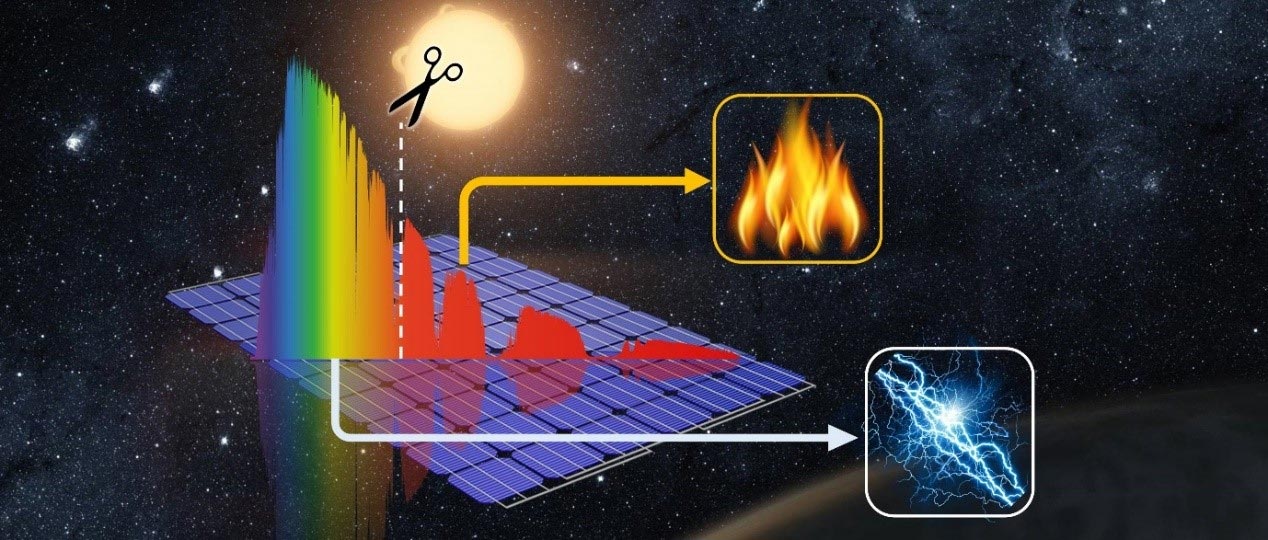
    Spectral-Splitting Hybrid PV-Thermal Collector Technology
    The solar spectrum is separated by an optical filter, and only part of the spectrum is sent to the PV cells for electricity generation. The rest of the spectrum, which cannot be utilized by the solar cells, is directed to a thermal absorber to generate thermal energy. Credit: Gan Huang, Kai Wang and Christos N. Markides

    New research reveals how spectral-splitting hybrid solar collectors can achieve peak performance by optimizing PV materials and optical filters based on the value of heat versus electricity.

    Solar energy is one of the most abundant renewable energy sources, and effective solar technologies have great potential to alleviate the grand challenges of rising global energy demands, while reducing associated emissions. Solar energy is capable of satisfying the electrical and thermal-energy needs of diverse end-users by means of photovoltaic (PV) and solar thermal (ST) technologies, respectively. Recently, hybrid photovoltaic-thermal (PVT) concepts have been proposed that synergistically combine the benefits of PV and ST technologies, and are capable of generating both electricity and useful heat simultaneously from the same area and component.

    Spectral splitting is an emerging approach for designing high-performance PVT solar collectors, which employ advanced designs with optical filters that direct different parts of the solar spectrum either to the PV cells for electricity generation or to a thermal absorber for heat generation. Nevertheless, the ultimate efficiency limits of spectral-splitting PVT (SSPVT) collectors depending on the application and end-user demands, along with the optimal collector designs, PV cell, and optical filter materials that can enable us to approach these limits have remained unclear, with a lack of consensus in the field, motivating a closer examination of these aspects of SSPVT technology.
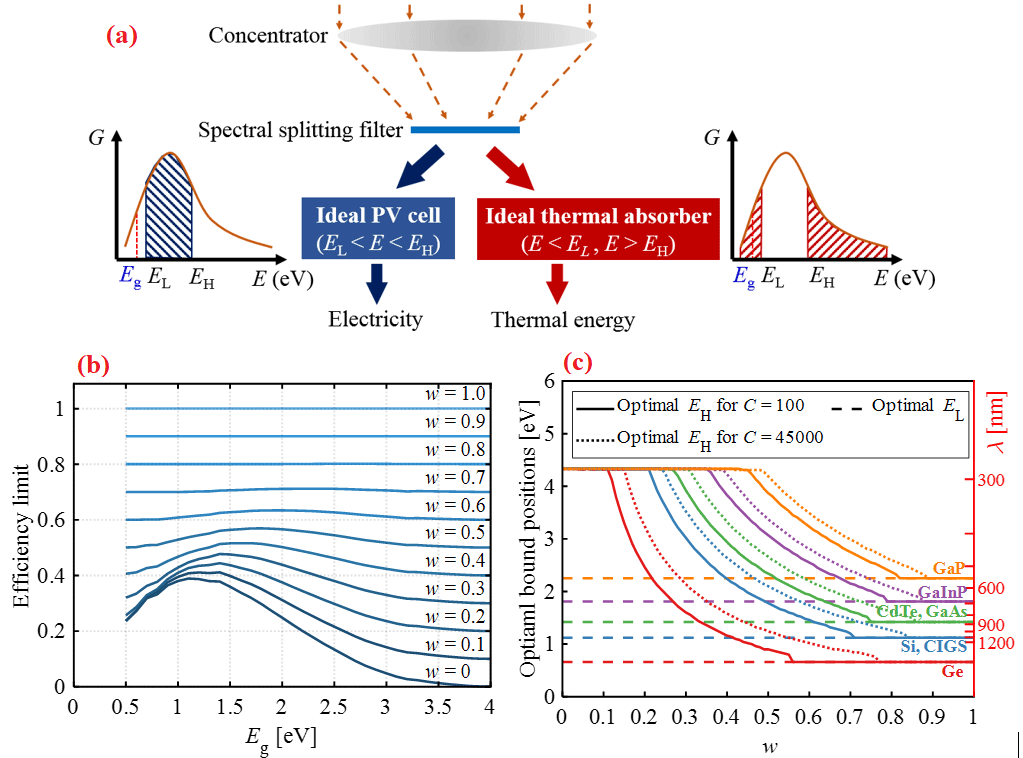
    Ideal Concentrating SSPVT Collector
    (a) Physical model of an ideal concentrating SSPVT collector. (b) Limit of total efficiency for different PV cells with different bandgap energies in different applications. (c) Optimal spectral-splitting filters for common PV cell materials. Credit: Gan Huang, Kai Wang and Christos N. Markides

    In a new paper published in Light Science & Application, Christos N. Markides and Gan Huang from Imperial College London in the UK, in collaboration with Kai Wang from Zhejiang University in China, report a comprehensive framework for predicting the performance of such collectors, which is then used to identify their efficiency limits, and to provide detailed guidance for selecting optimal PV materials and optimal spectral-splitting filters capable of delivering a combined thermal and electrical performance that approaches the efficiency limits of this technology.

    Materials and Filter Selection

    “We found that the relative value of thermal energy to that of electricity has a significant influence on the total effective efficiency limits, the optimal PV cell material, and the optimal spectral-splitting filter of SSPVT collectors.”

    “CIGS solar cells are considered particularly promising for SSPVT collector applications owing to their adjustable bandgap energy. The optimal lower- and upper-bounds of the spectral-splitting filter depend strongly on the PV material” they added.

    “Detailed maps in our research can assist designers in selecting appropriate solar-cell materials and spectral-splitting optical filters, depending on the conditions and application, in order to achieve optimal overall performance accounting for both energy vectors (electricity and heat) generated by these systems.” the scientists stated.

    Reference: “Efficiency limits of concentrating spectral-splitting hybrid photovoltaic-thermal (PV-T) solar collectors and systems” by Gan Huang, Kai Wang and Christos N. Markides, 5 February 2021, Light: Science & Applications.
    DOI: 10.1038/s41377-021-00465-1

    Funded by the UK Engineering and Physical Sciences Research Council (EPSRC), the Imperial College London EPSRC Impact Acceleration Account.

    Never miss a breakthrough: Join the SciTechDaily newsletter.
    Follow us on Google and Google News.

    Energy Solar Energy
    Share. Facebook Twitter Pinterest LinkedIn Email Reddit

    Related Articles

    Exciton Fission Breakthrough Could Revolutionize Photovoltaic Solar Cell Technology

    Harvesting Energy at Night: Solar Cell Keeps Working Long After Sun Sets

    MIT and Google Brain Create Tool To Speed Development of New Solar Cells

    Charged Up: Scientists Find New Pathway to Harnessing the Sun for a Clean Energy Future

    The Mystery of the Missing Energy in Singlet Fission Solar Cells – Solved

    A New Technique to Map Energy and Momentum of Electrons

    New Material Can Store Solar Energy During the Day and Release it Later as Heat

    Quantum Process Significantly Boosts the Energy That Can Be Harnessed from Sunlight

    Computer Simulation Shows High-Gain Nuclear Fusion

    Leave A Reply Cancel Reply

    • Facebook
    • Twitter
    • Pinterest
    • YouTube

    Don't Miss a Discovery

    Subscribe for the Latest in Science & Tech!

    Trending News

    The Universe Is Expanding Too Fast and Scientists Can’t Explain Why

    “Like Liquid Metal”: Scientists Create Strange Shape-Shifting Material

    Early Warning Signals of Esophageal Cancer May Be Hiding in Plain Sight

    Common Blood Pressure Drug Shows Surprising Power Against Deadly Antibiotic-Resistant Superbug

    Scientists Uncover Dangerous Connection Between Serotonin and Heart Valve Disease

    Scientists Discover a “Protector” Protein That Could Help Reverse Hair Loss

    Bone-Strengthening Discovery Could Reverse Osteoporosis

    Scientists Uncover Hidden Trigger Behind Stem Cell Aging

    Follow SciTechDaily
    • Facebook
    • Twitter
    • YouTube
    • Pinterest
    • Newsletter
    • RSS
    SciTech News
    • Biology News
    • Chemistry News
    • Earth News
    • Health News
    • Physics News
    • Science News
    • Space News
    • Technology News
    Recent Posts
    • Scientists Overcome Major Quantum Bottleneck, Potentially Transforming Teleportation and Computing
    • Quantum Physics’ Strangest Problem May Hold the Key to Time Itself
    • Scientists Create “Liquid Gears” That Spin Without Touching
    • The Simple Habit That Could Help Prevent Cancer
    • Forgotten Medicinal Plant Shows Promise in Fighting Dangerous Superbugs
    Copyright © 1998 - 2026 SciTechDaily. All Rights Reserved.
    • Science News
    • About
    • Contact
    • Editorial Board
    • Privacy Policy
    • Terms of Use

    Type above and press Enter to search. Press Esc to cancel.