
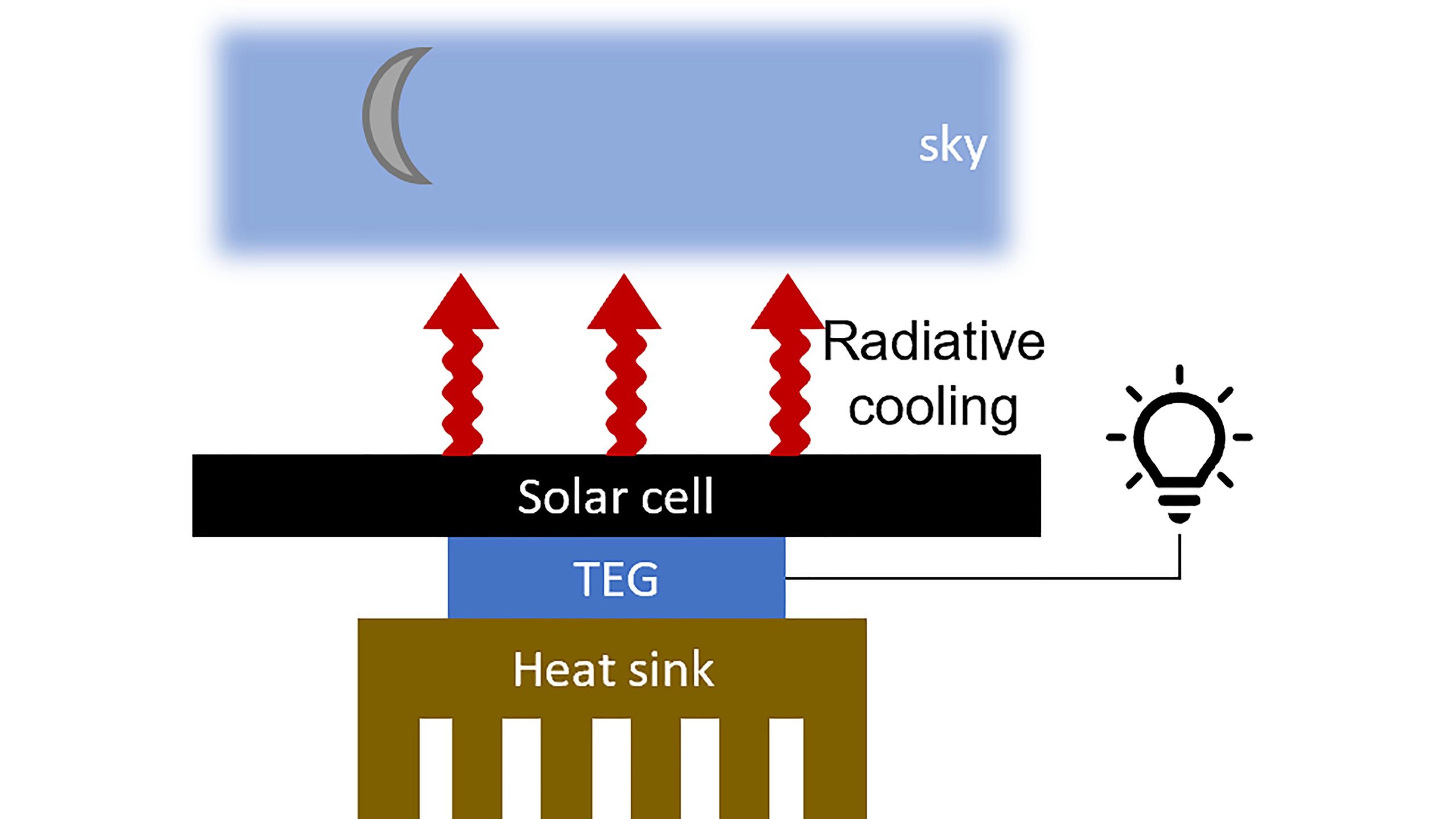
Harvesting energy from the temperature difference between photovoltaic cell, surrounding air leads to a viable, renewable source of electricity at night.
About 750 million people in the world do not have access to electricity at night. Solar cells provide power during the day, but saving energy for later use requires substantial battery storage.
In Applied Physics Letters, by AIP Publishing, researchers from Stanford University constructed a photovoltaic cell that harvests energy from the environment during the day and night, avoiding the need for batteries altogether. The device makes use of the heat leaking from Earth back into space – energy that is on the same order of magnitude as incoming solar radiation.
Innovative Thermoelectric Design
At night, solar cells radiate and lose heat to the sky, reaching temperatures a few degrees below the ambient air. The device under development uses a thermoelectric module to generate voltage and current from the temperature gradient between the cell and the air. This process depends on the thermal design of the system, which includes a hot side and a cold side.
“You want the thermoelectric to have very good contact with both the cold side, which is the solar cell, and the hot side, which is the ambient environment,” said author Sid Assawaworrarit. “If you don’t have that, you’re not going to get much power out of it.”
The team demonstrated power generation in their device during the day, when it runs in reverse and contributes additional power to the conventional solar cell, and at night.
A Low-Cost, Scalable Solution
The setup is inexpensive and, in principle, could be incorporated within existing solar cells. It is also simple, so construction in remote locations with limited resources is feasible.
“What we managed to do here is build the whole thing from off-the-shelf components, have a very good thermal contact, and the most expensive thing in the whole setup was the thermoelectric itself,” said author Zunaid Omair.
Using electricity at night for lighting requires a few watts of power. The current device generates 50 milliwatts per square meter, which means lighting would require about 20 square meters (215 square feet) of photovoltaic area.
“None of these components were specifically engineered for this purpose,” said author Shanhui Fan. “So, I think there’s room for improvement, in the sense that, if one really engineered each of these components for our purpose, I think the performance could be better.”
The team aims to optimize the thermal insulation and thermoelectric components of the device. They are exploring engineering improvements to the solar cell itself to enhance the radiative cooling performance without influencing its solar energy harvesting capability.
Reference: “Nighttime electric power generation at a density of 50mW/m2 via radiative cooling of a photovoltaic cell” by Sid Assawaworrarit, Zunaid Omair and Shanhui Fan, 5 April 2022, Applied Physics Letters.
DOI: 10.1063/5.0085205
Never miss a breakthrough: Join the SciTechDaily newsletter.
Follow us on Google and Google News.
9 Comments
Nothing new here folks. We were putting Peltier junction devices with heat sinks on the back our solar panels more than 20 years ago.
“The current device generates 50 milliwatts per square meter”
That is about what one can expect from a 2″x1″ photovoltaic cell in daylight. Not very much power!
Also, around sunset, there will be no thermal production because everything will be warm. Maximum thermal output will be just before sunrise, when most people will still be sleeping. If they live in a humid environment, it may never get cool enough to generate any usable power.
I was so excited when I saw this article but when I read 50miliwatts per m^2…Oh well, I wish them luck as it is a small step in the right direction. Literally any energy is a plus. I hope to see big improvements soon.
The efficiency of a TEG (Thermal Electric Generator) at these temperature differences is extremely poor. The payback time for the increased cost of the hardware is much longer than the expected life of the system.
Its cool to hear about new efficient energy devices, I’ve got a few great ideas, one is a magnified solar system using the sun, the other is a centripetal oil and water displacement, I have a two cycle magnet engine, and a kinetic wind and water generator, also a theory how to harvest energy from lightning with the ground, but nobody wants to listen to me so I just make comic books
“… also a theory how to harvest energy from lightning with the ground, …”
Calculate how much power is in a lightning strike.
Don’t give up your day job.
Thermoelectric generators have been in use for at least a half-Century. They are known to be not particularly efficient in converting thermal gradients into electrical energy despite decades of efforts to make them more efficient. As pointed out in the article they are one of the most expensive components in the sandwich.
The magnitude of output is insignificant. The cost of the battery solution to store this amount of lighting energy to the night is far less than the additional costs described in their process.
This technology looks very efficient at generating research funding, but not much good for anything else.