
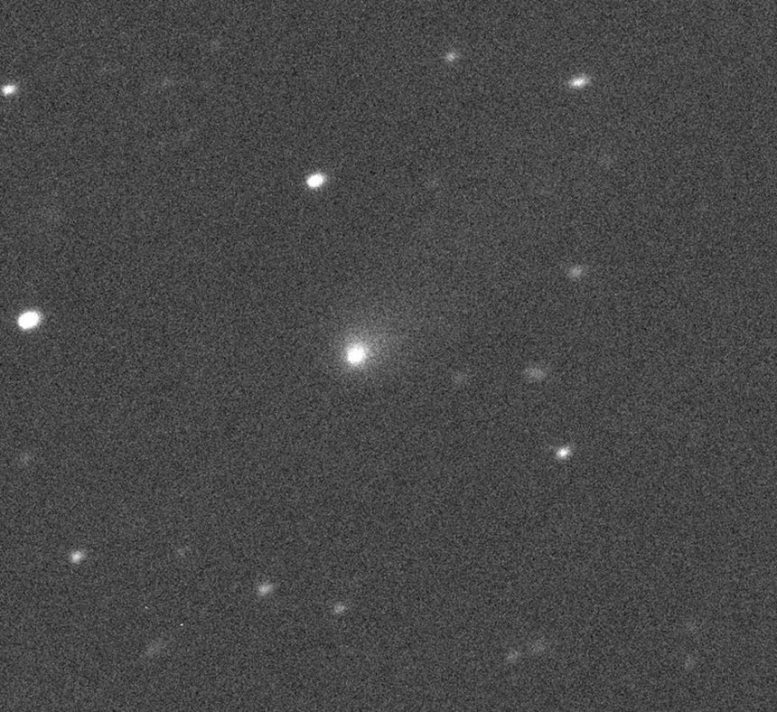
A newly discovered comet has excited the astronomical community this week because it appears to have originated from outside the solar system. The object – designated C/2019 Q4 (Borisov) – was discovered on August 30, 2019, by Gennady Borisov at the MARGO observatory in Nauchnij, Crimea. The official confirmation that comet C/2019 Q4 is an interstellar comet has not yet been made, but if it is interstellar, it would be only the second such object detected. The first, ‘Oumuamua, was observed and confirmed in October 2017.
The new comet, C/2019 Q4, is still inbound toward the Sun, but it will remain farther than the orbit of Mars and will approach no closer to Earth than about 190 million miles (300 million kilometers).
After the initial detections of the comet, Scout system, which is located at NASA’s Jet Propulsion Laboratory in Pasadena, California, automatically flagged the object as possibly being interstellar. Davide Farnocchia of NASA’s Center for Near-Earth Object Studies at JPL worked with astronomers and the European Space Agency’s Near-Earth Object Coordination Center in Frascati, Italy, to obtain additional observations. He then worked with the NASA-sponsored Minor Planet Center in Cambridge, Massachusetts, to estimate the comet’s precise trajectory and determine whether it originated within our solar system or came from elsewhere in the galaxy.
The comet is currently 260 million miles (420 million kilometers) from the Sun and will reach its closest point, or perihelion, on December 8, 2019, at a distance of about 190 million miles (300 million kilometers).
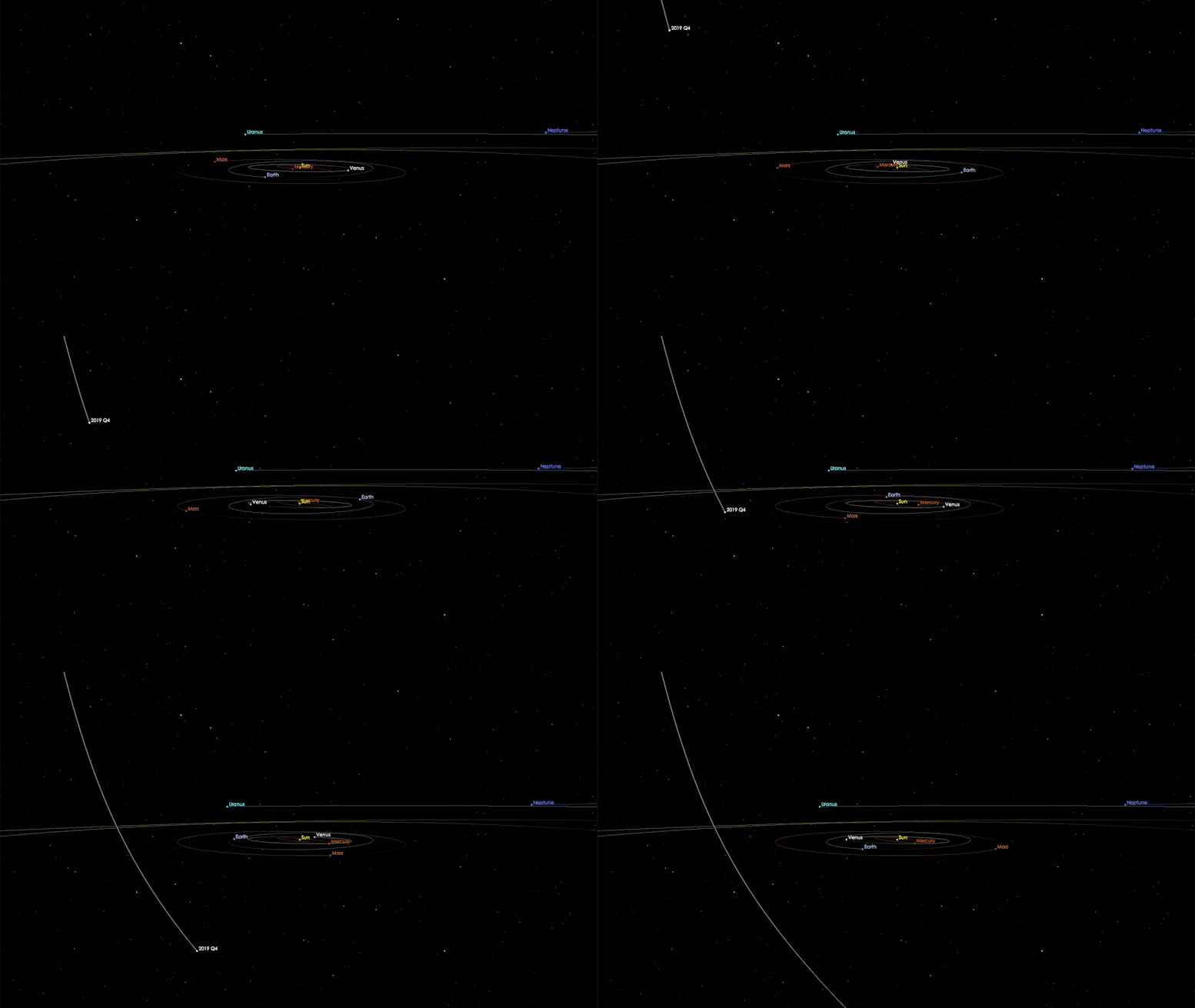
“The comet’s current velocity is high, about 93,000 mph [150,000 kph], which is well above the typical velocities of objects orbiting the Sun at that distance,” said Farnocchia. “The high velocity indicates not only that the object likely originated from outside our solar system, but also that it will leave and head back to interstellar space.”
Currently on an inbound trajectory, comet C/2019 Q4 is heading toward the inner solar system. On October 26, it will pass through the ecliptic plane — the plane in which Earth and the other planets orbit the Sun — from above at roughly a 40-degree angle.
C/2019 Q4 was established as being cometary due to its fuzzy appearance, which indicates that the object has a central icy body that is producing a surrounding cloud of dust and particles as it approaches the Sun and heats up. Its location in the sky (as seen from Earth) places it near the Sun – an area of sky not usually scanned by the large ground-based asteroid surveys or NASA’s asteroid-hunting NEOWISE spacecraft.
C/2019 Q4 can be seen with professional telescopes for months to come. “The object will peak in brightness in mid-December and continue to be observable with moderate-size telescopes until April 2020,” said Farnocchia. “After that, it will only be observable with larger professional telescopes through October 2020.”
Observations completed by Karen Meech and her team at the University of Hawaii indicate the comet nucleus is somewhere between 1.2 and 10 miles (2 and 16 kilometers) in diameter. Astronomers will continue to collect observations to further characterize the comet’s physical properties (size, rotation, etc.) and also continue to better identify its trajectory.
The Minor Planet Center is hosted by the Harvard-Smithsonian Center for Astrophysics and is a sub-node of NASA’s Planetary Data System Small Bodies Node at the University of Maryland. JPL hosts the Center for Near-Earth Object Studies. All are projects of NASA’s Near-Earth Object Observations Program and elements of the agency’s Planetary Defense Coordination Office within NASA’s Science Mission Directorate.
Never miss a breakthrough: Join the SciTechDaily newsletter.
Follow us on Google and Google News.