
Close Menu
    Facebook X (Twitter) Instagram
    SciTechDaily
    • Biology
    • Chemistry
    • Earth
    • Health
    • Physics
    • Science
    • Space
    • Technology
    Facebook X (Twitter) Pinterest YouTube RSS
    SciTechDaily
    Home»Space»View Passing Comet 46P/Wirtanen This Sunday
    Space

    View Passing Comet 46P/Wirtanen This Sunday

    By DC Agle​, Jet Propulsion LaboratoryDecember 14, 2018No Comments3 Mins Read
    Facebook Twitter Pinterest Telegram LinkedIn WhatsApp Email Reddit
    Share
    Facebook Twitter LinkedIn Pinterest Telegram Email Reddit
    See Passing Comet Wirtanen 16
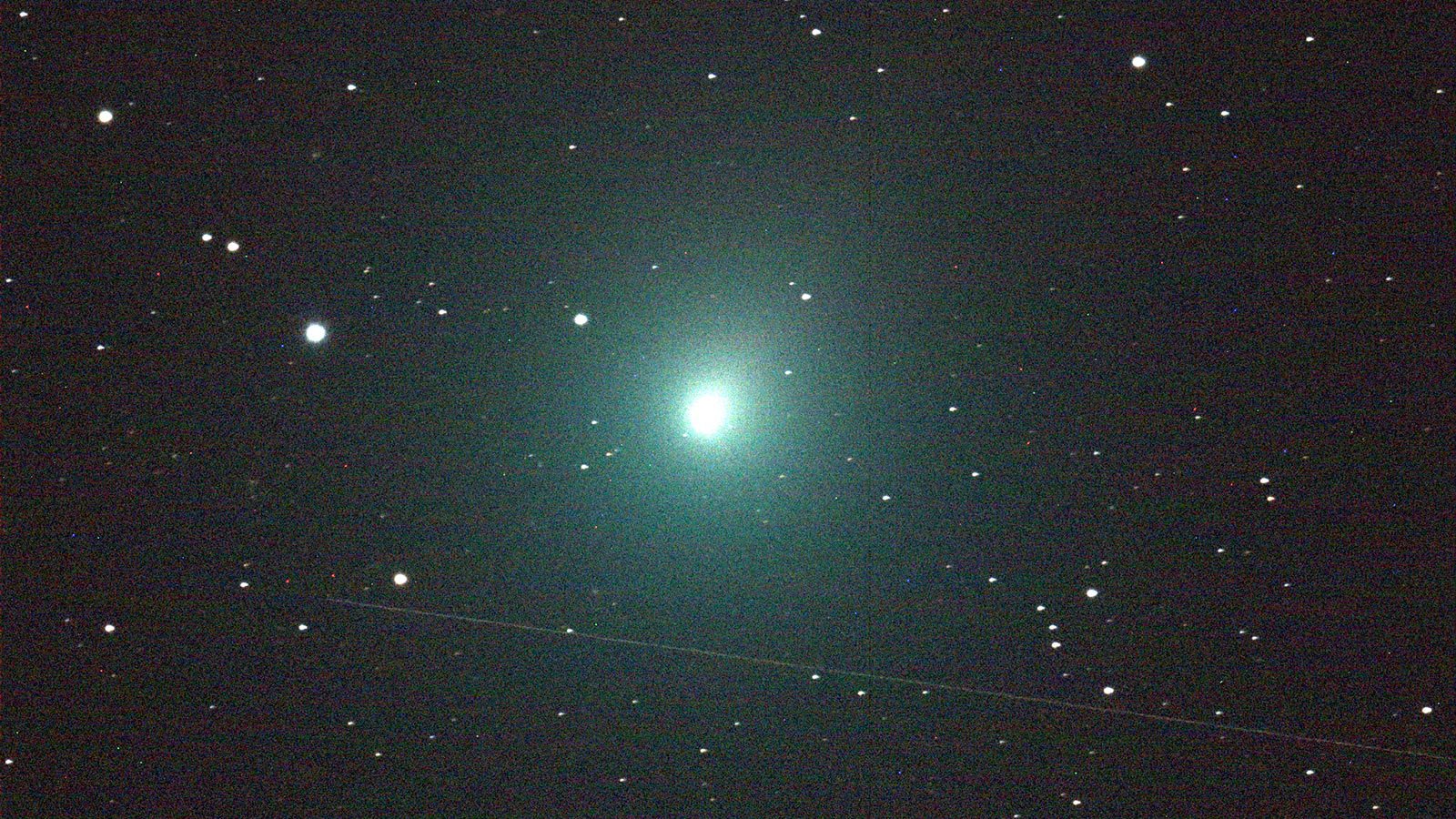
    This 120-second image of the comet was taken on December 2 by an iTelescope 50 mm refractor located at an observatory near Mayhill, New Mexico. The streak below the comet was produced by a rocket body (upper stage) passing through the telescope’s field of view during the exposure. Credit: NASA

    On Sunday, December 16, the comet known as 46P/Wirtanen will make one of the 10 closest comet flybys of Earth in 70 years, and you may even be able to see it without a telescope.

    Although the approach will be a distant 7.1 million miles (11.4 million kilometers, or 30 lunar distances) from Earth, it’s still a fairly rare opportunity. “This will be the closest comet Wirtanen has come to Earth for centuries and the closest it will come to Earth for centuries,” said Paul Chodas, manager of the Center for Near-Earth Object Studies at NASA’s Jet Propulsion Laboratory in Pasadena, California. What’s more, Chodas said, “This could be one of the brightest comets in years, offering astronomers an important opportunity to study a comet up close with ground-based telescopes, both optical and radar.”

    Comet Wirtanen has already been visible in larger amateur telescopes, and while the brightness of comets is notoriously difficult to predict, there is the possibility that during its close approach comet Wirtanen could be visible with binoculars or to the naked eye.

    Astronomer Carl Wirtanen discovered the comet in 1948 at Lick Observatory on Mt. Hamilton in Santa Clara County, California. With a width of 0.7 miles (1.1 kilometers), 46P/Wirtanen orbits the Sun fairly quickly for a comet — once every 5.4 years — making it a short-period comet. (Long-period comets, on the other hand, have orbital periods greater than 200 years.) At the time of closest approach, the comet will appear to be located in the constellation Taurus close to the Pleiades.

    An observation campaign is underway to take advantage of the close approach for the detailed scientific study of the properties of this “hyperactive” comet, which emits more water than expected, given its relatively small nucleus. The campaign, led by the University of Maryland, has worldwide participation across the professional and amateur astronomical communities. NASA-sponsored ground, air and space-based observatories getting in on the action include NASA’s Goldstone Solar System Radar in California; the NASA Infrared Telescope Facility on Maunakea, Hawaii; the Hubble, Chandra, Swift, and Spitzer space telescopes; and an airborne observatory known as the Stratospheric Observatory for Infrared Astronomy (SOFIA). The comet will even pass through the observing field of the Transiting Exoplanet Survey Satellite (TESS).

    The Comet Wirtanen Observing Campaign website is:

    http://wirtanen.astro.umd.edu

    A NASA ScienceCast on Comet Wirtanen is available at:

    https://science.nasa.gov/science-news/news-articles/you-light-up-our-night

    Never miss a breakthrough: Join the SciTechDaily newsletter.
    Follow us on Google and Google News.

    Astronomy Comet JPL NASA
    Share. Facebook Twitter Pinterest LinkedIn Email Reddit

    Related Articles

    Cosmic Chameleons: Mysterious “Dark Comets” May Hold Clues to Life’s Origins on Earth

    Skywatching Magic: October’s Spectacular Comet Lights Up the Night Sky

    Astronomers Discover “One of a Kind” Glow Surrounding Comet – Ultraviolet Atomic Emissions

    Comet NEOWISE Sizzles As It Slides by the Sun – A Treat for Observers on Earth and in Space

    NASA Confirms Newly Discovered Comet Is Likely Interstellar Visitor

    NASA Comet Hitchhiker Would Take Tour of Small Asteroids and Comets

    NASA’s NEOWISE Spacecraft Views Its First Comet

    NASA’s Near-Earth Object Observations Program Discovers Ten Thousandth NEO

    Comet 2013 A1 to Make a Very Close Flyby of Mars

    Leave A Reply Cancel Reply

    • Facebook
    • Twitter
    • Pinterest
    • YouTube

    Don't Miss a Discovery

    Subscribe for the Latest in Science & Tech!

    Trending News

    Largest-Ever Study Finds Medicinal Cannabis Ineffective for Anxiety, Depression, PTSD

    250-Million-Year-Old Egg Solves One of Evolution’s Biggest Mysteries

    Living With Roommates Might Be Changing Your Gut Microbiome Without You Knowing

    Century-Old Cleaning Chemical Linked to 500% Increased Risk of Parkinson’s Disease

    What if Your Memories Never Happened? Physicists Take a New Look at the Boltzmann Brain Paradox

    One of the Universe’s Largest Stars May Be Getting Ready To Explode

    Scientists Discover Enzyme That Could Supercharge Ozempic-Like Weight Loss Drugs

    Popular Sweetener Linked to DNA Damage – “It’s Something You Should Not Be Eating”

    Follow SciTechDaily
    • Facebook
    • Twitter
    • YouTube
    • Pinterest
    • Newsletter
    • RSS
    SciTech News
    • Biology News
    • Chemistry News
    • Earth News
    • Health News
    • Physics News
    • Science News
    • Space News
    • Technology News
    Recent Posts
    • Scientists Prove There Are Just Six Degrees of Separation in a Social Network
    • Bee Bacteria Could Fix a Major Flaw in Plant-Based Milk
    • Scientists Discover a Surprising Way To Make Bread Healthier and More Nutritious
    • Natural Compounds Boost Bone Implant Success While Killing Bacteria and Cancer Cells
    • After 60 Years, Scientists Uncover Unexpected Brain Effects of Popular Diabetes Drug Metformin
    Copyright © 1998 - 2026 SciTechDaily. All Rights Reserved.
    • Science News
    • About
    • Contact
    • Editorial Board
    • Privacy Policy
    • Terms of Use

    Type above and press Enter to search. Press Esc to cancel.