
Researchers have doubled the number of known dark comets, identifying two distinct types: larger ones in the outer solar system and smaller ones in the inner solar system.
This discovery raises new questions about their origins and their role in delivering life-sustaining materials to Earth.
Dark Comet Discoveries
Less than two years ago, astronomers identified the first dark comet — a space object that looks like an asteroid but behaves like a comet. Soon after, six more were discovered. In a newly published paper, researchers reveal the discovery of seven additional dark comets, doubling the known total. These objects fall into two distinct groups: larger dark comets in the outer solar system and smaller ones in the inner solar system, each with unique characteristics that set them apart.
The findings were published on December 9, in the Proceedings of the National Academy of Sciences.
Scientists got their first inkling that dark comets exist when they noted in a March 2016 study that the trajectory of “asteroid” 2003 RM had moved ever so slightly from its expected orbit. That deviation couldn’t be explained by the typical accelerations of asteroids, like the small acceleration known as the Yarkovsky effect.
“When you see that kind of perturbation on a celestial object, it usually means it’s a comet, with volatile material outgassing from its surface giving it a little thrust,” said study coauthor Davide Farnocchia of NASA’s Jet Propulsion Laboratory in Southern California. “But try as we might, we couldn’t find any signs of a comet’s tail. It looked like any other asteroid — just a pinpoint of light. So, for a short while, we had this one weird celestial object that we couldn’t fully figure out.”
Weird Celestial Objects
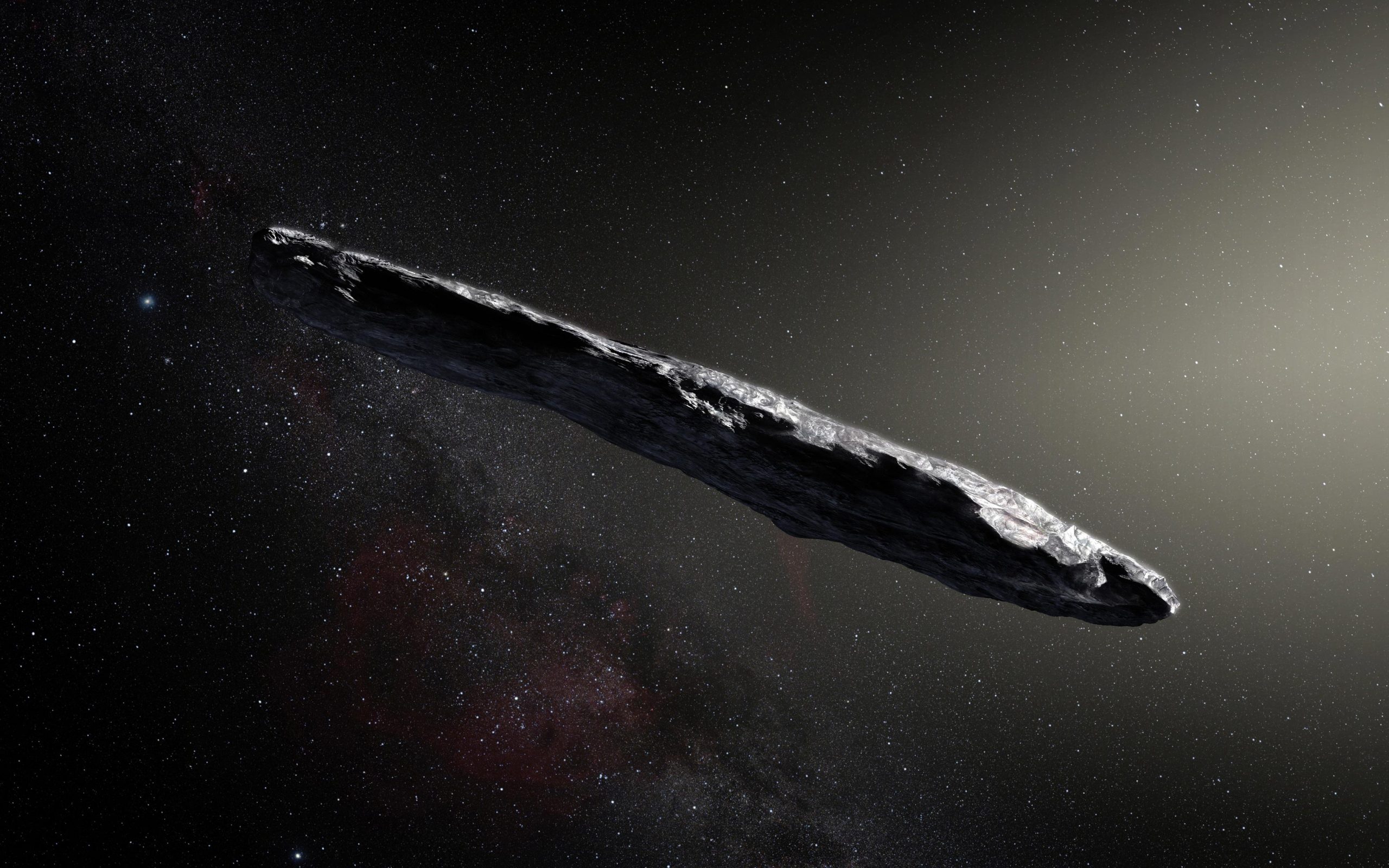
Farnocchia and the astronomical community didn’t have to wait long for another piece of the puzzle. The next year, in 2017, a NASA-sponsored telescope discovered history’s first documented celestial object that originated outside our solar system. Not only did 1I/2017 U1 (‘Oumuamua) appear as a single point of light, like an asteroid, its trajectory changed as if it were outgassing volatile material from its surface, like a comet.
“‘Oumuamua was surprising in several ways,” said Farnocchia. “The fact that the first object we discovered from interstellar space exhibited similar behaviors to 2003 RM made 2003 RM even more intriguing.”
By 2023, researchers had identified seven solar system objects that looked like asteroids but acted like comets. That was enough for the astronomical community to bestow upon them their own celestial object category: “dark comets.” Now, with the finding of seven more of these objects, researchers could start on a new set of questions.
“We had a big enough number of dark comets that we could begin asking if there was anything that would differentiate them,” said Darryl Seligman, a postdoctoral fellow in the department of Physics at Michigan State University, East Lansing, and lead author of the new paper. “By analyzing the reflectivity,” or albedo, “and the orbits, we found that our solar system contains two different types of dark comets.”
Two Types of Dark Comets
The study’s authors found that one kind, which they call outer dark comets, have similar characteristics to Jupiter-family comets: They have highly eccentric (or elliptical) orbits and are on the larger side (hundreds of meters or more across).
The second group, inner dark comets, reside in the inner solar system (which includes Mercury, Venus, Earth, and Mars), travel in nearly circular orbits, and are on the smaller side (tens of meters or less).
Implications for Astronomy and Earth
Like so many astronomical discoveries, Seligman and Farnocchia’s research not only expands on our knowledge of dark comets, but it also raises several additional questions: Where did dark comets originate? What causes their anomalous acceleration? Could they contain ice?
“Dark comets are a new potential source for having delivered the materials to Earth that were necessary for the development of life,” said Seligman. “The more we can learn about them, the better we can understand their role in our planet’s origin.”
Reference: “Two distinct populations of dark comets delineated by orbits and sizes” by Darryl Z. Seligman, Davide Farnocchia, Marco Micheli, Olivier R. Hainaut, Henry H. Hsieh, Adina D. Feinstein, Steven R. Chesley, Aster G. Taylor, Joseph Masiero and Karen J. Meech, 9 December 2024, Proceedings of the National Academy of Sciences.
DOI: 10.1073/pnas.2406424121
Never miss a breakthrough: Join the SciTechDaily newsletter.
Follow us on Google and Google News.