
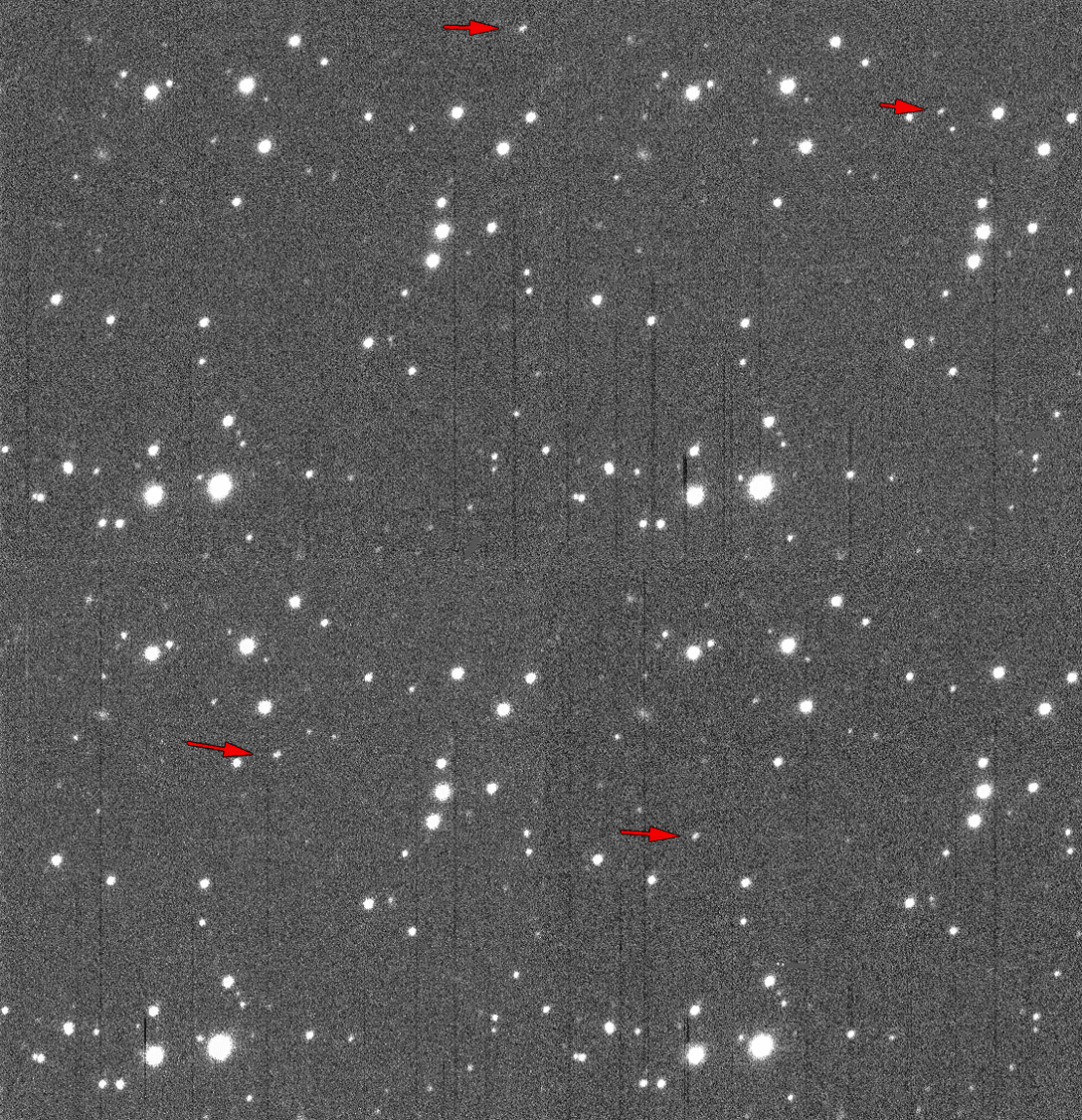
Researchers have now discovered 10,000 near-Earth asteroids and comets, with the 10,000th being a 1,000-foot (300-meter) asteroid called 2013 MZ5.
More than 10,000 asteroids and comets that can pass near Earth have now been discovered. The 10,000th near-Earth object, asteroid 2013 MZ5, was first detected on the night of June 18, 2013, by the Pan-STARRS-1 telescope, located on the 10,000-foot (3,000-meter) summit of the Haleakala crater on Maui. Managed by the University of Hawaii, the PanSTARRS survey receives NASA funding.
Ninety-eight percent of all near-Earth objects discovered were first detected by NASA-supported surveys.
“Finding 10,000 near-Earth objects is a significant milestone,” said Lindley Johnson, program executive for NASA’s Near-Earth Object Observations Program at NASA Headquarters, Washington. “But there are at least 10 times that many more to be found before we can be assured we will have found any and all that could impact and do significant harm to the citizens of Earth.” During Johnson’s decade-long tenure, 76 percent of the NEO discoveries have been made.
Near-Earth objects (NEOs) are asteroids and comets that can approach the Earth’s orbital distance to within about 28 million miles (45 million kilometers). They range in size from as small as a few feet to as large as 25 miles (41 kilometers) for the largest near-Earth asteroid, 1036 Ganymed.
Asteroid 2013 MZ5 is approximately 1,000 feet (300 meters) across. Its orbit is well understood and will not approach close enough to Earth to be considered potentially hazardous.
“The first near-Earth object was discovered in 1898,” said Don Yeomans, long-time manager of NASA’s Near-Earth Object Program Office at the Jet Propulsion Laboratory in Pasadena, California. “Over the next hundred years, only about 500 had been found. But then, with the advent of NASA’s NEO Observations program in 1998, we’ve been racking them up ever since. And with new, more capable systems coming on line, we are learning even more about where the NEOs are currently in our solar system, and where they will be in the future.”
Of the 10,000 discoveries, roughly 10 percent are larger than six-tenths of a mile (one kilometer) in size – roughly the size that could produce global consequences should one impact the Earth. However, the NASA NEOO program has found that none of these larger NEOs currently pose an impact threat and probably only a few dozen more of these large NEOs remain undiscovered.
The vast majority of NEOs are smaller than one kilometer, with the number of objects of a particular size increasing as their sizes decrease. For example, there are expected to be about 15,000 NEOs that are about one-and-half football fields in size (460 feet, or 140 meters), and more than a million that are about one-third a football field in size (100 feet, or 30 meters). A NEO hitting Earth would need to be about 100 feet (30 meters) or larger to cause significant devastation in populated areas. Almost 30 percent of the 460-foot-sized NEOs have been found, but less than 1 percent of the 100-foot-sized NEOs have been detected.
When it originated, the NASA-instituted Near-Earth Object Observations Program provided support to search programs run by the Massachusetts Institute of Technology’s Lincoln Laboratory (LINEAR); the Jet Propulsion Laboratory (NEAT); the University of Arizona (Spacewatch, and later Catalina Sky Survey) and the Lowell Observatory (LONEOS). All these search teams report their observations to the Minor Planet Center, the central node where all observations from observatories worldwide are correlated with objects, and they are given unique designations and their orbits are calculated.
“When I began surveying for asteroids and comets in 1992, a near-Earth object discovery was a rare event,” said Tim Spahr, director of the Minor Planet Center. “These days we average three NEO discoveries a day, and each month the Minor Planet Center receives hundreds of thousands of observations on asteroids, including those in the main belt. The work done by the NASA surveys, and the other international professional and amateur astronomers, to discover and track NEOs is really remarkable.”
Within a dozen years, the program achieved its goal of discovering 90 percent of near-Earth objects larger than 3,300 feet (1 kilometer) in size. In December 2005, NASA was directed by Congress to extend the search to find and catalog 90 percent of the NEOs larger than 500 feet (140 meters) in size. When this goal is achieved, the risk of an unwarned future Earth impact will be reduced to a level of only one percent when compared to pre-survey risk levels. This reduces the risk to human populations, because once an NEO threat is known well in advance, the object could be deflected with current space technologies.
Currently, the major NEO discovery teams are the Catalina Sky Survey, the University of Hawaii’s Pan-STARRS survey, and the LINEAR survey. The current discovery rate of NEOs is about 1,000 per year.
NASA’s Near-Earth Object Observations Program manages and funds the search for, study of, and monitoring of asteroids and comets whose orbits periodically bring them close to Earth. The Minor Planet Center is funded by NASA and hosted by the Smithsonian Astrophysical Observatory in Cambridge, Massachusetts. JPL manages the Near-Earth Object Program Office for NASA’s Science Mission Directorate in Washington. JPL is a division of the California Institute of Technology in Pasadena. More information about asteroids and near-Earth objects is available at: http://neo.jpl.nasa.gov/, http://www.jpl.nasa.gov/asteroidwatch, and via Twitter at http://www.twitter.com/asteroidwatch.
Never miss a breakthrough: Join the SciTechDaily newsletter.
Follow us on Google and Google News.