
Close Menu
    Facebook X (Twitter) Instagram
    SciTechDaily
    • Biology
    • Chemistry
    • Earth
    • Health
    • Physics
    • Science
    • Space
    • Technology
    Facebook X (Twitter) Pinterest YouTube RSS
    SciTechDaily
    Home»Space»New Images of Near-Earth Asteroid 2007 PA8
    Space

    New Images of Near-Earth Asteroid 2007 PA8

    By DC Agle, Jet Propulsion Laboratory: NASANovember 27, 2012No Comments3 Mins Read
    Facebook Twitter Pinterest Telegram LinkedIn WhatsApp Email Reddit
    Share
    Facebook Twitter LinkedIn Pinterest Telegram Email Reddit
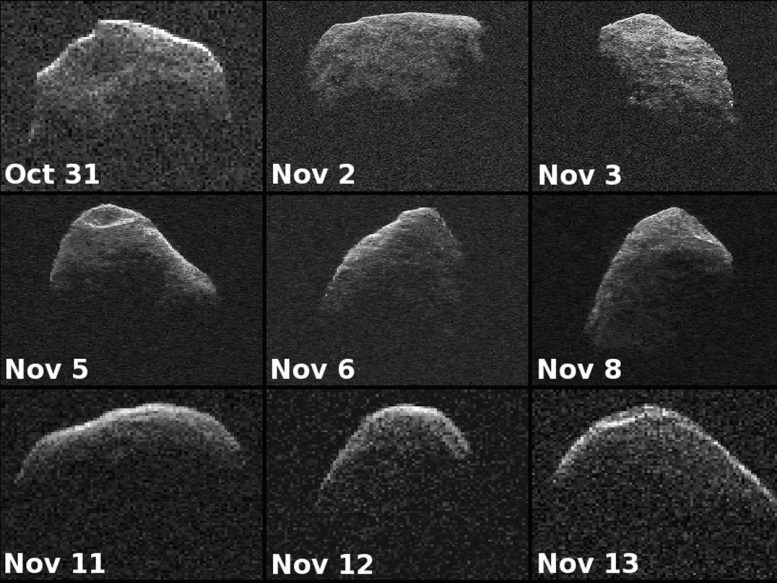
    Nine new radar images of near-Earth asteroid 2012 PA8
    Nine new radar images of near-Earth asteroid 2012 PA8 were obtained between October 31 and November 13, 2012, with data collected by NASA’s 230-foot-wide (70-meter) Deep Space Network antenna at Goldstone, California. Credit: NASA/JPL-Caltech

    Nine new radar images were taken of asteroid 2007 PA8, a near-Earth asteroid that measures roughly 1.6 kilometers wide. 2007 PA8 passed at a distance of roughly 6.5 million kilometers, the closest since 1880, and its next flyby with Earth will be in 2488.

    A collage shows nine radar images of near-Earth asteroid 2007 PA8 that were obtained between October 31 and November 13, 2012, with data collected by NASA’s 230-foot-wide (70-meter) Deep Space Network antenna at Goldstone, California. On November 5 at 8:42 a.m. PST (11:42 a.m. EST/16:42 UTC), the object came about 4 million miles (6.5 million kilometers) from Earth, or 17 times the distance between Earth and the moon.

    The images of 2007 PA8 reveal possible craters, boulders, an irregular, asymmetric shape, and very slow rotation. The asteroid measures approximately one mile wide (about 1.6 kilometers).

    Each panel shows one image per day, and all of them are oriented so rotation is counterclockwise. Each image is shown at the same scale and covers 1.1 miles (1.7 kilometers) from top to bottom. The resolution of the images varies from day to day as the asteroid’s distance changed. The images achieve resolutions as fine as 12 feet (3.75 meters) per pixel on November 5 and 6, when the asteroid was closest. The resolution was 25 feet (7.5 meters) per pixel on November 2, 3 and 8, and 62 feet (18.75 meters) per pixel on October 31 and November 11 to 13.

    New radar measurements of 2007 PA8’s distance and line-of-sight velocity refined calculations of its orbit about the sun, enabling reliable computation of the asteroid’s motion for the next 632 years. 2007 PA8 is not a threat to Earth. The 2012 flyby was the closest since 1880. The next flyby with Earth closer than the one that occurred this year will be in 2488, when the asteroid will approach no closer than 3.6 million miles (5.8 million kilometers).

    NASA detects, tracks and characterizes asteroids and comets passing close to Earth using both ground- and space-based telescopes. The Near-Earth Object Observations Program, commonly called “Spaceguard,” discovers these objects, characterizes a subset of them, and plots their orbits to determine if any could be potentially hazardous to our planet.

    JPL manages the Near-Earth Object Program Office for NASA’s Science Mission Directorate in Washington. JPL is a division of the California Institute of Technology in Pasadena.

    Never miss a breakthrough: Join the SciTechDaily newsletter.
    Follow us on Google and Google News.

    Asteroid Astronomy JPL NASA
    Share. Facebook Twitter Pinterest LinkedIn Email Reddit

    Related Articles

    Small Asteroid Strikes Earth’s Atmosphere – Discovered Just Two Hours Before Impact

    NASA’s “Eyes on Asteroids” Reveals Our Near-Earth Object Neighborhood in Real-Time 3D

    1,000th Near-Earth Asteroid Observed by Planetary Radar Since 1968

    NASA’s NEOWISE Asteroid-Hunting Space Telescope Gets Two-Year Mission Extension

    NASA Analysis: Earth Is Safe From Asteroid Apophis Impact for at Least 100 Years

    NASA’s Planetary Defense: “Potentially Hazardous Asteroid” Predicted to Safely Pass by Earth on March 21

    Asteroid Apophis Will Make a Record Setting Close Approach to Earth

    NASA’s Dawn Gets a Close Up View of the Canuleia Crater on Vesta

    NASA’s WISE Uncovers New Clues on Jovian Trojans

    Leave A Reply Cancel Reply

    • Facebook
    • Twitter
    • Pinterest
    • YouTube

    Don't Miss a Discovery

    Subscribe for the Latest in Science & Tech!

    Trending News

    Popular Sugar-Free Sweetener Linked to Liver Disease, Study Warns

    What Is Hantavirus? The Deadly Disease Raising Alarm Worldwide

    Scientists Just Discovered How the Universe Builds Monster Black Holes

    Scientists Unveil New Treatment Strategy That Could Outsmart Cancer

    A Simple Vitamin May Hold the Key to Treating Rare Genetic Diseases

    Scientists Think the Real Fountain of Youth May Be Hiding in Your Gut

    Ravens Don’t Follow Wolves, They Predict Them

    This Common Knee Surgery May Be Doing More Harm Than Good

    Follow SciTechDaily
    • Facebook
    • Twitter
    • YouTube
    • Pinterest
    • Newsletter
    • RSS
    SciTech News
    • Biology News
    • Chemistry News
    • Earth News
    • Health News
    • Physics News
    • Science News
    • Space News
    • Technology News
    Recent Posts
    • Why Are So Many New Fathers Dying? Scientists Say the U.S. Has a Dangerous Blind Spot
    • Scientists Identify Simple Supplement That Greatly Reduces Alzheimer’s Damage
    • You May Have a Dangerous Type of Cholesterol Even if Your Tests Look Normal
    • Study Reveals Dangerous Flaw in AI Symptom Checkers
    • New MRI Breakthrough Captures Stunningly Clear Images of the Eye and Brain
    Copyright © 1998 - 2026 SciTechDaily. All Rights Reserved.
    • Science News
    • About
    • Contact
    • Editorial Board
    • Privacy Policy
    • Terms of Use

    Type above and press Enter to search. Press Esc to cancel.