
Close Menu
    Facebook X (Twitter) Instagram
    SciTechDaily
    • Biology
    • Chemistry
    • Earth
    • Health
    • Physics
    • Science
    • Space
    • Technology
    Facebook X (Twitter) Pinterest YouTube RSS
    SciTechDaily
    Home»Space»Asteroid Apophis Will Make a Record Setting Close Approach to Earth
    Space

    Asteroid Apophis Will Make a Record Setting Close Approach to Earth

    By Whitney Clavin, Jet Propulsion Laboratory; NASAJanuary 10, 20132 Comments3 Mins Read
    Facebook Twitter Pinterest Telegram LinkedIn WhatsApp Email Reddit
    Share
    Facebook Twitter LinkedIn Pinterest Telegram Email Reddit
    Herschel-Spacecraft-Eyes-Asteroid-Apophis
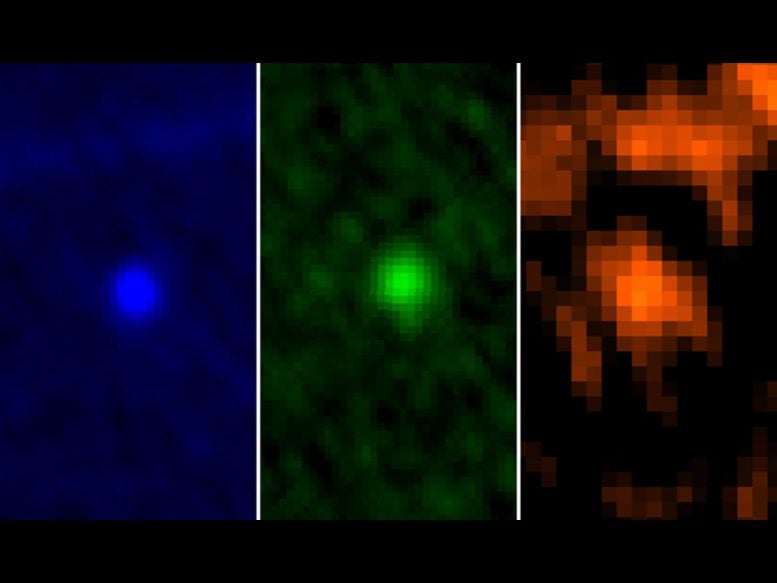
    The Photodetecting Array Camera and Spectrometer instrument aboard the European Space Agency’s Herschel Space Observatory captured asteroid Apophis in its field of view during the approach to Earth on January 5 and 6, 2013. The image shows asteroid Apophis in three wavelengths: 70, 100, and 160 microns, respectively. Credit: ESA/Herschel/PACS/MACH-11/MPE/ESAC

    Using the Herschel Space Observatory, scientists gathered new data on the asteroid Apophis, an asteroid that will make a recording-setting close approach to Earth and was initially given a 2.7 percent chance of impacting Earth in 2029.

    Scientists using the Herschel Space Observatory made new observations of asteroid Apophis as it approached Earth this past weekend. The data show the asteroid to be bigger than first estimated, and less reflective.

    Discovered in 2004, Apophis was initially thought to have a 2.7 percent chance of impacting Earth in 2029. Additional observations of the asteroid ruled out any possibility of an impact in 2029. However, Apophis is expected to make a record-setting — but harmless — close approach to Earth on April 13, 2029, when it comes no closer than 18,300 miles (29,450 kilometers) above Earth’s surface. The asteroid will make another approach to Earth in 2036. Data collected by telescopes during today’s close approach are expected to refine the asteroid’s orbit to the point where an impact in 2036 can be ruled out.

    The Herschel Observatory is a European Space Agency mission in which NASA plays an important role.

    Over the weekend, Herschel gathered data while observing Apophis for about two hours on its approach to Earth, ahead of today’s closest encounter at a little less than one-tenth of the distance from Earth to the sun: about 9 million miles (14.5 million kilometers).

    The space observatory provided the first thermal infrared observations of Apophis at different wavelengths, which together with optical measurements helped refine estimates of the asteroid’s properties. Previous estimates bracketed the asteroid’s average diameter at about 885 feet (270 meters). Herschel’s observations indicate the space rock is about 1,060 feet (325 meters) across.

    By analyzing the heat emitted by Apophis, Herschel also provided a new estimate of the asteroid’s albedo — a measure of its reflectivity — of 0.23. This value means that 23 percent of the sunlight falling onto the asteroid is reflected; the rest is absorbed and heats up the asteroid. The previous albedo estimate for Apophis was 0.33.

    Herschel is a European Space Agency cornerstone mission, with science instruments provided by consortia of European institutes and with important participation by NASA. NASA’s Herschel Project Office is based at NASA’s Jet Propulsion Laboratory, Pasadena, California, which contributed mission-enabling technology for two of Herschel’s three science instruments. The NASA Herschel Science Center, part of the Infrared Processing and Analysis Center at Caltech, supports the United States astronomical community.

    Never miss a breakthrough: Join the SciTechDaily newsletter.
    Follow us on Google and Google News.

    Asteroid Astronomy Herschel Space Observatory JPL NASA
    Share. Facebook Twitter Pinterest LinkedIn Email Reddit

    Related Articles

    A Cosmic Tale of Death & Dust Revealed in Orion Constellation

    Small Asteroid Strikes Earth’s Atmosphere – Discovered Just Two Hours Before Impact

    NASA’s “Eyes on Asteroids” Reveals Our Near-Earth Object Neighborhood in Real-Time 3D

    1,000th Near-Earth Asteroid Observed by Planetary Radar Since 1968

    NASA’s NEOWISE Asteroid-Hunting Space Telescope Gets Two-Year Mission Extension

    NASA Analysis: Earth Is Safe From Asteroid Apophis Impact for at Least 100 Years

    NASA’s Planetary Defense: “Potentially Hazardous Asteroid” Predicted to Safely Pass by Earth on March 21

    NASA’s Dawn Gets a Close Up View of the Canuleia Crater on Vesta

    NASA’s WISE Uncovers New Clues on Jovian Trojans

    2 Comments

    1. Din on January 10, 2013 8:19 pm

      Can’t we just like hike any asteroid for a free ride around the solar system for many scientific pursuits even for tracking purposes.

      Reply
    2. George J. Papagiannes on December 6, 2014 7:27 am

      Thank you for presenting an explanation of the data in a clear and concise manner for us layman. I was an engineer for 25 years and find it somewhat unsettling that the percentages stated in NASA’s and this article concerning close approach orbits are accurate within less than five percent(5%). I studied both Physics and Chemistry with labs and of course performed tightly controlled, laboratory experiments. My professors in both subjects unequivocally stated, that in industry, if a scientist attained a five percent (5%) accuracy it was considered outstanding, therefore, the 2.7% accuracy stated makes me somewhat suspicious. I was taught, that when presenting your data, you cannot use decimals places beyond the accuracy of your measuring instruments. NASA presents data up to ten (10) decimal places? These are uncontrolled, astronomical distances measurements with infinite possibilities for error!

      Reply
    Leave A Reply Cancel Reply

    • Facebook
    • Twitter
    • Pinterest
    • YouTube

    Don't Miss a Discovery

    Subscribe for the Latest in Science & Tech!

    Trending News

    Scientists Discover 132-Million-Year-Old Dinosaur Tracks on South Africa’s Coast

    Scientists Uncover the Secret Ingredient Behind the Spark That May Have Started Life on Earth

    Physicists Observe Matter in Two Places at Once in Mind-Bending Quantum Experiment

    Stanford Scientists Discover Hidden Brain Circuit That Fuels Chronic Pain

    New Study Reveals Why Ozempic Works Better for Some People Than Others

    Climate Change Is Altering a Key Greenhouse Gas in a Way Scientists Didn’t Expect

    New Study Suggests Gravitational Waves May Have Created Dark Matter

    Scientists Discover Why the Brain Gets Stuck in Schizophrenia

    Follow SciTechDaily
    • Facebook
    • Twitter
    • YouTube
    • Pinterest
    • Newsletter
    • RSS
    SciTech News
    • Biology News
    • Chemistry News
    • Earth News
    • Health News
    • Physics News
    • Science News
    • Space News
    • Technology News
    Recent Posts
    • 320 Light-Years Away, a Planet Confirms a Fundamental Cosmic Assumption
    • Astronomers Solve Decades-Long Mystery About Saturn’s Spin – “Something Strange Was Happening”
    • Scientists Uncover Strange New State of Matter Inside Uranus and Neptune
    • The Crown Jewel of Dentistry? Breakthrough Tech Could Transform Tooth Repair
    • The Surprising Non-Medical Factor That Determines Cancer Survival
    Copyright © 1998 - 2026 SciTechDaily. All Rights Reserved.
    • Science News
    • About
    • Contact
    • Editorial Board
    • Privacy Policy
    • Terms of Use

    Type above and press Enter to search. Press Esc to cancel.