
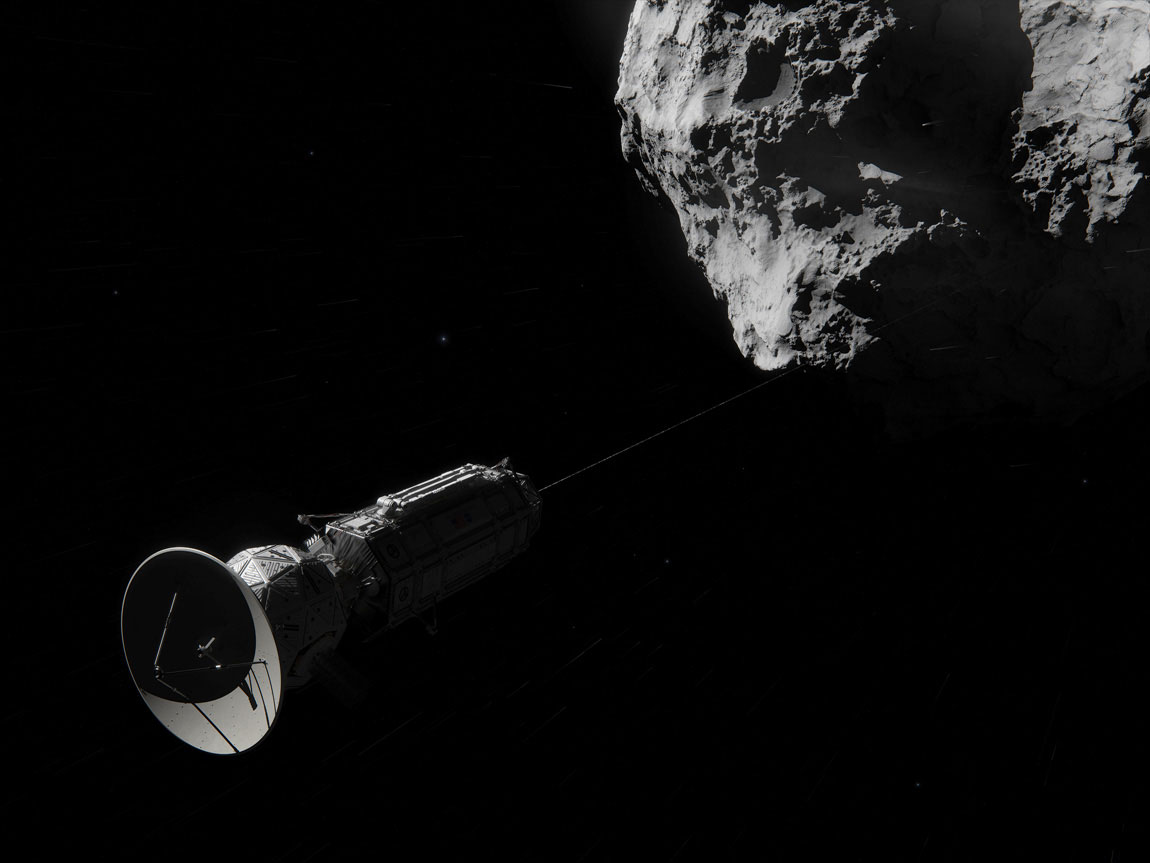
Comet Hitchhiker is in Phase I study through the NASA Innovative Advanced Concepts Program. Its goal is to use the kinetic energy of comets and asteroids to get into orbit and land on them.
Catching a ride from one solar system body to another isn’t easy. You have to figure out how to land your spacecraft safely and then get it on its way to the next destination. The landing part is especially tricky for asteroids and comets, which have low gravitational pull.
A concept called Comet Hitchhiker, developed at NASA’s Jet Propulsion Laboratory, Pasadena, California, puts forth a new way to get into orbit and land on comets and asteroids, using the kinetic energy — the energy of motion — of these small bodies. Masahiro Ono, the principal investigator based at JPL, had “Hitchhiker’s Guide to the Galaxy” in mind when dreaming up the idea.
“Hitchhiking a celestial body is not as simple as sticking out your thumb, because it flies at an astronomical speed and it won’t stop to pick you up. Instead of a thumb, our idea is to use a harpoon and a tether,” Ono said. Ono is presenting results about the concept at the American Institute of Aeronautics and Astronautics SPACE conference on September 1.
A reusable tether system would replace the need for propellant for entering orbit and landing, so running out wouldn’t be an issue, according to the concept design.
While closely flying by the target, a spacecraft would first cast an extendable tether toward the asteroid or comet and attach itself using a harpoon attached to the tether. Next, the spacecraft would reel out the tether while applying a brake that harvests energy while the spacecraft accelerates.
This technique is analogous to fishing on Earth. Imagine you’re on a boat on a lake with a fishing pole, and want to catch a big fish. Once the fish bites, you would release more of the line with a moderate tension, rather than holding it tightly. With a long enough line, the boat will eventually catch up with the fish.
Once the spacecraft matches its velocity to the “fish” — the comet or asteroid in this case — it is ready to land by simply reeling in the tether and descending gently. When it’s time to move on to another celestial target, the spacecraft would use the harvested energy to quickly retrieve the tether, which accelerates the spacecraft away from the body.
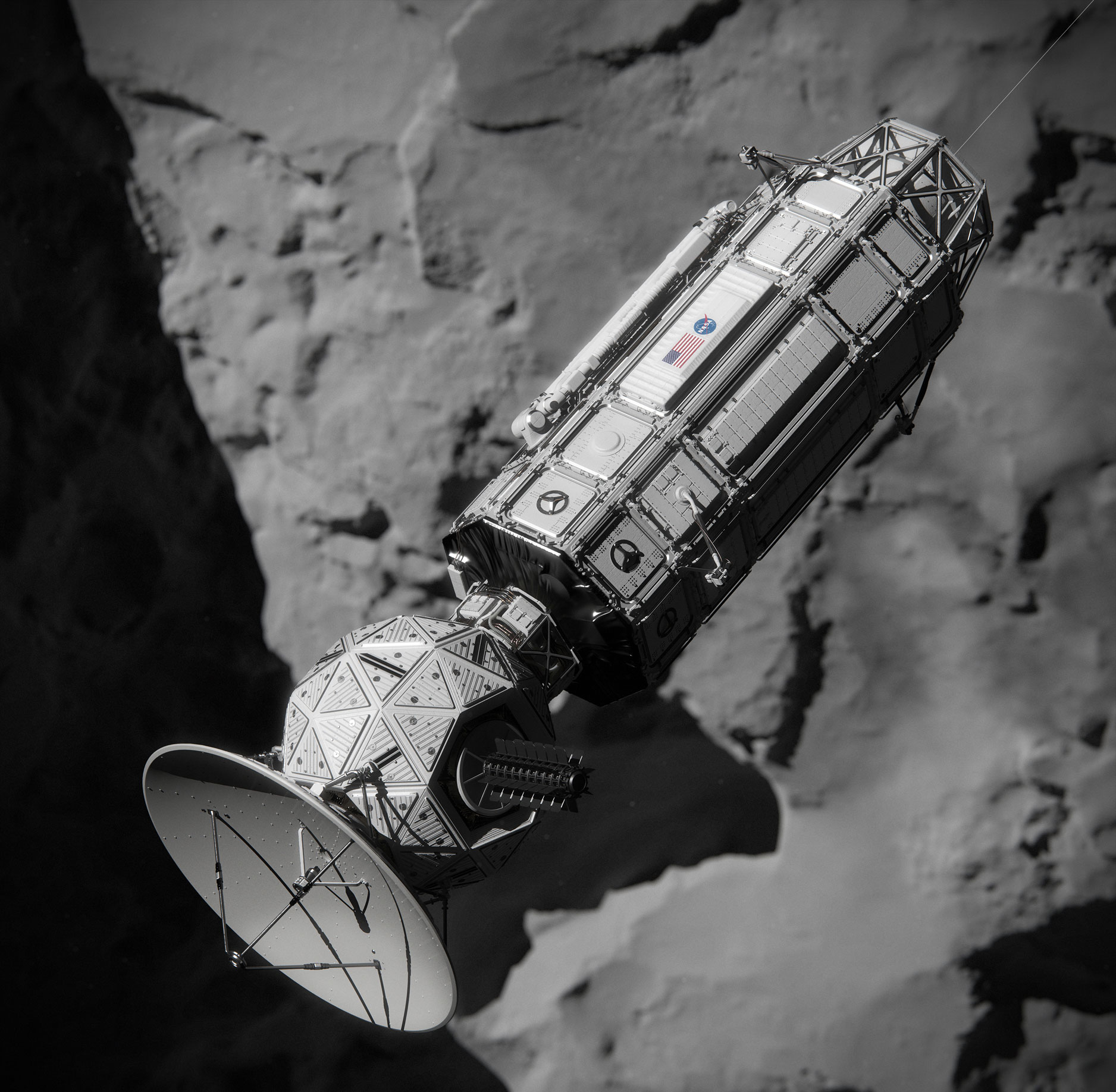
“This kind of hitchhiking could be used for multiple targets in the main asteroid belt or the Kuiper Belt, even five to 10 in a single mission,” Ono said.
Ono and colleagues have been studying whether a harpoon could tolerate an impact of this magnitude, and whether a tether could be created strong enough to support this kind of maneuver. They used supercomputer simulations and other analyses to figure out what it would take.
Researchers have come up with what they call the Space Hitchhike Equation, which relates the specific strength of the tether, the mass ratio between the spacecraft and the tether, and the change in velocity needed to accomplish the maneuver.
In missions that use conventional propellants, spacecraft use a lot of fuel just to accelerate enough to get into orbit.
“In Comet Hitchhiker, accelerating and decelerating do not require propellant because the spacecraft is harvesting kinetic energy from the target,” Ono said.
For any spacecraft landing on a comet or asteroid, being able to slow down enough to arrive safely is critical. Comet Hitchhiker requires a tether made from a material that can withstand the enormous tension and heat generated by a rapid decrease in speed for getting into orbit and landing. Ono and colleagues calculated that a velocity change of about 0.9 miles (1.5 kilometers) per second is possible with some materials that already exist: Zylon and Kevlar.
“That’s like going from Los Angeles to San Francisco in under seven minutes,” Ono said.
But the bigger the velocity change required for orbit insertion, the shorter the flight time needed to get from Earth to the target — so if you want to get to a comet or asteroid faster, you need even stronger materials. A 6.2 mile-per-second (10 kilometer-per-second) velocity change is possible, but would require more advanced technologies such as a carbon nanotube tether and a diamond harpoon.
Researchers also estimated that the tether would need to be about 62 to 620 miles long (100 to 1,000 kilometers) for the hitchhiking maneuver to work. It would also need to be extendable, and capable of absorbing jerks on it, while avoiding being damaged or cut by small meteorites.
The next steps for studying the concept would be to do more high-fidelity simulations and try casting a mini-harpoon at a target that mimics the material found on a comet or asteroid.
Comet Hitchhiker is in Phase I study through the NASA Innovative Advanced Concepts (NIAC) Program. NIAC is a program of NASA’s Space Technology Mission Directorate, located at the agency’s headquarters in Washington. Professor David Jewitt at the University of California, Los Angeles, partnered in this research. JPL is managed by the California Institute of Technology in Pasadena for NASA.
Never miss a breakthrough: Join the SciTechDaily newsletter.
Follow us on Google and Google News.
1 Comment
Hello, Elizabeth. Just wondering what the acceleration of the satellite would be. Is it 0.9 miles per second per second or 0.9 miles per hour per second.
Thanks!