
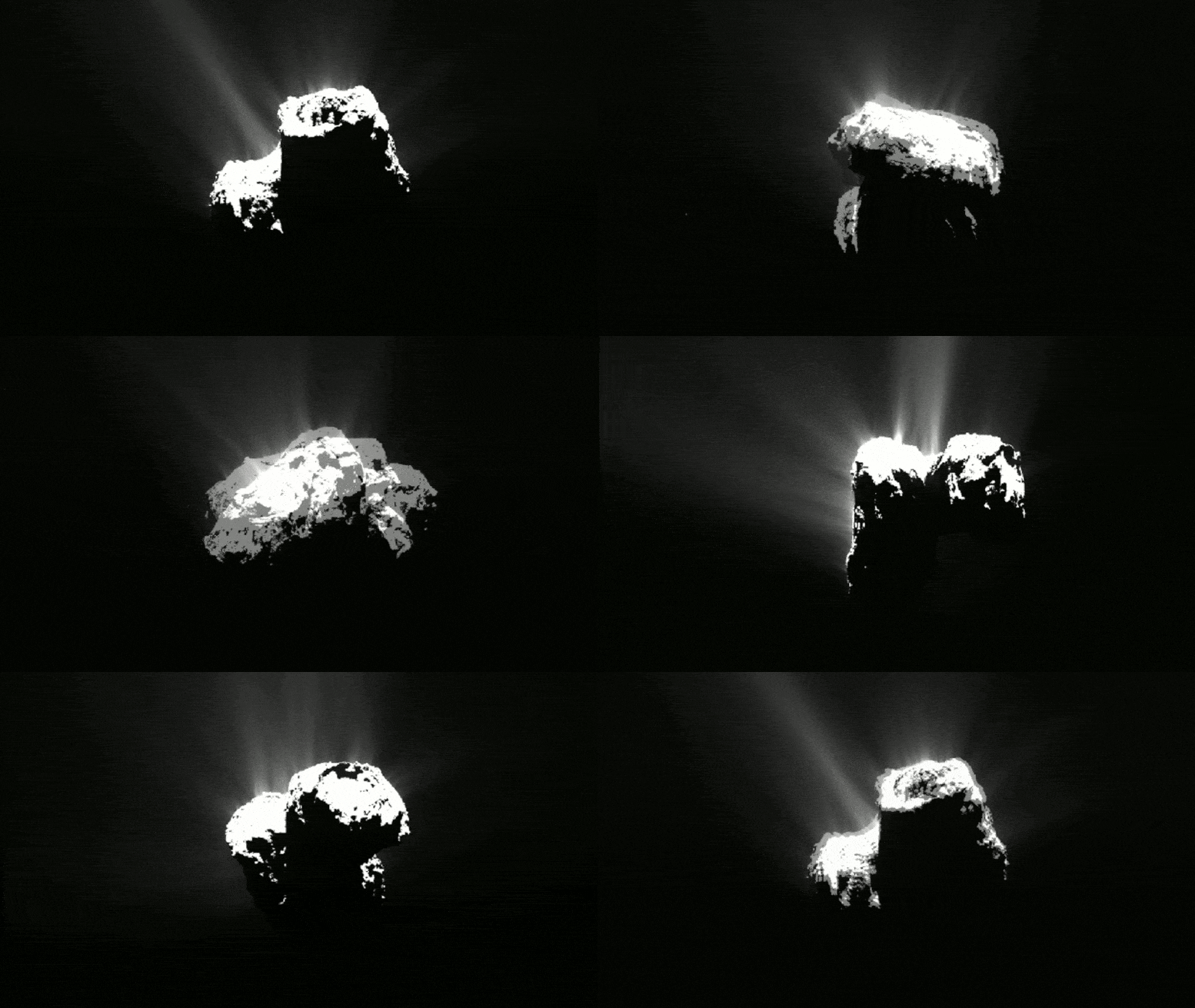
An atmospheric light show previously relegated to planets and Jupiter moons is found on comet using data from ESA’s Rosetta spacecraft.
Data from NASA instruments aboard the ESA (European Space Agency) Rosetta mission have helped reveal that comet 67P/Churyumov-Gerasimenko has its own far-ultraviolet aurora. It is the first time such electromagnetic emissions in the far-ultraviolet have been documented on a celestial object other than a planet or moon. A paper on the findings was released in the journal Nature Astronomy yesterday, September 21, 2020.
On Earth, aurora (also known as the northern or southern lights) are generated when electrically charged particles speeding from the Sun hit the upper atmosphere to create colorful shimmers of green, white, and red. Elsewhere in the solar system, Jupiter and some of its moons — as well as Saturn, Uranus, Neptune, and even Mars — have all exhibited their own version of northern lights. But the phenomena had yet to be documented in comets.
Rosetta is space exploration’s most traveled and accomplished comet hunter. Launched in 2004, it orbited comet 67P/Churyumov-Gerasimenko (67P/C-G) from August 2014 until its dramatic end-of-mission comet landing in September 2016. The data for this most recent study is on what mission scientists initially interpreted as “dayglow,” a process caused by photons of light interacting with the envelope of gas — known as the coma — that radiates from, and surrounds, the comet’s nucleus. But a new analysis of the data paints a very different picture.

“The glow surrounding 67P/C-G is one of a kind,” said Marina Galand of Imperial College London and lead author of the study. “By linking data from numerous Rosetta instruments, we were able to get a better picture of what was going on. This enabled us to unambiguously identify how 67P/C-G’s ultraviolet atomic emissions form.”
The data indicate 67P/C-G’s emissions are actually auroral in nature. Electrons streaming out in the solar wind — the stream of charged particles flowing out from the Sun — interact with the gas in the comet’s coma, breaking apart water and other molecules. The resulting atoms give off a distinctive far-ultraviolet light. Invisible to the naked eye, far-ultraviolet has the shortest wavelengths of radiation in the ultraviolet spectrum.
Exploring the emission of 67P/C-G will enable scientists to learn how the particles in the solar wind change over time, something that is crucial for understanding space weather throughout the solar system. By providing better information on how the Sun’s radiation affects the space environment they must travel through, such information could ultimately can help protect satellites and spacecraft, as well as astronauts traveling to the Moon and Mars.
“Rosetta is the gift that keeps on giving,” said Paul Feldman, an investigator on Alice at the Johns Hopkins University in Baltimore and a co-author of the paper. “The treasure trove of data it returned over its two-year visit to the comet have allowed us to rewrite the book on these most exotic inhabitants of our solar system — and by all accounts there is much more to come.”
NASA Instruments Aboard ESA’s Rosetta
NASA-supplied instruments contributed to this investigation. The Ion and Electron Sensor (IES) instrument detected the amount and energy of electrons near the spacecraft, the Alice instrument measured the ultraviolet light emitted by the aurora, and the Microwave Instrument for the Rosetta Orbiter (MIRO) measured the amount of water molecules around the comet (the MIRO instrument includes contributions from France, Germany, and Taiwan). Other instruments aboard the spacecraft used in the research were the Italian Space Agency’s Visible and InfraRed Thermal Imaging Spectrometer (VIRTIS), the Langmuir Probe (LAP) provided by Sweden, and the Rosetta Orbiter Spectrometer for Ion and Neutral Analysis (ROSINA) provided by Switzerland.
Rosetta was an ESA mission with contributions from its member states and NASA. Rosetta’s Philae lander, which successfully landed on the comet in November 2014, was provided by a consortium led by the German Aerospace Center in Cologne; Max Planck Institute for Solar System Research in Gottingen, Germany; the French National Space Agency in, Paris; and the Italian Space Agency in Rome. A division of Caltech, NASA’s Jet Propulsion Laboratory in Southern California managed the U.S. contribution of the Rosetta mission for NASA’s Science Mission Directorate in Washington. JPL also built the MIRO and hosts its principal investigator, Mark Hofstadter. The Southwest Research Institute (San Antonio and Boulder, Colorado), developed the Rosetta orbiter’s IES and Alice instruments and hosts their principal investigators, James Burch (IES) and Joel Parker (Alice).
For more on this astronomical discovery, read Ultraviolet Aurora Phenomenon Discovered on Comet Chury.
Reference: “Far-ultraviolet aurora identified at comet 67P/Churyumov-Gerasimenko” by M. Galand, P. D. Feldman, D. Bockelée-Morvan, N. Biver, Y.-C. Cheng, G. Rinaldi, M. Rubin, K. Altwegg, J. Deca, A. Beth, P. Stephenson, K. L. Heritier, P. Henri, J. Wm. Parker, C. Carr, A. I. Eriksson and J. Burch, 21 September 2020, Nature Astronomy.
DOI: 10.1038/s41550-020-1171-7
Never miss a breakthrough: Join the SciTechDaily newsletter.
Follow us on Google and Google News.
2 Comments
It is looking like the head of a person… 🙂
I noted that the paper made the local press, since one of the authors is from the Institute of Space Physics, Uppsala [ https://sverigesr…/7558532 ].
“Anders Eriksson at the Institute of Space Physics in Uppsala is one of the researchers behind the study.
– When we had first collected all the measurements – of UV light, of electrons, of plasma density and of gas density – and discovered the image that came out of this, we just looked at each other and said: “but, this is the northern lights” .”
I practiced there – Anders is nice person with lots of humor which often gets interviewed locally on these matters, this time on his own research.