
Close Menu
    Facebook X (Twitter) Instagram
    SciTechDaily
    • Biology
    • Chemistry
    • Earth
    • Health
    • Physics
    • Science
    • Space
    • Technology
    Facebook X (Twitter) Pinterest YouTube RSS
    SciTechDaily
    Home»Biology»Tiny Spider Brains Overflow Into the Body and Legs
    Biology

    Tiny Spider Brains Overflow Into the Body and Legs

    By SciTechDailyDecember 13, 20111 Comment2 Mins Read
    Facebook Twitter Pinterest Telegram LinkedIn WhatsApp Email Reddit
    Share
    Facebook Twitter LinkedIn Pinterest Telegram Email Reddit
    Spider Brains
    Spider brains

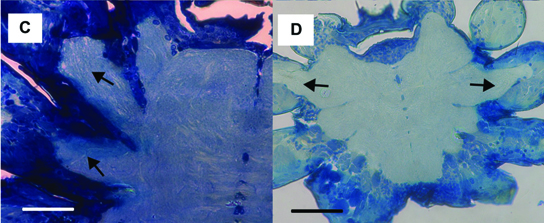
    According to Smithsonian researchers, the brains of tiny spiders are so large that they fill their body cavities and even overflow into their legs. They are essentially walking brains. Researchers measured the central nervous systems of nine species of spiders, everything from giant rainforest dwellers to spiders smaller than the head of a pin. What they found is startling. As the spiders get smaller, their brains get proportionally bigger, to the point where they fill up more and more of the body.

    They discovered that the central nervous systems of the smallest spiders fill up nearly 80 percent of the body cavity, including about 25 percent of their legs. This would explain why some of the tiniest, immature spiders have deformed and bulging bodies. The bulge contains extra brain. Adults of this same species do not have that bulge.

    It’s a matter of getting a whole species’ worth of genetic info into a smaller size. Brain cells can’t really get any smaller, because most cells have a nucleus that contains all of the spider’s genes. This takes up space. The diameter of the nerve fibers or axons also cannot be smaller because the flow of ions that carry nerve signals cannot be interrupted, or the signals are not transferred properly. It’s sort of like taking the hard drive from your laptop and incorporating that into your tablet PC. You have a smaller device, but now more of it is storage.

    “We suspected that the spiderlings might be mostly brain because there is a general rule for all animals, called Haller’s rule, that says that as body size goes down, the proportion of the body taken up by the brain increases,” said William Wcislo, staff scientist at the Smithsonian Tropical Research Institute. “Human brains only represent about 2-3 percent of our body mass. Some of the tiniest ant brains that we’ve measured represent about 15 percent of their biomass, and some of these spiders are much smaller.”

    Never miss a breakthrough: Join the SciTechDaily newsletter.
    Follow us on Google and Google News.

    Brain Nature Smithsonian Smithsonian Tropical Research Institute Spiders
    Share. Facebook Twitter Pinterest LinkedIn Email Reddit

    Related Articles

    “Astonishing” 500-Million-Year-Old Fossilized Brains Prompt a Rethink of the Evolution of Insects and Spiders

    Spider Fangs May Lead to the Development of New Specialized Materials

    Neuroscientists Study Cortical Areas Specialized in Processing Visual Inputs in Mice

    Genetically Modified Silk Worms Yield Super Strong Silk

    Female Sumatran Rhino May Be The Key to Saving The Species

    Bearing Gifts Equals More Sex Even With Spiders

    Using Bees To Ease Tensions Between People And Elephants

    Human Stem Cells Transplanted Into Mouse Brains

    Orb Spiders Have Toxic Burglar Alarms To Protect Against Web Invasion

    1 Comment

    1. Madanagopal.V.C. on November 15, 2012 7:18 pm

      Why? Even our brains pass through spinal chord through the spinal column which is the nerve junction for all organs of the body. Since spiders are spineless creatures this arrangement is made to contain its developing brain whose activity involves very fine highly skilled spinning ability. Even in our brain the portion allotted to fingers and especially the thumb occupies more space to tackle the highly skilled work of humans. Thank You.

      Reply
    Leave A Reply Cancel Reply

    • Facebook
    • Twitter
    • Pinterest
    • YouTube

    Don't Miss a Discovery

    Subscribe for the Latest in Science & Tech!

    Trending News

    Don’t Miss: August Brings Two Eclipses and the Perseid Meteor Shower

    Brain Waves Once Dismissed As Noise May Help Build Our Reality

    Perseverance Finds Organic Carbon Preserved Just Beneath the Martian Surface

    Tick Found in Austin Apartment Linked to Rare Relapsing Fever

    Ozempic Changes Your Body, but Does It Change Your Life? A New Study Suggests Not

    Ancient Super-Eruptions May Have Frozen Earth for Centuries

    A Common Sugar May Loosen Cancer Cells and Help Them Spread

    Scientists Discover a Major Brain Change That Starts Around Age 50

    Follow SciTechDaily
    • Facebook
    • Twitter
    • YouTube
    • Pinterest
    • Newsletter
    • RSS
    SciTech News
    • Biology News
    • Chemistry News
    • Earth News
    • Health News
    • Physics News
    • Science News
    • Space News
    • Technology News
    Recent Posts
    • Scientists Discover a Hidden Way T Cells Attack Leukemia
    • A Vegan Diet May Begin Changing Gene Activity in Just 4 Weeks
    • Belly Fat and Low Vitamin D May More Than Double the Risk of Early Death
    • Researchers Map the Hidden 3D Geometry of a Quantum Wavefunction
    • Lost in Space: Rare Cosmic Flare Exposes a Wandering Black Hole Far From Its Galaxy’s Center
    Copyright © 1998 - 2026 SciTechDaily. All Rights Reserved.
    • Science News
    • About
    • Contact
    • Editorial Board
    • Privacy Policy
    • Terms of Use

    Type above and press Enter to search. Press Esc to cancel.