
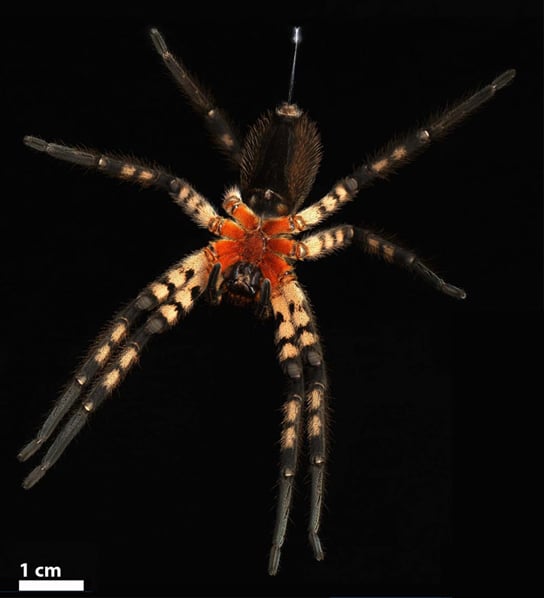
Looking to nature for technological inspiration is nothing new and now a team of scientists are hoping that new insights into spider fangs and the composition and structure of their materials may provide inspiration for the optimization of similar technical materials and devices.
Although their armor consists of the same material as their predator’s fangs, flies, grasshoppers and other insects that are the usual prey of spiders have little to offer by way of defense against the spider’s bite. As researchers of the Max Planck Institute of Colloids and Interfaces in Potsdam, the Max Planck Institute of Microstructure Physics in Halle and the University of Vienna have discovered, the chitin fibers in the fangs of a large Central American wandering spider are arranged and surrounded with proteins in a way that makes the material particularly rigid and thus capable of penetrating its prey’s cuticular armor. Thanks to the composition and structure of their materials, the fangs become optimized and reusable hypodermic needles for injecting prey with paralyzing venom. The new insights into this biological material could provide inspiration for the optimization of similar technical materials and devices.
Nature has been using fiber-reinforced materials far longer than technology. The material of the armor deployed by arthropods, such as arachnids, insects and crustaceans, the cuticle, is composed of a multitude of extremely fine layers of chitin fibers. The fibers arrange themselves parallel to the surface and are typically embedded in a protein matrix. This natural composite adapts to its wide-ranging uses through the strong variations in both the composition and form of the material in different parts of the exoskeleton. The arrangement of the fibers and the protein composition have a crucial influence on the mechanical properties of the material.
“In-depth studies of this cuticular armor can provide numerous new ideas for better, bio-inspired material design,” says Yael Politi, who has studied the spider at close quarters together with her colleagues. This view is particularly applicable to structures like the fangs as, due to their vital function, their “design” clearly came under particularly strong pressure over the course of evolution. Because the technical perfection of a biological structure can only be completely understood if its natural functions are taken into account, the scientists from the Max Planck Institutes in Potsdam and Halle worked closely with Friedrich Barth, a biologist from the University of Vienna and expert on spiders with particular expertise in their sensory systems and biomechanics.
The arrangement of the chitin fibers influences the properties of the material
In the course of their studies the scientists noticed that the structure of the material in the fangs of the wandering spider Cupiennius salei differs clearly from that in other parts of the skeleton. Specifically, they observed that the chitin fibers are arranged in a particular way there. In a special zone, the fibers in the different layers mainly run in the direction in which high strain trajectories may be expected during biting. This lends the fang tailor-made mechanical resistance, as the chitin fibers are always stiffer parallel to their longitudinal axis than perpendicular to it. “The highest degree of alignment was found in the mid part of the fang”, explains Friedrich Barth.
Metal ions increase the stability of the fang tip
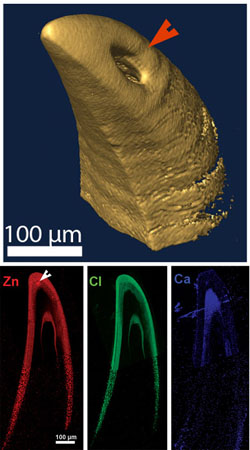
The protein matrix in the venom fang is also optimized with a view to its function. Proteins are characterized by high chemical variability and can, therefore, be easily modified. The spider takes advantage of this in its fangs to gain a material-technological advantage over its prey when hunting. “Remarkably, the fang tip and the outer cuticular layers, which are exposed to the highest strain during biting, mainly consist of proteins,” says Friedrich Barth. The protein composition changes from the base of the fang to its tip, where the concentration of the amino acid histidine is significantly higher. Histidine is particularly suitable for cross-linking the proteins with metal ions. Because the researchers also discovered zinc and calcium in the protein matrix, they assume that neighboring fibers in the protein matrix of the fang tip are actually cross-linked. This makes the tip particularly hard and stiff. Moreover, the stable protein matrix also effectively transmits the stress that arises during the penetration of a prey’s cuticular armor to the chitin fibers.
The researchers also established that chloride ions are incorporated into the protein matrix. “Interestingly, the chloride ions and each of the metal ions are distributed differently” says Yael Politi. However, the function of the chloride ions, the criteria according to which the distribution of the incorporated elements is selected, and how this affects the mechanical properties of the fangs, remains unclear.
Nonetheless, what is definite is that: “Spider fangs have a highly specialized material structure. The material properties change in fine gradations from the base to the tip of the fang and the external layer of the fangs seems to be resistant to abrasion,” explains Yael Politi. An in depth investigation of the different chemical and structural changes enabling the material properties of the cuticular armor to adapt so sensitively to specific biological functions is a highly rewarding objective for the researchers. Their work may well prove to be of practical benefit. “The knowledge we are gaining here could provide the basis for the development of materials for special applications or hypodermic syringes with special shapes and material properties for medical applications,” says Politi.
Reference: “A Spider’s Fang: How to Design an Injection Needle Using Chitin-Based Composite Material” by Yael Politi, Matthias Priewasser, Eckhard Pippel, Paul Zaslansky, Jürgen Hartmann, Stefan Siegel, Chenghao Li, Friedrich G. Barth and Peter Fratzl, 22 March 2012, Advanced Functional Materials.
DOI: 10.1002/adfm.201200063
Never miss a breakthrough: Join the SciTechDaily newsletter.
Follow us on Google and Google News.