
Close Menu
    Facebook X (Twitter) Instagram
    SciTechDaily
    • Biology
    • Chemistry
    • Earth
    • Health
    • Physics
    • Science
    • Space
    • Technology
    Facebook X (Twitter) Pinterest YouTube RSS
    SciTechDaily
    Home»Space»NASA Prepares for Mars with Desert Rover Tests
    Space

    NASA Prepares for Mars with Desert Rover Tests

    By Guy Webster, Jet Propulsion LaboratoryMay 14, 2012No Comments2 Mins Read
    Facebook Twitter Pinterest Telegram LinkedIn WhatsApp Email Reddit
    Share
    Facebook Twitter LinkedIn Pinterest Telegram Email Reddit
    Mojave Desert Tests for NASA Mars Rover
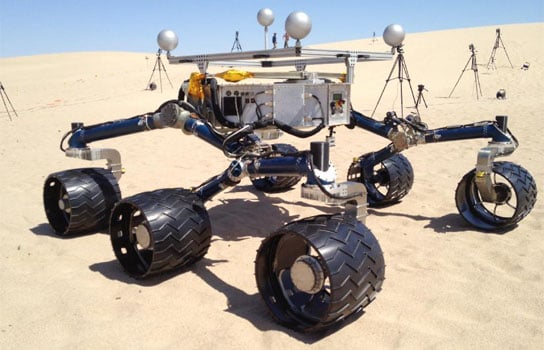
    Mars Science Laboratory mission team members ran mobility tests on California sand dunes in early May 2012 in preparation for operating the Curiosity rover, currently en route to Mars, after its landing in Mars’ Gale Crater. Credit: NASA/JPL-Caltech

    In preparation for Curiosity’s exploration of Mount Sharp on Mars, NASA engineers took a test rover out to the desert for last-minute training in the sand dunes.

    Team members of NASA’s Mars Science Laboratory mission took a test rover to Dumont Dunes in California’s Mojave Desert this week to improve knowledge of the best way to operate a similar rover, Curiosity, currently flying to Mars for an August landing.

    The test rover that they put through paces on various sandy slopes has a full-scale version of Curiosity’s mobility system, but it is otherwise stripped down so that it weighs about the same on Earth as Curiosity will weigh in the lesser gravity of Mars.

    Information collected in these tests on windward and downwind portions of dunes will be used by the rover team in making decisions about driving Curiosity on dunes near a mountain in the center of Gale Crater.

    First, however, the Mars Science Laboratory spacecraft, launched on November 26, 2011, must put Curiosity safely onto the ground. Safe landing on Mars is never assured, and this mission will use innovative methods to land the heaviest vehicle in the smallest target area ever attempted on Mars. Advances in landing heavier payloads more precisely are steps toward eventual human missions to Mars.

    Curiosity is on track for landing on the evening of August 5, 2012, PDT (early on August 6, Universal Time and EDT) to begin a two-year prime mission. Researchers plan to use Curiosity to study layers in Gale Crater’s central mound, Mount Sharp. The mission will investigate whether the area has ever offered an environment favorable for microbial life.

    Never miss a breakthrough: Join the SciTechDaily newsletter.
    Follow us on Google and Google News.

    Curiosity Rover JPL Mars NASA
    Share. Facebook Twitter Pinterest LinkedIn Email Reddit

    Related Articles

    This Martian “Stone Web” Could Rewrite Mars’ Geological History

    What Left This Long, Winding Trail Across Mars? NASA’s Orbiter Has the Answer

    Mars Kept a Secret for 3.5 Billion Years – NASA’s Curiosity Rover Finally Dug It Up

    Life on Mars? NASA’s Curiosity Rover Finds Prebiotic Clues in a 3.7-Billion-Year-Old Rock

    NASA’s Curiosity Rover Uncovers Mars’ Mysterious Spiderweb Rocks and Hidden Crystals

    Curiosity’s Wild Ride: How the Sky Crane Changed the Way NASA Explores Mars

    “Strange and Unexpected” – NASA’s Curiosity Rover Stumbles Upon Yellow Crystals on Mars

    NASA’s Curiosity Mars Rover Faces a Particularly Prickly Power Puzzle

    Dusty Dilemmas: NASA’s Curiosity Mars Rover Navigates Rocky Riddles

    Leave A Reply Cancel Reply

    • Facebook
    • Twitter
    • Pinterest
    • YouTube

    Don't Miss a Discovery

    Subscribe for the Latest in Science & Tech!

    Trending News

    JWST Finds a “Star” 100 Billion Times Brighter Than Any Star Should Be

    Scientists Find a Hidden Biological Link Across Different Forms of Autism

    Astronomers Discover a Ghostly River of Stars That Could Reveal Dark Matter

    Why Is Colorectal Cancer Rising in People Under 50? New Clues Point to the Environment

    Quantum Fluctuations Break a Crystal’s Symmetry Rules

    Why Does an Irregular Heartbeat Strike 40 Years Early in Some People?

    Scientists Reveal How ADHD Could Fuel Creative Thinking

    Scientists Find Just 3 Minutes of Sprinting Can Transform Blood Chemistry

    Follow SciTechDaily
    • Facebook
    • Twitter
    • YouTube
    • Pinterest
    • Newsletter
    • RSS
    SciTech News
    • Biology News
    • Chemistry News
    • Earth News
    • Health News
    • Physics News
    • Science News
    • Space News
    • Technology News
    Recent Posts
    • This Grain-of-Rice-Sized “Rainbow” Chip Could Transform 6G Communications
    • Physicists Discover Time Crystals Can Communicate Across a Semiconductor
    • Scientists Finally Solve a 20-Year Mystery About Diamond Melting
    • Common Vape Flavor May Disrupt Early Human Development
    • Ultra-Processed Foods Linked to 30% Higher Prostate Cancer Risk
    Copyright © 1998 - 2026 SciTechDaily. All Rights Reserved.
    • Science News
    • About
    • Contact
    • Editorial Board
    • Privacy Policy
    • Terms of Use

    Type above and press Enter to search. Press Esc to cancel.