
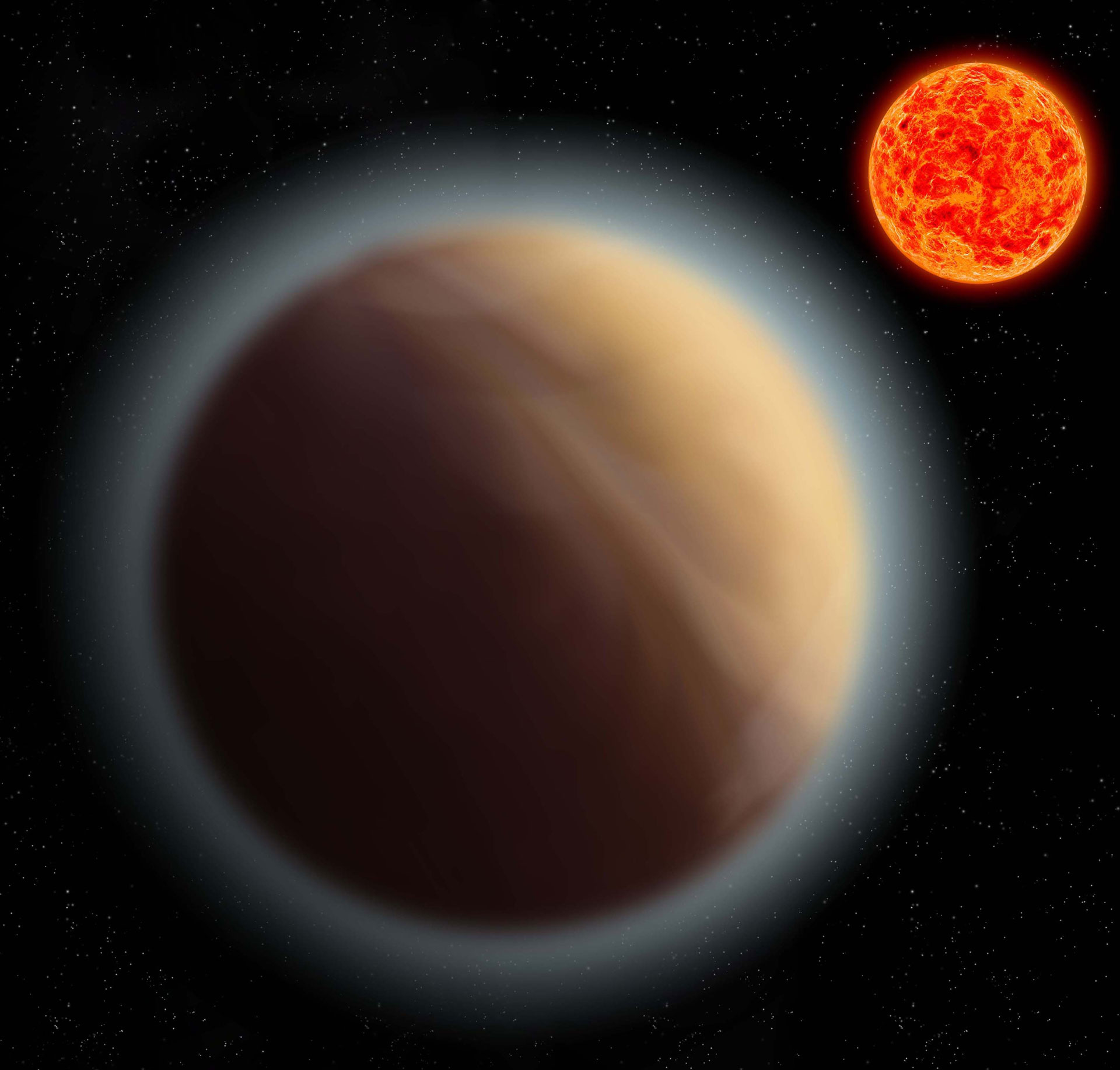
Using ESO/MPG telescope in Chile, a team of astronomers has detected an atmosphere around an Earth-like planet for the first time. The planet, super-Earth planet GJ 1132b, is located 39 light-years away.
Researchers have detected an atmosphere around the super-Earth planet GJ 1132b. This marks the first detection of an atmosphere around an Earth-like planet other than Earth itself, and thus is a significant step on the path towards the detection of life outside our Solar System. The team that made the discovery, led by Keele University’s Dr. John Southworth, used the 2.2 m ESO/MPG telescope in Chile to take images of the planet’s host star GJ 1132. They were able to measure the slight decrease in brightness as the planet and its atmosphere absorbed some of the starlight while transiting (passing in front of) the host star.
Dr. John Southworth explains:
“While this is not the detection of life on another planet, it’s an important step in the right direction: the detection of an atmosphere around the super-Earth GJ 1132b marks the first time that an atmosphere has been detected around an Earth-like planet other than Earth itself.”
Is there life out there?
Astronomers’ current strategy for finding life on another planet is to detect the chemical composition of that planet’s atmosphere, on the lookout for chemical imbalances which could be caused by living organisms. In the case of our own Earth, the presence of large amounts of oxygen is a tell-tale sign of life.
Until these findings by Dr. Southworth’s team, the only previous detections of exoplanet atmospheres all involved gas giants reminiscent of a high-temperature Jupiter.
Dr. Southworth says that whilst we’re still a long way from detecting life on exoplanets, this discovery is the first step:
“With this research, we have taken the first tentative step into studying the atmospheres of smaller, Earth-like, planets. We simulated a range of possible atmospheres for this planet, finding that those rich in water and/or methane would explain the observations of GJ 1132b. The planet is significantly hotter and a bit larger than Earth, so one possibility is that it is a “water world” with an atmosphere of hot steam.”
Studying atmospheres
The planet in question, GJ 1132b, orbits the very low-mass star GJ 1132 in the Southern constellation Vela, at a distance of 39 light-years from Earth. The system was studied by a team led by John Southworth (Keele University, UK) and Luigi Mancini (currently at the University of Rome Tor Vergata), including researchers from the Max Planck Institute for Astronomy (MPIA, Germany) and the University of Cambridge.
The team used the GROND imager at the 2.2 m ESO/MPG telescope of the European Southern Observatory in Chile to observe the planet simultaneously at seven different wavelength bands spanning the optical and near-infrared. As GJ 1132b is a transiting planet, it passes directly between Earth and its host star every 1.6 days, blocking a small fraction of the star’s light. From the amount of light lost, astronomers can deduce the planet’s size – in this case only 1.4 times that of Earth.
Crucially, the new observations showed the planet to be larger in one of the seven wavelength bands. This suggests the presence of an atmosphere that is opaque to this specific light (making the planet appear larger), but transparent to all the others.
The discovery of this atmosphere is encouraging. Very low-mass stars are extremely common (much more so than Sun-like stars), and are known to host lots of small planets. But they also show a lot of magnetic activity, causing high levels of X-rays and ultraviolet light to be produced which might completely evaporate the planets’ atmospheres. However, the properties of GJ 1132b show that an atmosphere can endure this for billion of years without being destroyed. Given the huge number of very low-mass stars and planets, this could mean that the conditions suitable for life are common in the Universe.
This discovery makes GJ 1132b one of the highest-priority targets for further study by the current top facilities, such as the Hubble Space Telescope and ESO’s Very Large Telescope, as well as the James Webb Space Telescope which is slated for launch in 2018.
Reference: “Detection of the atmosphere of the 1.6 Earth mass exoplanet GJ 1132b” by John Southworth, Luigi Mancini, Nikku Madhusudhan, Paul Mollière, Simona Ciceri and Thomas Henning, 31 March 2017, The Astrophysical Journal.
DOI: 10.3847/1538-3881/aa6477
Never miss a breakthrough: Join the SciTechDaily newsletter.
Follow us on Google and Google News.