
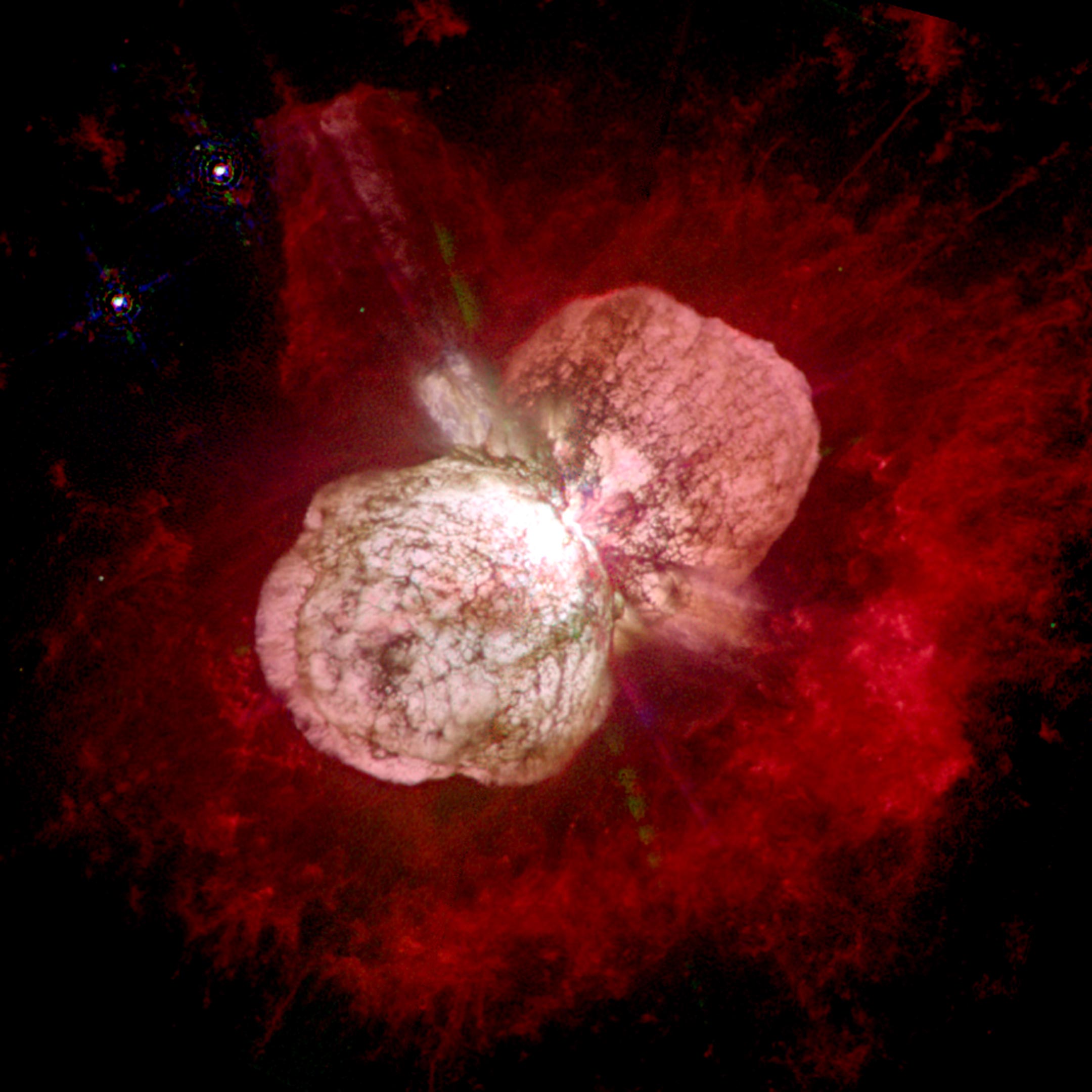
New simulations suggest Eta Carinae’s nebula likely formed from a stellar merger in a triple system.
‘Eta Carinae’ is an extraordinary star that has fascinated mankind for decades. It’s surrounded by an expanding ‘Homunculus nebula’, shaped like an hourglass. This nebula was expelled in an energetic explosion called the ‘Great Eruption’ that occurred in the 1840s, when Eta Carinae became the second brightest star in the sky and was visible to the naked eye for over a decade.
There are other clusters of bullets outside the Homunculus nebula, that were shot out several centuries before the Great Eruption. Eta Carinae itself is extremely massive with a mass more than 100 times the Sun and is orbited by another star that has a mass about 30 times the Sun on a highly eccentric orbit. With all these and many more peculiar features, scientists have been puzzled for a long time about how the star exploded and created the surrounding messy nebula.
A Clue from a Triple System Hypothesis
Out of many other proposed models, our recently published study focused on one hypothesis that the star system used to be a triple system that eventually became unstable and caused a stellar merger. As more detailed observations are made, this scenario is becoming increasingly popular but has lacked detailed theoretical investigations so far.
In this work, we performed the first comprehensive set of detailed theoretical calculations for this scenario. We first carried out three-body dynamical simulations to see how a triple system becomes unstable and eventually two of the stars collide. We started with a stable system in which one star is in a wide orbit around the other two stars which are in close orbit. Once the most massive star approaches the end of its life, it expands and starts transferring matter to its companion. This makes the system unstable and causes two of the stars to merge within a few thousand years. We found that before the final merger, the stars can wildly swap their positions and encounter each other at close distances, grazing each other’s surfaces.
We carried out additional N-body simulations to see how a star responds to these close encounters. Part of the surface material can be peeled off and sent away as narrow sprays. Combining the orbital dynamics and close-encounter simulations, we found that the multiple grazing encounters—that occurred centuries before the merger—can reproduce the messy structure outside the Homunculus nebula.
We also carried out hydrodynamical simulations to see how the outflow from the stellar merger is shaped into the hourglass shape we see today. We proposed a new scenario that takes similar ideas for how the triple-ring nebula for the supernova SN1987A was formed. As the stars merge, a huge amount of energy is released inside the star, causing the Great Eruption. But unlike supernovae, a large fraction of the energy and mass remains in the star. This energy slowly leaks out over the following century as strong bipolar winds. The wind sweeps up the inner parts of the explosion ejecta and forms a hollow shell-like structure. Our simulations show that with this scenario, we can closely reproduce the shape and size of the Homunculus nebula.
Understanding Stellar Mergers and Cosmic Exotica
Our combination of simulations successfully reproduces the main features of Eta Carinae’s surrounding nebula and provides strong support to the stellar-merger-in-a-triple scenario. This not only gives us insight into the origin of Eta Carinae, but also many other astronomical objects that can be created through mergers in triple systems. For example, some massive black holes found by LIGO (GW190521) are considered to have been created this way. Using the rich information from Eta Carinae, we can learn much more about the formation of exotica in our Universe.
Never miss a breakthrough: Join the SciTechDaily newsletter.
Follow us on Google and Google News.