
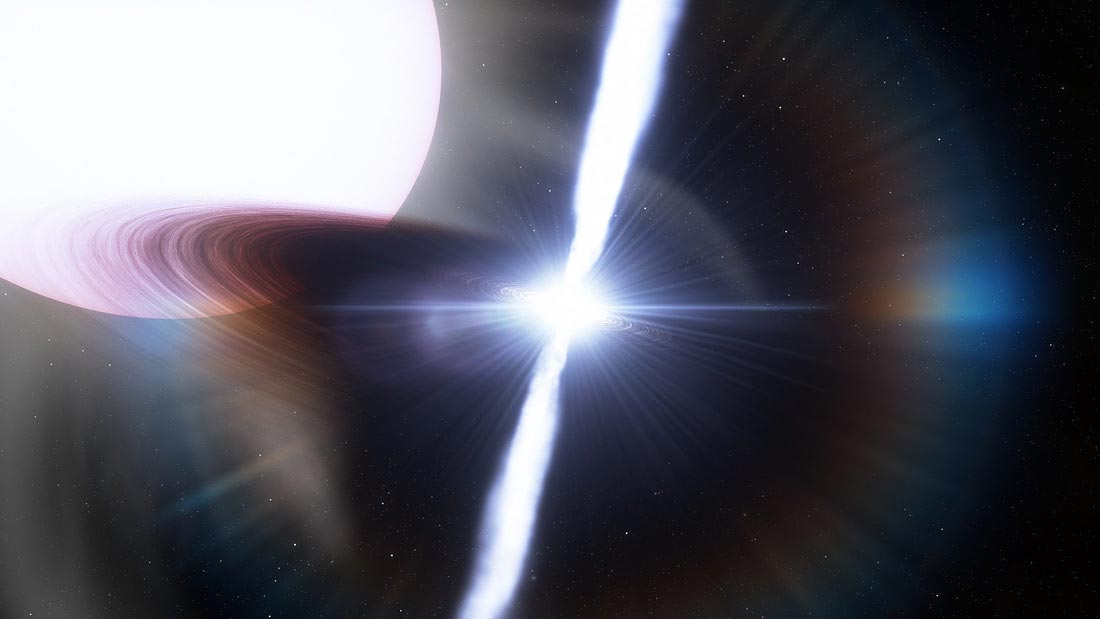
Few black hole–star systems emit X-rays because only rare asymmetric stellar winds allow the formation of glowing accretion disks.
The first evidence of the existence of black holes was found in the 1960s, when strong X-rays were detected from a system called Cygnus X-1. In this system, the black hole is orbited by a massive star blowing an extremely strong wind, more than 10 million times stronger than the wind blowing from the Sun. Part of the gas in this wind is gravitationally attracted towards the black hole, creating an ‘accretion disk’, which emits the strong X-rays that we observe. These systems with a black hole and a massive star are called ‘high-mass X-ray binaries’ and have been very helpful in understanding the nature of black holes.
After nearly 60 years since the first discovery, only a handful of similar high-mass X-ray binaries have been detected. Many more of them were expected to exist, especially given that many binary black holes (the future states of high-mass X-ray binaries) have been discovered with gravitational waves in the past few years. There are also many binaries found in our Galaxy that are expected to eventually become a high-mass X-ray binary. So, we see plenty of both the predecessors and descendants, but where are all the high-mass X-ray binaries themselves hiding?
One explanation states that even if a black hole is orbited by a massive star blowing a strong wind, it does not always emit X-rays. To emit X-rays, the black hole needs to create an accretion disk, where the gas swirls around and becomes hot before falling in. To create an accretion disk, the falling gas needs ‘angular momentum’, so that all the gas particles can rotate around the black hole in the same direction. However, we find it is generally difficult to have enough angular momentum falling onto the black hole in high-mass X-ray binaries. This is because the wind is usually considered to be blowing symmetrically, so there is almost the same amount of gas flowing past the black hole both clockwise and counter-clockwise. As a result, the gas can fall into the black hole directly without creating an accretion disk, so the black hole is almost invisible.
How Stellar Winds Create X-Rays
But if this is true, why do we see any X-ray binaries at all? In our paper, we solved the equations of motion for stellar winds and we found that the wind does not blow symmetrically when the black hole is close enough to the star. The wind blows with a slower speed in the direction towards and away from the black hole, due to the tidal forces. Because of this break of symmetry in the wind, the gas can now have a large amount of angular momentum, enough to form an accretion disk around the black hole and shine in X-rays. The necessary conditions for this asymmetry are rather strict, so only a small fraction of black hole + massive star binaries will be able to be observed.
The model in our study explains why there are only a small number of detected high-mass X-ray binaries, but this is only the first step in understanding asymmetric stellar winds. By investigating this model further, we might be able to solve many other mysteries of high-mass X-ray binaries.
Written by OzGrav Postdoc Ryosuke Hirai, Monash University
Reference: “Conditions for accretion disc formation and observability of wind-accreting X-ray binaries” by Ryosuke Hirai and Ilya Mandel, 18 November 2021, Publications of the Astronomical Society of Australia.
DOI: 10.1017/pasa.2021.53
Never miss a breakthrough: Join the SciTechDaily newsletter.
Follow us on Google and Google News.
2 Comments
Black holes are a delusion of the imagination, first the Bible gave us ‘let there be light’ and the scientists invented the singlarity to explain this methid of creation, now we have the Devil created as the Black hole, the nemesis of the light, something that sucks in all the light and is prophesied to destroy the universe. GET A GRIP
To ken are you a blind person. Microscope in space sees (?) Humans can not. Same for medical (n)crime. Experience + true. I pray for individuals like you. Earth is not alone,your theory may put you outs…strike baseball ⚾️ ken merry Christmas 🎅 🎄