
Close Menu
    Facebook X (Twitter) Instagram
    SciTechDaily
    • Biology
    • Chemistry
    • Earth
    • Health
    • Physics
    • Science
    • Space
    • Technology
    Facebook X (Twitter) Pinterest YouTube RSS
    SciTechDaily
    Home»Earth»A Striking Colorful Confluence in the Canadian Arctic
    Earth

    A Striking Colorful Confluence in the Canadian Arctic

    By Kathryn Hansen, NASA Earth ObservatoryApril 4, 2021No Comments3 Mins Read
    Facebook Twitter Pinterest Telegram LinkedIn WhatsApp Email Reddit
    Share
    Facebook Twitter LinkedIn Pinterest Telegram Email Reddit
    Nunavut, Canada Annotated
    June 30, 2014

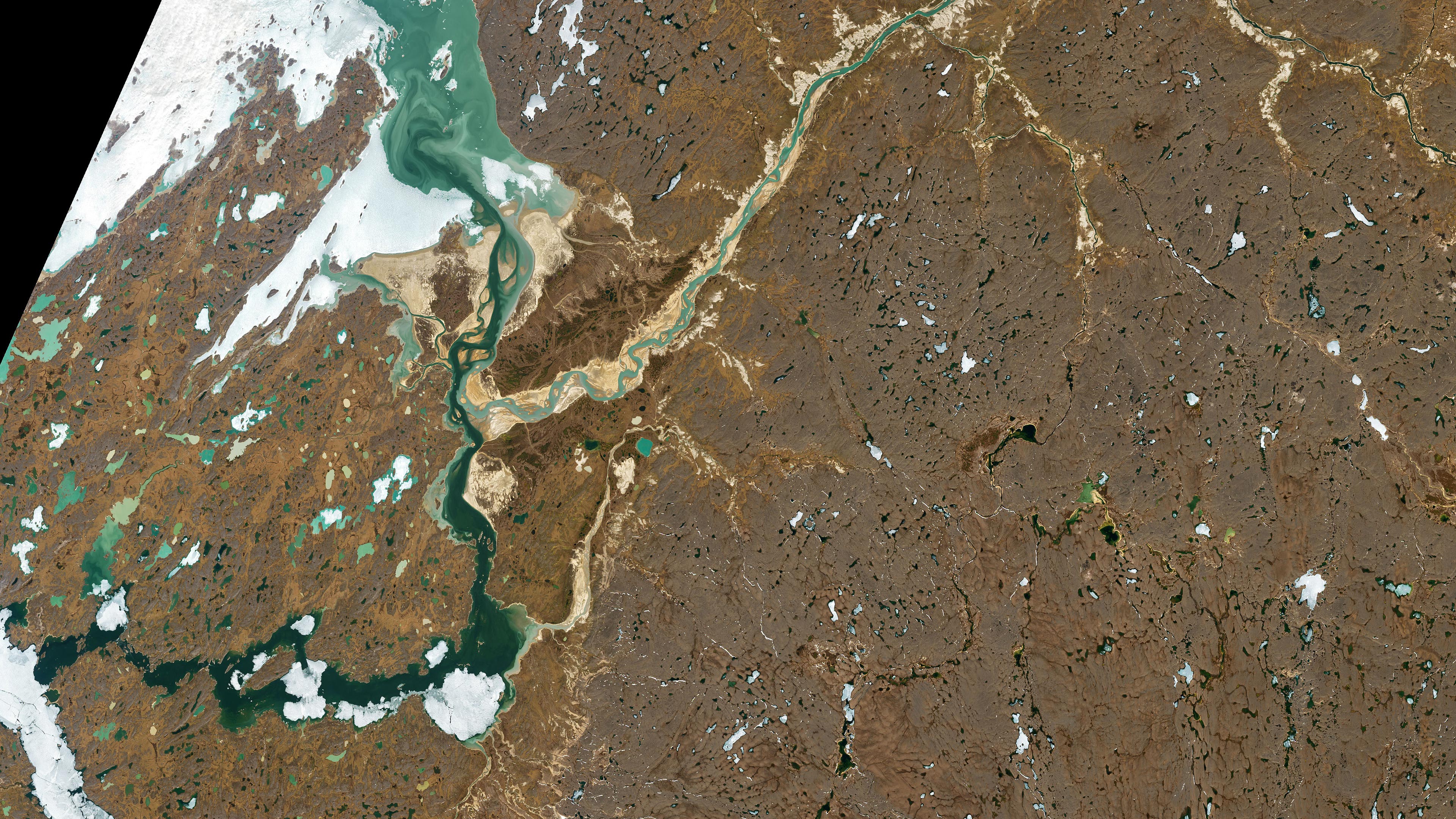
    The Back and Hayes rivers in Nunavut, Canada, display a striking contrast in color.

    Where two rivers meet without mixing much, the colorful contrast can be striking. The confluence of the Back and Hayes rivers in Nunavut, Canada, is such a place.

    The colorful confluence and surrounding landscape in the eastern Canadian Arctic are visible in this image acquired on June 30, 2014, with the Operational Land Imager (OLI) on Landsat 8. The relatively dark blue-green water of the Back River contrasts sharply with the light turquoise of the Hayes.

    The Back River approaches the confluence from the southwest, flowing for nearly 1,000 kilometers (600 miles) from near the Great Slave Lake to its outlet at Chantrey Inlet. It traverses the so-called Barren Grounds—a mostly flat, treeless plain covered with grasses, mosses, lichen, and the occasional granite outcrop. Studies of the Back River corridor have noted that the river is typically clear, with sediment and occasionally algae on the bottom.

    The Hayes River approaches from the opposite direction, flowing for more than 300 kilometers (200 miles) from an unnamed lake to its junction with the Back River. Research has shown that the Hayes River valley contains an abundance of marine silts and clays, which have been eroded to form a badlands-like landscape. The river water appears turbid—possibly rich with sediment that would give it a milky color.

    Confluence of Back and Hayes Rivers
    June 2014

    The photograph above shows a detailed view of the confluence. Robie Macdonald, a scientist at the University of Manitoba and the Canadian Department of Fisheries and Oceans, snapped the photo from an airplane in late June 2014 while doing fieldwork in the region. The purpose of the fieldwork, led by Matt Alkire of the University of Washington, was to investigate the geochemistry of small rivers across the Canadian Arctic.

    What Keeps the Waters Separate?

    Notice the distinct boundary between the two water sources that continues north beyond the confluence for about 15 kilometers (10 miles). A satellite image alone cannot tell us why the streams stay distinct, but stark boundaries like this tend to occur when there are differences in the water’s temperature, density, and rate of flow. You can see similar examples around the planet, including the famous confluence of the Rio Negro and Rio Solimões in Brazil. (See image below.) The waters finally start to mix where the Back River enters Chantrey Inlet—a waterway of the Canadian Archipelago near the Northwest Passage sea route.
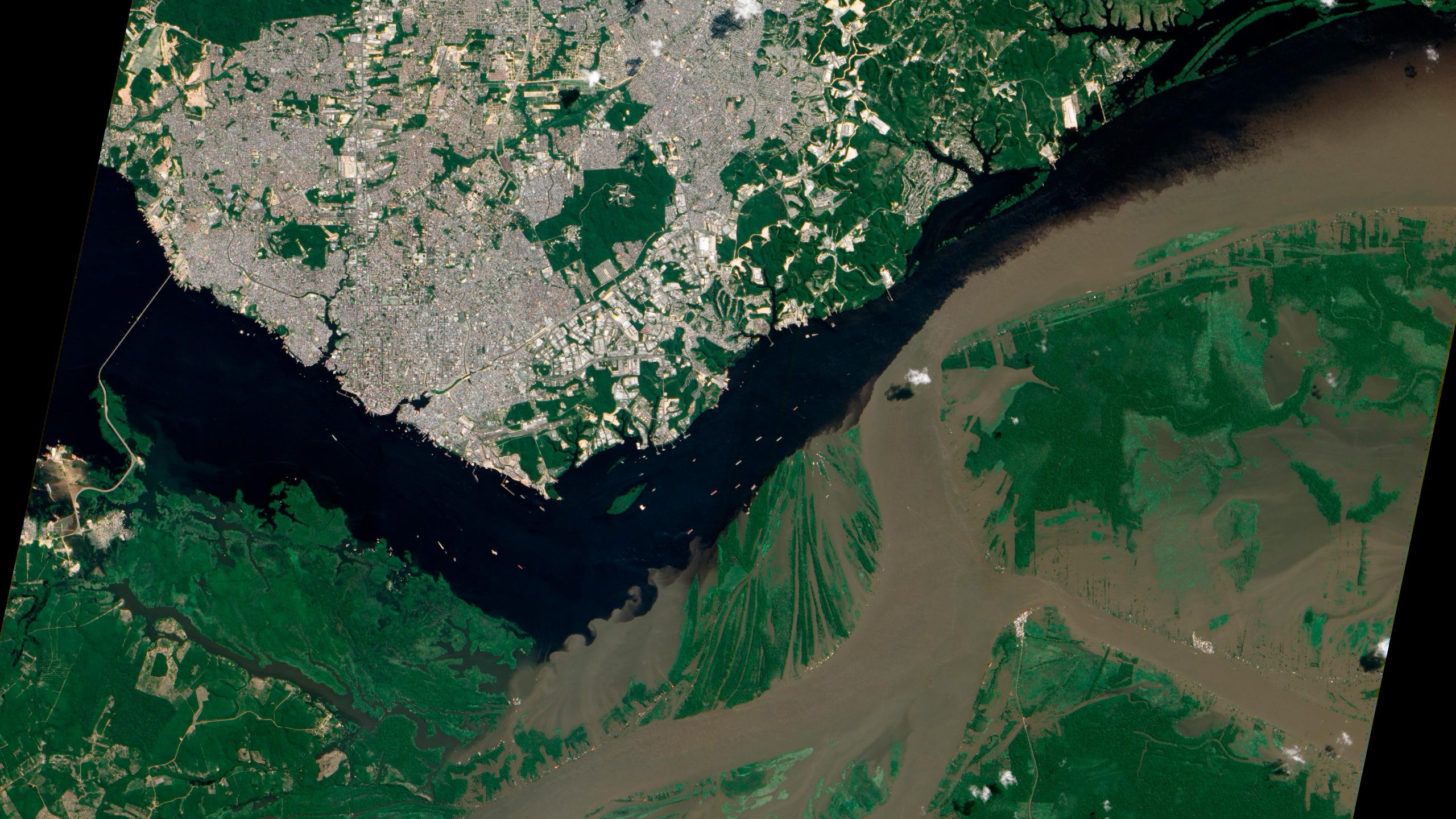
    Confluence of Rio Negro and Rio Solimoes
    June 17, 2012

    Royal Navy officer George Back, for whom the river is named, reached Chantrey Inlet after exploring the length of the river in the 1830s. A decade later, the Franklin Expedition set out to explore unnavigated sections of the Northwest Passage’s icy waters; the ships from that ill-fated expedition were recently discovered in Victoria Strait, not far from the Back River Estuary.

    Check out this story and blog post to see more images shot by Macdonald during fieldwork more than 1,000 kilometers away in the western Canadian Arctic.

    NASA Earth Observatory image by Joshua Stevens, using Landsat data from the U.S. Geological Survey. Photo by Robie Macdonald/University of Manitoba.

    Never miss a breakthrough: Join the SciTechDaily newsletter.
    Follow us on Google and Google News.

    Geography NASA NASA Earth Observatory
    Share. Facebook Twitter Pinterest LinkedIn Email Reddit

    Related Articles

    NASA Picturing Earth: Astronaut Photography In Focus [Video]

    Coloring the Great Salt Lake – Astronaut Takes Beautiful Photograph From Space Station

    Sea Ice in Denmark Strait – Drifted More Than 1,000 Km (600 Miles) From the Arctic Ocean

    NASA Scientists Map Beirut Blast Damage – Devastating Explosion Rocked Port Area

    NASA Advanced Rapid Imaging Satellite Maps Blast Damage: Beirut Explosion Aftermath

    NASA/NOAA Satellites Observe Surprisingly Rapid Increase in Scale and Intensity of Fires in Siberia

    Mars Terraforming: Cultivating Ideas for Mars on Earth

    Meandering Mississippi River: Photo Taken by Astronaut on Space Station Shows Divergence From State Boundaries

    Incredible Rare Peek at Patagonia in Winter

    Leave A Reply Cancel Reply

    • Facebook
    • Twitter
    • Pinterest
    • YouTube

    Don't Miss a Discovery

    Subscribe for the Latest in Science & Tech!

    Trending News

    Artificial Sweeteners May Harm Future Generations, Study Suggests

    Splashdown! NASA Artemis II Returns From Record-Breaking Moon Mission

    What If Consciousness Exists Beyond Your Brain

    Scientists Finally Crack the 100-Million-Year Evolutionary Mystery of Squid and Cuttlefish

    Beyond “Safe Levels”: Study Challenges What We Know About Pesticides and Cancer

    Researchers Have Found a Dietary Compound That Increases Longevity

    Scientists Baffled by Bizarre “Living Fossil” From 275 Million Years Ago

    Your IQ at 23 Could Predict Your Wealth at 27, Study Finds

    Follow SciTechDaily
    • Facebook
    • Twitter
    • YouTube
    • Pinterest
    • Newsletter
    • RSS
    SciTech News
    • Biology News
    • Chemistry News
    • Earth News
    • Health News
    • Physics News
    • Science News
    • Space News
    • Technology News
    Recent Posts
    • Scientists Discover New Way To Make Protein Shakes Taste Better
    • Scientists Break Optical Limits With Quantum Dot-Powered Nanoscopy
    • Scientists Shrink a Lab Spectrometer to the Size of a Grain of Sand
    • Quantum Reality Gets Stranger: Physicists Put a Lump of Metal in Two Places at Once
    • 34-Million-Year-Old Snake Found in Wyoming Rewrites Our Understanding of Evolution
    Copyright © 1998 - 2026 SciTechDaily. All Rights Reserved.
    • Science News
    • About
    • Contact
    • Editorial Board
    • Privacy Policy
    • Terms of Use

    Type above and press Enter to search. Press Esc to cancel.