
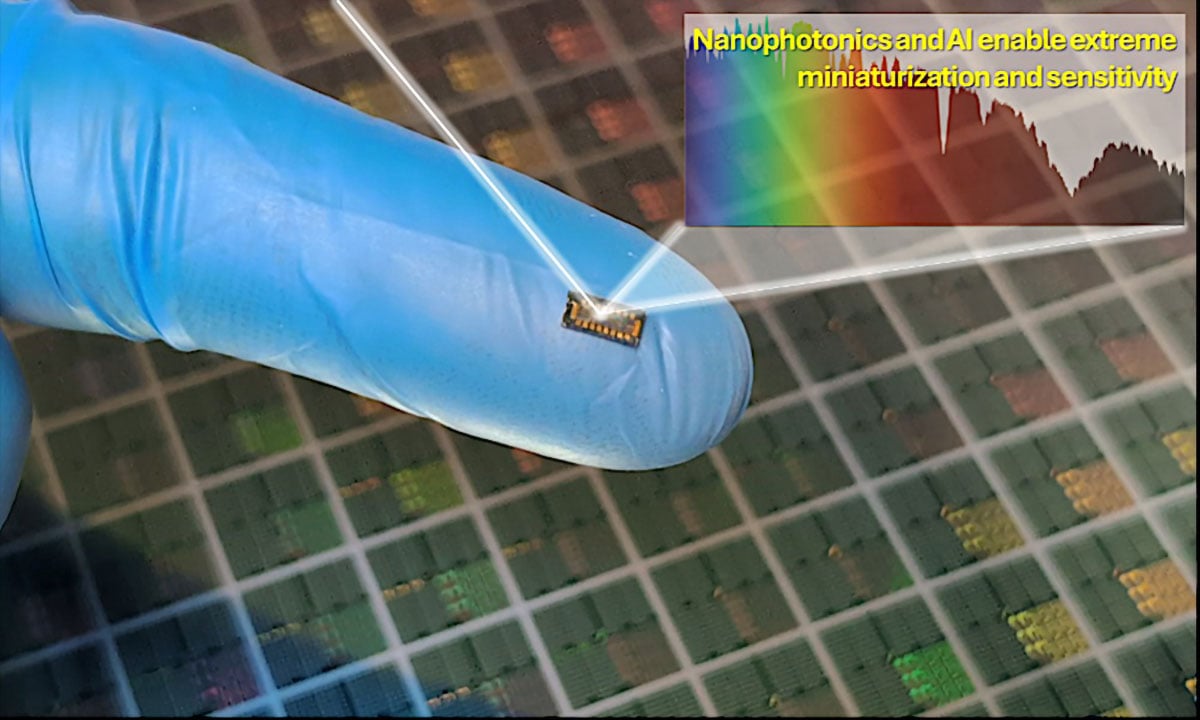
A new chip-scale spectrometer challenges the long-standing reliance on bulky optical systems by replacing physical light separation with computational reconstruction.
For decades, analyzing the chemical makeup of materials, whether for medical diagnosis, food inspection, or pollution monitoring, has relied on large and costly laboratory instruments known as spectrometers. These systems work by splitting light into its component colors using a prism or grating, then measuring the intensity of each wavelength. Because this process requires light to travel a relatively long distance, the instruments tend to be bulky and difficult to shrink.
Researchers at the University of California, Davis (UC Davis), have now taken a different approach to miniaturization. In a study published in Advanced Photonics, they describe a spectrometer reduced to the scale of a grain of sand. This compact spectrometer-on-a-chip is designed for integration into portable devices. Instead of separating light into a spectrum physically, the system relies on computational reconstruction.
The chip replaces traditional optics with just 16 silicon detectors, each tuned to respond slightly differently to incoming light. Together, these detectors capture overlapping signals that encode the original spectrum. This process is similar to having multiple sensors sample different elements of a mixed signal, with the full picture emerging only after analysis. That analysis is performed using artificial intelligence (AI).
Expanding Silicon’s Capabilities
The design depends on two key advances. First, the researchers modified standard silicon photodiodes by adding photon-trapping surface textures (PTSTs). While silicon is well-suited for detecting visible light, it is much less effective in the near-infrared (NIR) range (wavelengths up to 1100 nm (about 1.1 micrometers)), which is important for applications like biomedical imaging because it penetrates tissue more effectively than visible light.
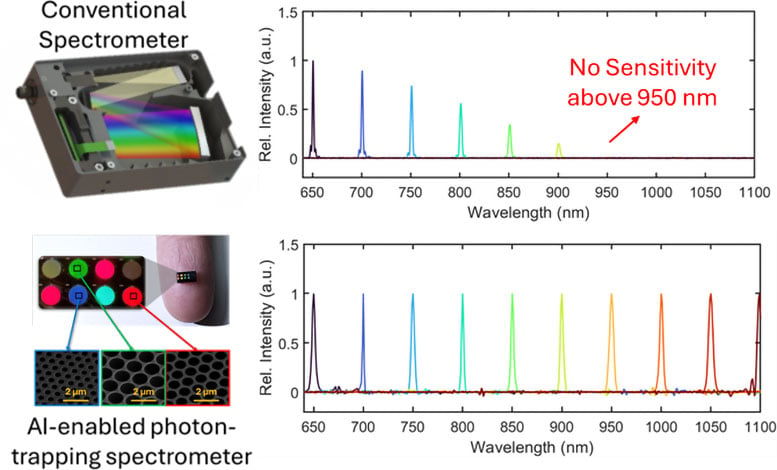
These engineered surface textures cause incoming NIR photons to scatter within the thin silicon layer instead of passing through it. As a result, the likelihood of absorption increases, allowing the chip to detect a broader range of wavelengths.
The system also includes high-speed sensors capable of measuring photon lifetime with very high precision. This allows the device to capture extremely fast light–matter interactions that conventional spectrometers cannot resolve.
AI Solving the Inverse Problem
The second major component is a fully connected neural network. Because the detectors produce indirect and noisy signals rather than a clear spectrum, the AI must learn how to interpret them. It is trained on large datasets to map the detectors’ outputs back to the original light spectrum.
By solving this “inverse problem,” the system can reconstruct spectral information with a resolution of about 8 nm. This approach removes the need for prisms, gratings, and other bulky optical components.
The finished device occupies just 0.4 square mm, yet delivers high sensitivity and strong resistance to noise. It can maintain accurate readings even in environments with significant electrical interference, which is often a limitation for compact, low-cost electronics. By extending silicon’s sensitivity into the NIR range and combining it with machine learning, this technology opens the door to real-time hyperspectral sensing in fields such as medical diagnostics and environmental monitoring.
Reference: “AI-augmented photon-trapping spectrometer-on-a-chip on silicon platform with extended near-infrared sensitivity” by Ahasan Ahamed, Htet Myat, Amita Rawat, Lisa N. McPhillips and M. Saif Islam, 19 January 2026, Advanced Photonics.
DOI: 10.1117/1.AP.8.1.016008
Never miss a breakthrough: Join the SciTechDaily newsletter.
Follow us on Google and Google News.
4 Comments
thanks
This title makes it seem like the scientist created a shrinking technology to make a smaller spectrometer. I promise I did not think that was possible but the world is full of people who know nothing about science and do think it is possible. And it’d be best not to mislead them.
Investigative spectroscopy will be of premium importance in the ability to investigate and resolve biological warfare threats, and the presence, in air samples, of destructive substances carried by terrorists.
הפיתוח המוצג יאפשר פיתוח מכשים ביתיים לבדיקת צזון בכל מטבח משםחתי בעולם יאפשר פיתוח מכדים ידני נישא המתחבר לכח המיחשוב של מעבד הטלפון הנייד לזיהוי מינרלים תוךשהיה בטח בזמן אמת יאפשר פיצוח מזהי גזים ושימויים בהרכב האוויר בשגה הקרב כאשר האויב ינסנ להפיץ גזי מלחממה המשפיעים על התודעה העייפות המוטיבציה להילחם שלא ניתן לאבחן אותם בתנאים רגיחם יאפשר אבחון צחלות לפיהאויר היותא מהריאות שהרכבו הכימי והביולוגי משתנהבהתאם לחוליים שנושט האדם יאפשר זיהוי מיידי כבר במרפאה של רופא המשפחה של השתן והרכסו הכימי והביולוגי כמוכ יאפשר לאדם בדיקת הצואה של עצמו בבית ולו מדגימת נייר הטואלט ולהביאה לרופא לפענוח. המשמעויות הן כה רב תחומיות שניסית לכסות רק מעטות מהן המפתח להצלחה מסחרחת היא ייצור המוני אמין במחיקמתקבל על הדעת לכל בית בעולםולכל צבא ולכל טייל/גיאולוג חובב בעולם.