
Close Menu
    Facebook X (Twitter) Instagram
    SciTechDaily
    • Biology
    • Chemistry
    • Earth
    • Health
    • Physics
    • Science
    • Space
    • Technology
    Facebook X (Twitter) Pinterest YouTube RSS
    SciTechDaily
    Home»Space»Chinese Solar Telescope Reveals Acceleration of Magnetic Reconnection From a Nearby Filament Eruption
    Space

    Chinese Solar Telescope Reveals Acceleration of Magnetic Reconnection From a Nearby Filament Eruption

    By Chinese Academy of SciencesApril 9, 2021No Comments3 Mins Read
    Facebook Twitter Pinterest Telegram LinkedIn WhatsApp Email Reddit
    Share
    Facebook Twitter LinkedIn Pinterest Telegram Email Reddit
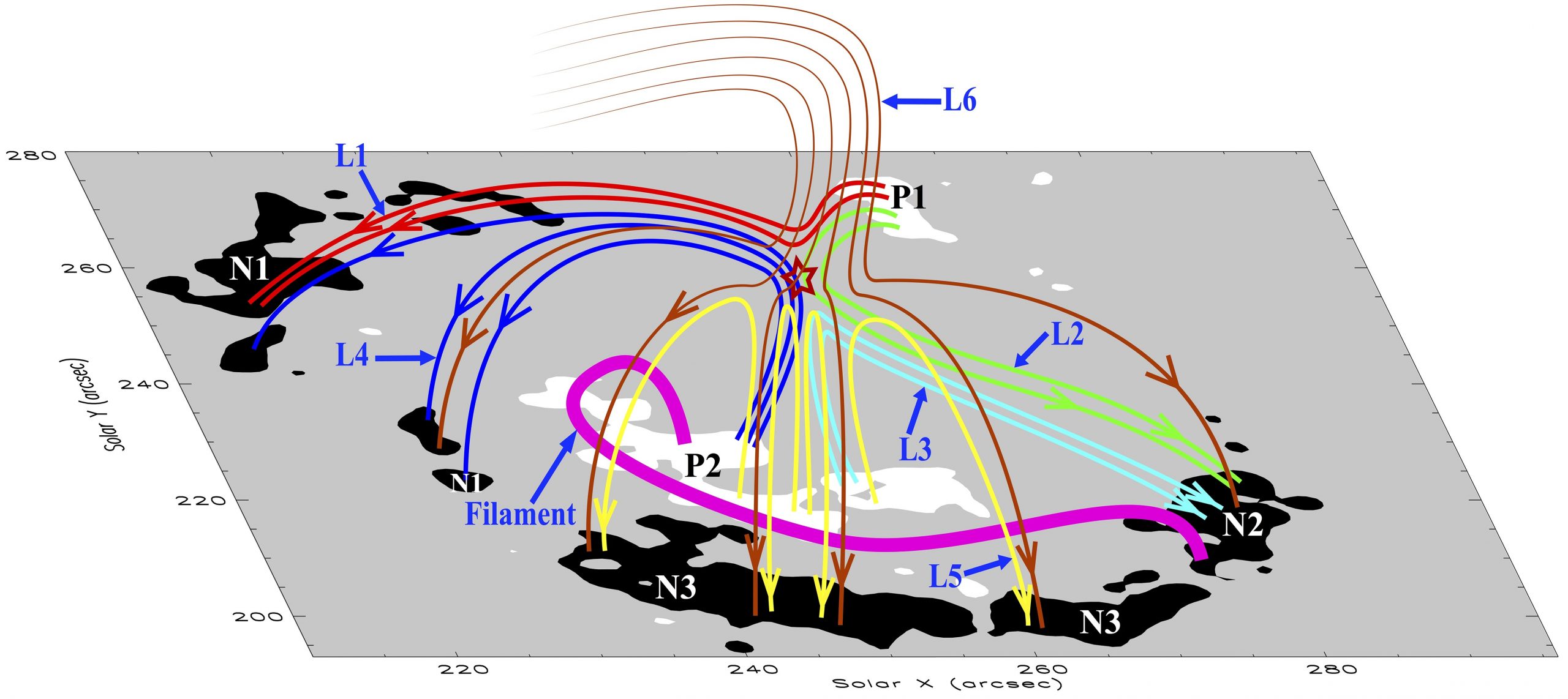
    Magnetic Reconnection Between Loops Accelerated by Nearby Filament Eruption
    Two groups of fibrils, marked L2 and L4, converge and reconnect with each other. Two sets of newly formed fibrils, marked L1 and L3, then appear and retract from the reconnection region. Credit: LI Leping

    Magnetic reconnection was observed to intensify due to disturbances from an adjacent solar filament eruption. This acceleration resulted in greater energy release and clearer reconnection signatures in both visible and ultraviolet wavelengths.

    Magnetic reconnection refers to the reconfiguration of magnetic field geometry. It plays an elemental role in the rapid release of magnetic energy and its conversion to other forms of energy in magnetized plasma systems throughout the universe.

    Researchers led by Dr. LI Leping from the National Astronomical Observatories of the Chinese Academy of Sciences (NAOC) analyzed the evolution of magnetic reconnection and its nearby filament. The result suggested that reconnection is significantly accelerated by the propagating disturbance caused by the adjacent filament eruption.

    The study was published in The Astrophysical Journal.

    The New Vacuum Solar Telescope (NVST) is a 1-m ground-based solar telescope, located in the Fuxian Solar Observatory of the Yunnan Astronomical Observatories of the Chinese Academy of Sciences (YNAO). It provides observations of the solar fine structures and their evolution in the solar lower atmosphere.

    The NVST observed the active region 11696 on March 15, 2013, in the Hα channel, centered at 6562.8 Å with a bandwidth of 0.25 Å.

    Employing the NVST Hα images with higher spatial resolution, the researchers studied the evolution of magnetic loops and their nearby filament in the active region, combining the Atmospheric Imaging Assembly (AIA) extreme ultraviolet (EUV) images and Helioseismic and Magnetic Imager (HMI) line-of-sight magnetograms on board the Solar Dynamic Observatory (SDO).

    Evidence of Magnetic Reconnection in Action

    In NVST Hα images, two groups of fibrils converged and interacted with each other. Two sets of newly formed fibrils then appeared and retracted from the interaction region.

    “The result provides clear evidence of magnetic reconnection,” said Prof. Hardi Peter from the Max Planck Institute for Solar System Research (MPS), a co-author of the study. In AIA EUV images, the current sheet formed repeatedly in the reconnection region in the lower-temperature channels, and plasmoids appeared in the current sheet and propagated along it bidirectionally.

    A filament was located to the southeast of the reconnection region. It erupted and pushed away the loops covering the reconnection region. “The filament eruption led to a disturbance propagating outward across the reconnection region,” said Dr. LI Leping, the first author of this study.

    The current sheet subsequently became shorter and brighter, with a larger reconnection rate. It appeared in the AIA higher-temperature channels. In the current sheet, more and hotter plasmoids formed.

    “Compared with the observations before the filament eruption during the same time intervals, more thermal and kinetic energy was converted through reconnection after the filament eruption,” said Dr. LI. “The reconnection was thus significantly accelerated by the propagating disturbance caused by the nearby filament eruption.”

    Reference: “Magnetic Reconnection between Loops Accelerated By a Nearby Filament Eruption” by Leping Li, Hardi Peter, Lakshmi Pradeep Chitta, Hongqiang Song, Kaifan Ji and YongYuan Xiang, 25 February 2021, The Astrophysical Journal.
    DOI: 10.3847/1538-4357/abd47e

    Never miss a breakthrough: Join the SciTechDaily newsletter.
    Follow us on Google and Google News.

    Astronomy Astrophysics Chinese Academy of Sciences Sun
    Share. Facebook Twitter Pinterest LinkedIn Email Reddit

    Related Articles

    Global Maps of the Solar Corona Magnetic Field Created for the First Time

    NASA Spacecraft Observe Magnetic Reconnection in Action

    Sun’s Magnetic Field Weaker Than a Normal Fridge Magnet

    Sun’s Loops are Tapered, Wider at the Top and Narrower at the Ends

    New Observations Help Astronomers Learn How Young Stars Accrete Material and Grow

    TW Hydrae Provides Insight About the Birth of Our Sun

    Model of Sun’s Magnetic Field Revealed

    CoRoT Sol 1 Discovery Helps Unveil the Future of the Sun

    New Model Advances the Understanding of How Solar Wind Works

    Leave A Reply Cancel Reply

    • Facebook
    • Twitter
    • Pinterest
    • YouTube

    Don't Miss a Discovery

    Subscribe for the Latest in Science & Tech!

    Trending News

    Why Popular Diabetes Drugs Like Ozempic Don’t Work for Everyone: The “Genetic Glitch”

    Scientists Stunned After Finding Plant Thought Extinct for 60 Years

    Scientists Discover Tiny New Spider That Hunts Prey 6x Its Size

    Natural Component From Licorice Shows Promise for Treating Inflammatory Bowel Disease

    Scientists Warn: Popular Sweetener Linked to Dangerous Metabolic Effects

    Monster Storms on Jupiter Unleash Lightning Beyond Anything on Earth

    Scientists Create “Liquid Gears” That Spin Without Touching

    The Simple Habit That Could Help Prevent Cancer

    Follow SciTechDaily
    • Facebook
    • Twitter
    • YouTube
    • Pinterest
    • Newsletter
    • RSS
    SciTech News
    • Biology News
    • Chemistry News
    • Earth News
    • Health News
    • Physics News
    • Science News
    • Space News
    • Technology News
    Recent Posts
    • Pomegranate Compound Could Help Protect Against Heart Disease
    • Your Blood Test Might Already Show Alzheimer’s Risk
    • Common Pregnancy Medications Linked to Higher Autism Risk in Massive U.S. Study
    • Scientists Teach AI To Think Like a Professional Chemist
    • Scientists Were Wrong About This Strange “Rule-Breaking” Particle
    Copyright © 1998 - 2026 SciTechDaily. All Rights Reserved.
    • Science News
    • About
    • Contact
    • Editorial Board
    • Privacy Policy
    • Terms of Use

    Type above and press Enter to search. Press Esc to cancel.