
Close Menu
    Facebook X (Twitter) Instagram
    SciTechDaily
    • Biology
    • Chemistry
    • Earth
    • Health
    • Physics
    • Science
    • Space
    • Technology
    Facebook X (Twitter) Pinterest YouTube RSS
    SciTechDaily
    Home»Space»Sun’s Magnetic Field Weaker Than a Normal Fridge Magnet
    Space

    Sun’s Magnetic Field Weaker Than a Normal Fridge Magnet

    By University College LondonJuly 11, 2013No Comments3 Mins Read
    Facebook Twitter Pinterest Telegram LinkedIn WhatsApp Email Reddit
    Share
    Facebook Twitter LinkedIn Pinterest Telegram Email Reddit
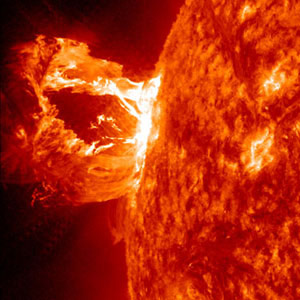
    SDO Provides the First Accurate Estimates of the Suns Magnetic Field
    An eruption on April 16, 2012 was captured here by NASA’s Solar Dynamics Observatory in the 304 Angstrom wavelength, which is typically colored in red. Credit: NASA/SDO/AIA

    Using data from NASA’s Solar Dynamics Observatory and the Hinode spacecraft, researchers reveal that the Sun’s atmosphere has a magnetic field about ten times weaker than a normal fridge magnet.

    A solar tsunami observed by NASA’s Solar Dynamics Observatory (SDO) and the Japanese Hinode spacecraft has been used to provide the first accurate estimates of the Sun’s magnetic field.

    Solar tsunamis are produced by enormous explosions in the Sun’s atmosphere called coronal mass ejections (CMEs). As the CME travels out into space, the tsunami travels across the Sun at speeds of up to 1000 kilometers per second (620 miles per second).

    Similar to tsunamis on Earth, the shape of solar tsunamis is changed by the environment through which they move. Just as sound travels faster in water than in air, solar tsunamis have a higher speed in regions of stronger magnetic field. This unique feature allowed the team, led by researchers from UCL’s Mullard Space Science Laboratory, to measure the Sun’s magnetic field. The results are outlined in a paper soon to be published in the journal Solar Physics.

    Dr. David Long, UCL Mullard Space Science Laboratory, and lead author of the research, said: “We’ve demonstrated that the Sun’s atmosphere has a magnetic field about ten times weaker than a normal fridge magnet.”

    Using data obtained using the Extreme ultraviolet Imaging Spectrometer (EIS), a UK-led instrument on the Japanese Hinode spacecraft, the team measured the density of the solar atmosphere through which the tsunami was traveling.

    The combination of imaging and spectral observations provides a rare opportunity to examine the magnetic field which permeates the Sun’s atmosphere.

    Dr Long noted: “These are rare observations of a spectacular event that reveal some really interesting details about our nearest star.”

    Visible as loops and other structures in the Sun’s atmosphere, the Sun’s magnetic field is difficult to measure directly and usually has to be estimated using intensive computer simulations. The Hinode spacecraft has three highly sensitive telescopes, which use visible, X-ray and ultraviolet light to examine both slow and rapid changes in the magnetic field.

    The instruments on Hinode act like a microscope to track how the magnetic field around sunspots is generated, shapes itself, and then fades away. These results show just how sensitive these instruments can be, measuring magnetic fields that were previously thought too weak to detect.

    The explosions that produce solar tsunamis can send CMEs hurtling towards the Earth. Although protected by its own magnetic field, the Earth is vulnerable to these solar storms as they can adversely affect satellites and technological infrastructure.

    Dr Long said: “As our dependency on technology increases, understanding how these eruptions occur and travel will greatly assist in protecting against solar activity.”

    Publication: accepted for publication in Solar Physics

    Reference: “Measuring the Magnetic-Field Strength of the Quiet Solar Corona Using “EIT Waves”” by D. M. Long, D. R. Williams, S. Régnier and L. K. Harra, 10 July 2013, Solar Physics.
    DOI: 10.1007/s11207-013-0331-7
    arXiv:1305.5169


    Never miss a breakthrough: Join the SciTechDaily newsletter.
    Follow us on Google and Google News.

    Astronomy Astrophysics Coronal Mass Ejections NASA Solar Dynamics Observatory Sun University College London
    Share. Facebook Twitter Pinterest LinkedIn Email Reddit

    Related Articles

    New Clues To Predict When and Where the Sun’s Next Flare Might Explode

    Unusual “Rosetta Stone” Solar Eruption Could Help Explain Mysterious Powerful Explosions on the Sun

    Celestial Geometry Posed a Special Opportunity During Parker Solar Probe’s 7th Solar Encounter

    10 Amazing Discoveries About the Sun From NASA’s Solar Dynamics Observatory

    Magnetic Explosions Observed on Sun – Unlike Anything Seen Before [Video]

    Astronomers Reveal How a Magnetic Cage Stopped a Solar Eruption

    NASA’s Solar Dynamics Observatory Captures Filament Explosion

    New Light Shed on the Origins of Extreme Space Storms

    NASA Solar Dynamics Observatory Captures Eruption in Extreme UV

    Leave A Reply Cancel Reply

    • Facebook
    • Twitter
    • Pinterest
    • YouTube

    Don't Miss a Discovery

    Subscribe for the Latest in Science & Tech!

    Trending News

    AI Could Detect Early Signs of Alzheimer’s in Under a Minute – Far Before Traditional Tests

    What if Dark Matter Has Two Forms? Bold New Hypothesis Could Explain a Cosmic Mystery

    This Metal Melts in Your Hand – and Scientists Just Discovered Something Strange

    Beef vs. Chicken: Surprising Results From New Prediabetes Study

    Alzheimer’s Breakthrough: Scientists Discover Key Protein May Prevent Toxic Protein Clumps in the Brain

    Quantum Reality Gets Stranger: Physicists Put a Lump of Metal in Two Places at Once

    Scientists May Have Found the Key to Jupiter and Saturn’s Moon Mystery

    Scientists Uncover Brain Changes That Link Pain to Depression

    Follow SciTechDaily
    • Facebook
    • Twitter
    • YouTube
    • Pinterest
    • Newsletter
    • RSS
    SciTech News
    • Biology News
    • Chemistry News
    • Earth News
    • Health News
    • Physics News
    • Science News
    • Space News
    • Technology News
    Recent Posts
    • Humans Returned to Britain 500 Years Earlier Than Scientists Thought
    • 250-Million-Year-Old Egg Solves One of Evolution’s Biggest Mysteries
    • Living With Roommates Might Be Changing Your Gut Microbiome Without You Knowing
    • Simple and Cheap Blood Test Could Detect Cancer and Other Diseases Before Symptoms Appear
    • Century-Old Cleaning Chemical Linked to 500% Increased Risk of Parkinson’s Disease
    Copyright © 1998 - 2026 SciTechDaily. All Rights Reserved.
    • Science News
    • About
    • Contact
    • Editorial Board
    • Privacy Policy
    • Terms of Use

    Type above and press Enter to search. Press Esc to cancel.