
Close Menu
    Facebook X (Twitter) Instagram
    SciTechDaily
    • Biology
    • Chemistry
    • Earth
    • Health
    • Physics
    • Science
    • Space
    • Technology
    Facebook X (Twitter) Pinterest YouTube RSS
    SciTechDaily
    Home»Technology»DARPA & Harvard’s Soft, Self-Camouflaging Robot
    Technology

    DARPA & Harvard’s Soft, Self-Camouflaging Robot

    By SciTechDailyAugust 20, 2012No Comments2 Mins Read
    Facebook Twitter Pinterest Telegram LinkedIn WhatsApp Email Reddit
    Share
    Facebook Twitter LinkedIn Pinterest Telegram Email Reddit
    soft-DARPA-harvard-camouflaging-robot
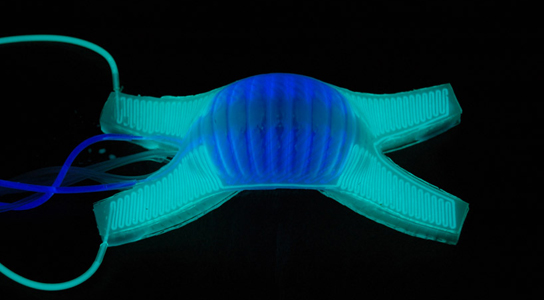
    A soft, walking robot with the remarkable ability to camouflage itself within its environment.

    Researchers at Harvard University have developed a soft, walking robot for DARPA, which has the uncanny ability to camouflage itself within its environment. This system consists of a microfluid that’s networked throughout the robot’s chassis that is then used to camouflage or display various colors in different levels within its silicone sheets.

    The soft robot uses a variety of heated and cooled dyes, which are chemiluminescent and fluorescent for optimal effect. Water can be pumped through its channels to adjust the temperature, causing the robot to alter and conceal itself. The initial concept was developed from observing living organisms that used bioluminescence for communication, achieving a similar, glowing effect by pumping pigmented solutions through their layered channels.
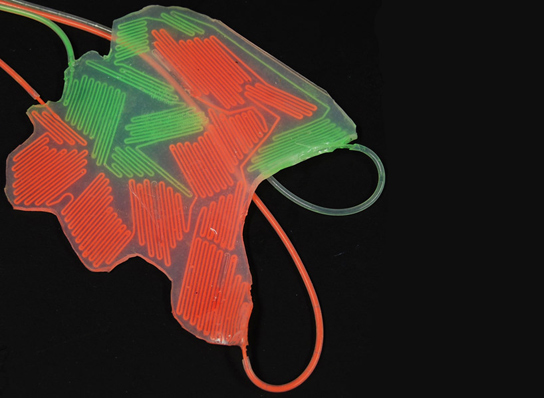
    soft-DARPA-harvard-camouflaging-robot-bioluminescence

    In order to function, the robot needs to be connected to a series of tethers that are attached to a control system, through which pressurized gases and liquids are pumped into the robot. The current rate of pumping is about 2.25 milliliters per minute, which allows the robot to change its colors within 30 seconds. This process reduces the size and weight of the robot by leaving power sources and pumps off-board, requiring no additional power to sustain its luminous layers.

    Stephen Morin, chemical biologist at Harvard University, stated that the robot has the ability to camouflage itself in various environments, simply by relying on its systems, mainly the ability to change color and shape.

    The robot was fairly successful in evading predators in trials, and can move at approximately 40 meters per hour. Without any fluid, it can accelerate up to 67 meters per hour. Researchers state that speed wasn’t an important factor in developing this robot, it was more important that it could move over surfaces without being detected.

    DARPA notes that the robot costs about $100 to make, which will make it an interesting, disposable option for military operations. Read the August 16 paper published in the journal Science.

    Reference: “Camouflage and Display for Soft Machines” by Stephen A. Morin, Robert F. Shepherd, Sen Wai Kwok, Adam A. Stokes, Alex Nemiroski, and George M. Whitesides, 17 August 2012, Science.
    DOI: 10.1126/science.1222149

    Never miss a breakthrough: Join the SciTechDaily newsletter.
    Follow us on Google and Google News.

    Bioluminescence DARPA Harvard University Popular Robotics
    Share. Facebook Twitter Pinterest LinkedIn Email Reddit

    Related Articles

    Solving the Tricky Challenges of Robotic Pizza-Making

    Shape-Shifting Materials With Infinite Possibilities: Totimorphic Structural Materials Can Achieve Any Shape

    Jumping Spiders Inspire Incredible Compact Depth Sensor

    Engineers Develop Multifunctional Flexible Robots Using MORPH System

    Cancer-Fighting DNA Nanorobots Could Target Specific Cells for Repair

    Robotic Tentacles Have a Soft Enough Touch to Pick Up Flowers

    DARPA’s Legged Squad Support System (LS3) To Ease Physical Load on Troops

    DARPA Researchers Use Electricity to Suppress Fire

    Harvard Scientists Develop $5 Rubber Robot

    Leave A Reply Cancel Reply

    • Facebook
    • Twitter
    • Pinterest
    • YouTube

    Don't Miss a Discovery

    Subscribe for the Latest in Science & Tech!

    Trending News

    The Secret to Healthy Aging May Be More Protein and More Exercise

    These 567-Million-Year-Old Fossils Are Rewriting the Story of Life on Earth

    The Spider-Like Creatures Helping Scientists Decode the Origins of Fatherhood

    Scientists Baffled by a Sudden Reversal Deep Inside Earth’s Core

    This Strange Sea Creature Can Survive Five Years Without Food – Scientists Finally Know Why

    New Quantum Sensor Opens a Window Into the Invisible Universe

    Stanford Scientists Reverse Age-Related Memory Loss by Targeting the Gut

    James Webb Uncovers the Atmosphere of a Hellish Lava World 41 Light-Years Away

    Follow SciTechDaily
    • Facebook
    • Twitter
    • YouTube
    • Pinterest
    • Newsletter
    • RSS
    SciTech News
    • Biology News
    • Chemistry News
    • Earth News
    • Health News
    • Physics News
    • Science News
    • Space News
    • Technology News
    Recent Posts
    • Your Daily Orange Juice Could Have an Unexpected Health Benefit
    • New Research Could Help Break China’s Rare Earth Magnet Monopoly
    • The Milky Way’s Black Hole Isn’t Tearing Everything Apart – New Observations Reveal a Surprise
    • Black Hole Shredded a Massive Star in the Most Powerful Stellar Explosion Ever Seen
    • Building the Brain Requires Millions of Dangerous DNA Breaks
    Copyright © 1998 - 2026 SciTechDaily. All Rights Reserved.
    • Science News
    • About
    • Contact
    • Editorial Board
    • Privacy Policy
    • Terms of Use

    Type above and press Enter to search. Press Esc to cancel.