
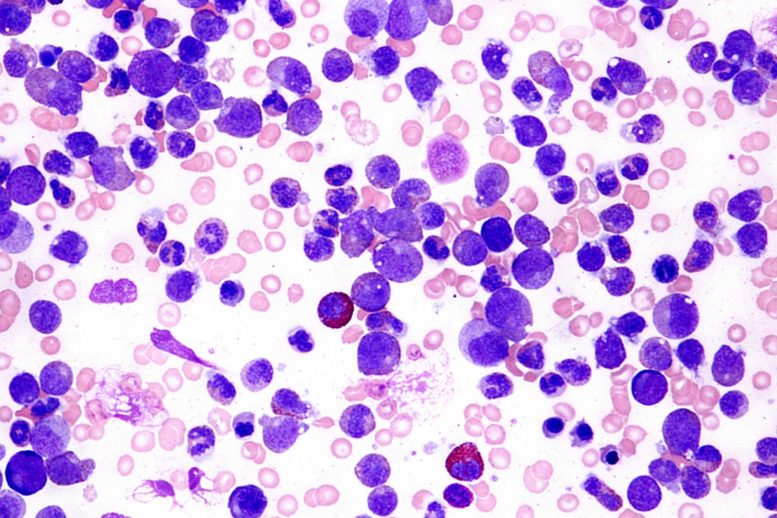
Blocking TGFß1 could reverse bone marrow suppression in AML, offering new hope for improving patient outcomes.
Bone marrow failure due to acute myeloid leukemia (AML) is a significant factor behind the disease’s high rate of morbidity and mortality. Previous studies in mice suggest that AML cells inhibit healthy hematopoietic (blood) stem and progenitor cells (HSPC). A study released in STEM CELLS adds to this extent of knowledge by showing how secreted cell factors, in particular a protein called transforming growth factor beta 1 (TGFβ1), leads to a breakdown in the production of healthy blood cells (a process called hematopoiesis) in humans.
The study’s findings indicate that blocking TGFβ1 could improve hematopoiesis in AML patients.
Although AML makes up only about 1 percent of all cancers, it is the second most common type of leukemia diagnosed, according to the American Cancer Society. AML affects the blood and bone marrow — the spongy tissue inside bones where blood cells are made. The mortality rate is high — for those aged 20 and older, the five-year survival rate is a dismal 26 percent.

The mechanisms by which AML develops are not completely understood, but it is generally believed to begin in the hemopoietic stem cells or progenitors, which develop into myeloid cells and in turn go on to become red blood cells, white blood cells or platelets. This latest study, by researchers at Heinrich-Heine-University Düsseldorf, was designed to investigate what role fluids secreted by leukemic cells might play in inhibiting the growth of healthy hematopoietic stem and HSPC.
Modeling Human Leukemia-Bone Marrow Interaction
“Experiments using conditioned media (CM) from AML cells to address secretory mechanisms have been performed before, but mainly in mice. In order to gain new insights into how this plays out in humans, we focused on the interaction between leukemic cells and healthy HSPC using an in vitro system modeling the in vivo situation of bone marrow infiltration by AML cells,” said the study’s corresponding author, Thomas Schroeder, M.D., Ph.D., Department of Hematology, Oncology and Clinical Immunology. This was accomplished by exposing healthy bone marrow-derived CD34+ HSPC to supernatants derived from AML cell lines and newly diagnosed AML patients. (CD34 is a marker of human HSC, while supernatants are the products secreted by cells.)
“Our findings revealed that exposure to AML-derived supernatants significantly inhibited proliferation, cell cycling, colony formation, and differentiation of healthy CD34+ HSPC,” Dr. Schroeder reported. “Further experiments determined that leukemic cells induce functional inhibition of healthy HSPC, at least in part through TGFβ1.
“Blocking the TGFβ1 pathway is something that could be pharmacologically accomplished with a TGFβ1 inhibitor such as SD208. Our data indicate this could be a promising approach to improve hematopoiesis in AML patients.”
Dr. Jan Nolta, Editor-in-Chief of STEM CELLS, said, “Finding factors for possible intervention in the perplexing issue of suppression of normal hematopoiesis by AML cells is highly important. The possibility of targeting TGFβ1 in order to allow the normal stem and progenitor cells to expand is a promising lead toward future treatments.”
Reference: “Acute myeloid leukemia-induced functional inhibition of healthy CD34+ hematopoietic stem and progenitor cells” by Paul Jäger, Stefanie Geyh, Sören Twarock, Ron-Patrick Cadeddu, Pablo Rabes, Annemarie Koch, Uwe Maus, Tobias Hesper, Christoph Zilkens, Christina Rautenberg, Felix Bormann, Karl Köhrer, Patrick Petzsch, Dagmar Wieczorek, Beate Betz, Harald Surowy, Barbara Hildebrandt, Ulrich Germing, Guido Kobbe, Rainer Haas and Thomas Schroeder, 20 May 2021, Stem Cells.
DOI: 10.1002/stem.3387
Never miss a breakthrough: Join the SciTechDaily newsletter.
Follow us on Google and Google News.