
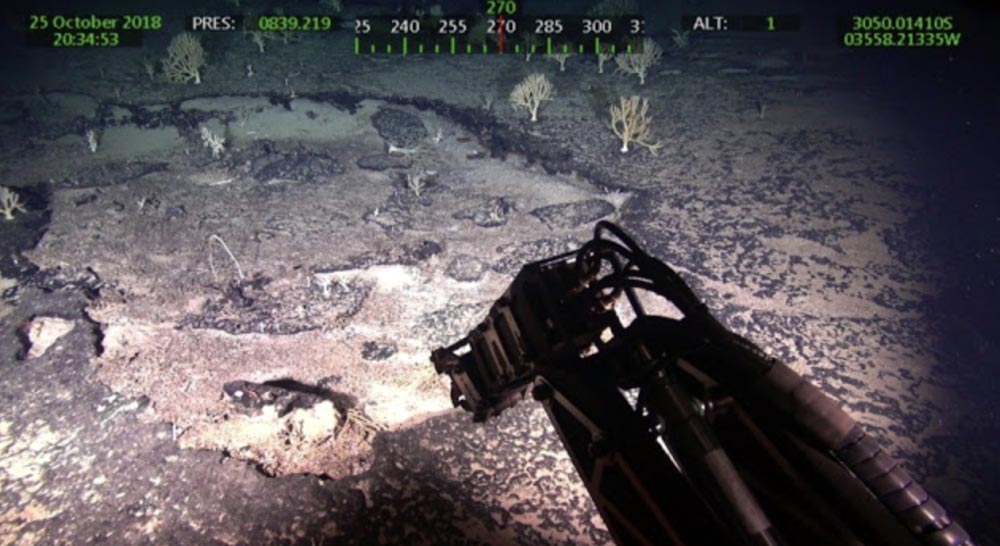
Researchers conducted the first large-scale survey of the microbiota present in the seamount’s ferromanganese crusts, describing bacteria and archaea involved in the nutrient cycle and formation of metals.
The abundant biological and mineral diversity of the Rio Grande Rise, a seamount in the depths of the Atlantic Ocean about 1,500 km from the coast of Brazil, is probably due to a great extent to little-known microscopic creatures.
Researchers affiliated with the University of São Paulo’s Oceanographic Institute (IO-USP), collaborating with colleagues at the UK’s National Oceanography Center, investigated the microorganisms inhabiting the seamount’s ferromanganese crusts and concluded that bacteria and archaea are probably responsible for maintaining the abundant local life, besides being involved in the process of biomineralization that forms the metals present in the crusts.
An article published in the journal Microbial Ecology describes the study, which was funded by FAPESP and the UK’s Natural Environment Research Council (NERC).
In 2014, the International Seabed Authority (ISA) awarded Brazil a 15-year grant of mineral exploitation rights to the Rio Grande Rise. Comprising 167 member states plus the European Union, the ISA is mandated under the United Nations Convention on the Law of the Sea to organize, regulate and control all mineral-related activities in the international seabed area, which corresponds to some 50% of the total area of the world’s oceans.
“Very little is known about the area’s biodiversity or about the impact of mining on its ecosystems,” said Vivian Pellizari, a professor at IO-USP and principal investigator for the study.
The study was part of a Thematic Project supported by FAPESP. The article is one of the results of the PhD research of Natascha Menezes Bergo, currently a postdoctoral research intern at IO-USP.
Microbes and the Mystery of Manganese Oxidation
“Although the process known as microbial biomineralization is well-known, oxidation and precipitation of manganese hadn’t been proved, and we had no idea how it occurred in ocean areas. In July 2020, however, an article by US researchers was published in Nature showing for the first time that bacteria use manganese to convert carbon dioxide into biomass via a process called chemosynthesis,” said Bergo, who participated in sample collection in 2018 on the UK research vessel RRS Discovery.
“One of these bacteria, which belongs to the group Nitrospirae, was present in the DNA sequences we extracted from crust samples collected at the Rio Grande Rise. This is strong evidence that the metals there are formed not just by a geological process but also by a biological process in which microorganisms play an important part,” she noted.
Besides iron and manganese, the crusts are rich in cobalt, nickel, molybdenum, niobium, platinum, titanium and tellurium, among other elements. Cobalt is essential to the production of rechargeable batteries, for example, and tellurium is a key input for the production of high-efficiency solar cells. In late 2018, Brazil applied to the ISA for an extension of its continental shelf to include the Rio Grande Rise.
In other parts of the world, similar areas that have been studied for longer with the same objectives include the Clarion-Clipperton Zone and the Takuyo-Daigo Seamount, both in the North Pacific, as well as the Tropic Seamount in the North Atlantic.
Formation
The Rio Grande Rise has an area of some 150,000 km2 (58,000 mi²), three times the size of Rio de Janeiro state, and depths ranging from 800 m to 3,000 m (2,600 ft to 9,800 ft). Formed when present-day Africa and South America separated from the supercontinent Gondwana between 146 million years ago (mya) and 100 mya, the Rise was an island that sank some 40 mya, probably owing to the weight of a volcano and its lava and the movement of tectonic plates.
On one of their 2018 expeditions, the researchers collected from a part of the Rise samples of the ferromanganese crusts and of the coral skeletons that live on them, as well as calcarenite rock and biofilms on the crusts’ surfaces. These biofilms are structured microbial communities enveloped in substances they secrete to protect themselves from threats such as lack of nutrients or potential toxins.
“Finding biofilm was an interesting surprise, as it’s an indicator of an incipient biomineralization process,” Bergo said. “We found the same microorganisms in our biofilm, coral, calcarenite and crust samples. The only difference was the age of the surfaces. The coral is more recent than the crusts, and the biofilm is even younger.”
DNA Sequencing Reveals Nitrogen and Methane Cycle Microbes
A total of 666,782 DNA sequences were recovered from the samples. The bacteria and archaea found by the scientists belong to groups known to be involved in the nitrogen cycle whereby ammonia is converted into nitrite and nitrate, and hence to serve as a source of energy for other microorganisms. Besides Nitrospirae, they found other prokaryotes such as the archaeon class Nitrososphaeria. Sequencing of the samples also revealed groups involved in the methane cycle such as Methylomirabilales and Deltaproteobacteria.
The results amplify scientists’ understanding of the microbial diversity and potential ecological processes found on the ferromanganese crusts of the South Atlantic seabed. They will also contribute to future regulation of possible mining activities in the area of the Rio Grande Rise.
“As the crusts are removed, local circulation will probably change and this, in turn, will change the available supply of organic matter and nutrients, and hence the local microbiome and all the life associated with it,” Bergo said. “Besides, the crusts grow 1 mm every 1 million years on average, so there won’t be time for recolonization. It’s no accident that so many studies have been published recently on how to assess and mitigate the impact of deep-sea mining.”
Reference: “Microbial Diversity of Deep-Sea Ferromanganese Crust Field in the Rio Grande Rise, Southwestern Atlantic Ocean” by Natascha Menezes Bergo, Amanda Gonçalves Bendia, Juliana Correa Neiva Ferreira, Bramley J. Murton, Frederico Pereira Brandini and Vivian Helena Pellizari, 16 January 2021, Microbial Ecology.
DOI: 10.1007/s00248-020-01670-y
Never miss a breakthrough: Join the SciTechDaily newsletter.
Follow us on Google and Google News.