

Ocean drifters once thought identical are actually several species. Genetics and ocean modeling uncover unexpected isolation.
Bluebottles, also known as Portuguese man o’ war, were long thought to be a single species drifting across the world’s oceans. However, new research has revealed that they are actually a group of at least four distinct species, each with its own unique physical traits, genetic makeup, and geographic range.
This discovery came from an international study led by scientists at Yale University, along with researchers from the University of New South Wales (UNSW) and Griffith University in Australia. The team sequenced the genomes of 151 Physalia specimens collected from various regions across the globe.
Isolated lineages reveal cryptic diversity
The study, published in Current Biology, found strong evidence that five genetic lineages of bluebottles are reproductively isolated. This challenges the long-standing assumption that the open ocean is home to a single, well-mixed population of the species.
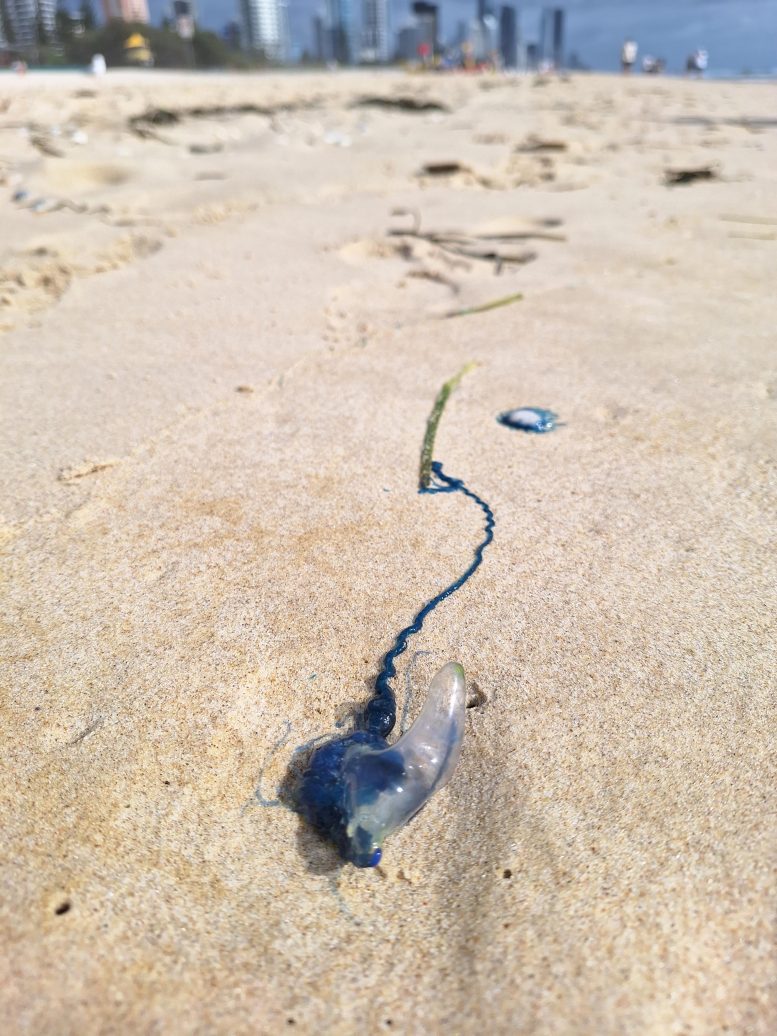
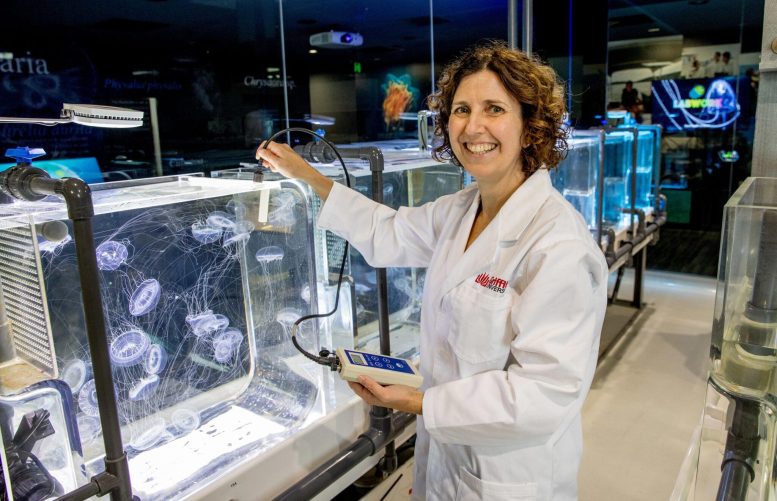
“We were shocked, because we assumed they were all the same species,” Griffith’s Professor Kylie Pitt said.
“But the genetic data clearly show they’re not only different, they’re not even interbreeding despite overlapping ranges. The bluebottle is uniquely suited to long-distance travel, using its gas-filled float and muscular crest to catch the wind and sail the sea surface.”
Morphological evidence confirmed by genomics
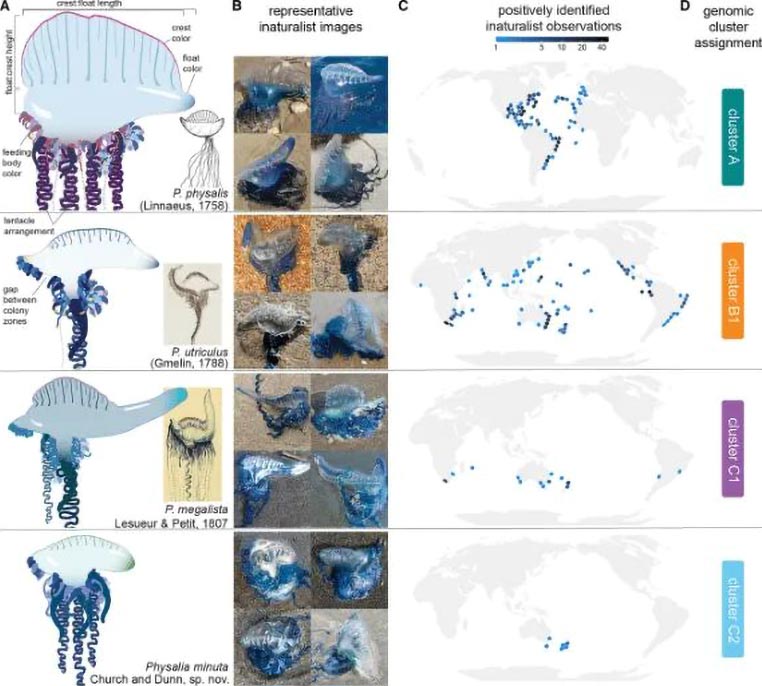
The team used an integrative approach to link genomic lineages with four distinct physical forms, which were identified through thousands of citizen-science images submitted to iNaturalist.org.
These morphologies – originally proposed as separate species in the 18th and 19th centuries but later dismissed – have now been verified by modern genomic evidence.
The study describes Physalia physalis, P. utriculus, and P. megalista, alongside a newly identified species, Physalia minuta, found near New Zealand and Australia.
Each species is further subdivided into genetically distinct subpopulations shaped by regional winds and ocean currents, according to advanced ocean circulation modelling.
Rethinking ocean connectivity and speciation
“There’s this idea the open oceans all connected, and it’s just one species of bluebottle and they’re all globally connected because they drift with the wind and the current,” Professor Pitt said.
“But that’s absolutely not the case. And what’s really interesting in Eastern Australia is that we have multiple species that have evolved despite potentially co-existing. So why is it that they developed into separate species when you think they’ll all be in the same environment, mixing up together? What was the selection pressure that led to the differentiation of the species?”
The researchers said future investigations into the physical, environmental, and biological processes that generated and maintained this genetic variation would be crucial in recalibrating science’s expectations towards open-ocean biodiversity.
Reference: “Population genomics of a sailing siphonophore reveals genetic structure in the open ocean” by Samuel H. Church, River B. Abedon, Namrata Ahuja, Colin J. Anthony, Dalila Destanović, Diego A. Ramirez, Lourdes M. Rojas, Maria E. Albinsson, Itziar Álvarez Trasobares, Reza E. Bergemann, Ozren Bogdanovic, David R. Burdick, Tauana J. Cunha, Alejandro Damian-Serrano, Guillermo D’Elía, Kirstin B. Dion, Thomas K. Doyle, João M. Gonçalves, Alvaro Gonzalez Rajal, Steven H.D. Haddock, Rebecca R. Helm, Diane Le Gouvello, Zachary R. Lewis, Bruno I.M.M. Magalhães, Maciej K. Mańko, C. Gabriela Mayorga-Adame, Alex de Mendoza, Carlos J. Moura, Catriona Munro, Ronel Nel, Kohei Oguchi, Jessica N. Perelman, Laura Prieto, Kylie A. Pitt, Moninya Roughan, Amandine Schaeffer, Andrea L. Schmidt, Javier Sellanes, Nerida G. Wilson, Gaku Yamamoto, Eric A. Lazo-Wasem, Chris Simon, Mary Beth Decker, Jenn M. Coughlan and Casey W. Dunn, 19 June 2025, Current Biology.
DOI: 10.1016/j.cub.2025.05.066
In 2022, UNSW were awarded an Australian Research Council Linkage grant for the project ‘Bluebottle dynamics: towards a prediction tool for Surf Life Saving Australia’, which will develop a forecasting method to prevent bluebottle stings, in partnership with Griffith University, Seatech (University of Toulon, France), the Bureau of Meteorology, Surf Life Saving Australia and the NSW Department of Planning and Environment.
Never miss a breakthrough: Join the SciTechDaily newsletter.
Follow us on Google and Google News.
3 Comments
On the one hand, this is super cool and interesting and obviously scientifically important. OTOH, one jellyfish of nightmares isn’t enough?!
Obviously, these are a DNA eating species left by aliens to destroy the world – but on a slow time scale. Wake up.
Hasn’t this been common knowledge for ages? I remember learning about them on the old WWF Dangerous Creature CD-ROMs back in the 90s.