
Greenland’s glacier calving is foreshadowed by the loosening of the ice mélange, offering a new predictor for sea-level rise.
Shortly before Jakobshavn Isbræ, a tidewater glacier in Greenland, calves massive chunks of ice into the ocean, there’s a sudden change in the slushy collection of icebergs floating along the glacier’s terminus, according to a new CIRES-led paper. The work, published today in Nature Geoscience, shows that a relaxation in the thick aggregate of icebergs floating at the glacier-ocean boundary occurs up to an hour before calving events. This finding may help scientists better understand future sea-level rise scenarios and could also help them predict when major episodes of calving are about to occur.
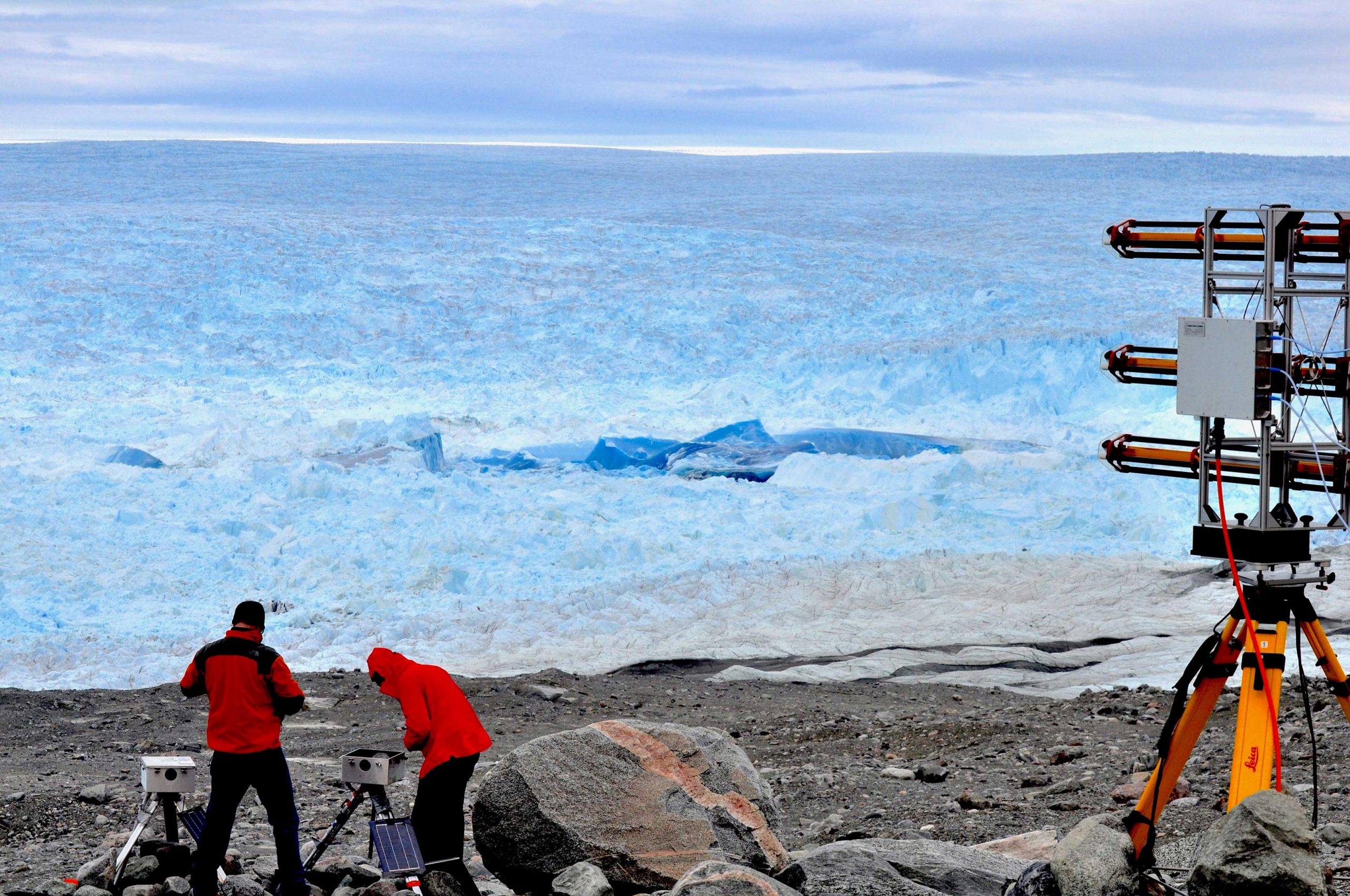
In winter months, icebergs and sea ice accumulate within the fjord in front of Jakobshavn Isbræ, forming a frozen plug that prevents calving. The glacier can continue to flow into the fjord, intact, and advance dozens of meters each day. This accumulation of icy material, which scientists refer to as ice mélange, persists into the summer, but its shelf-like structure loses rigidity in the relative warmth, and it behaves more like individual icebergs jammed together in the fjord. Until now, no study has shown whether this type of late summer ice mélange can influence iceberg calving.
“It only takes a small bit of strain for the mélange to stretch or relax a little bit, and so it’s no longer an ice jam,” said Ryan Cassotto, a researcher in CIRES’ Earth Science and Observation Center and lead author of the new study.
To understand what was happening during these calving events, Cassotto and his colleagues took ground-based radar interferometers to Greenland in 2012 and set them up in Jakobshavn Isbræ’s proglacial fjord to record iceberg interactions every three minutes. They found that in between calving events, icebergs within the ice mélange moved together, flowing down the fjord as a single, cohesive unit.
Behavioral Shift Precedes Calving Events
But the movement of individual icebergs changed just before each of the 14 calving events that they observed—instead of flowing as a single, coherent unit, the ice mélange relaxed and icebergs began to move independently of each other.
“When the ice mélange relaxes, individual icebergs begin to rotate around, and when they begin to rotate around, the mélange loses its structure,” said Cassotto. “And when it loses its structure, it loses its ability to impede calving.”
To understand what was happening to the icebergs within the ice mélange during these events, the researchers used a particle dynamics model that simulates the movement of individual icebergs. They found that only a small downfjord expansion of the ice mélange was needed to trigger independent movement of the icebergs.
Implications for Sea-Level Rise Forecasting
“As a gateway to the ocean, ice mélange can have a direct impact on future predictions of sea-level rise,” said Justin Burton, associate professor of physics at Emory University and co-author of the paper. “We’ve provided the best, most precise data ever showing the processes leading up to major calving events. That helps us understand the forces determining how much ice discharges into the ocean, and how fast it happens.”
The exact cause of such shifts is not yet clear, but changes in ocean tides, the subglacial discharge of meltwater, and winds may help explain the sudden relaxation of the thick aggregate of icebergs pushing back against the glacier.
This study is the first to show that an ice mélange largely free of sea ice can control the timing of calving, Cassotto said. It is also the first study in which researchers were able to observe granular scale changes in a material within the natural environment.
“Most studies of granular materials are conducted in laboratories,” said Jason Amundson, associate professor of geophysics at the University of Alaska Southeast and co-author of the paper. “These observations demonstrate that we can gain new insights into the behavior of granular materials by studying dense packs of icebergs, which represent some of the largest granular materials on Earth.” The methods in this study could be used to predict failure in other geophysical materials, such as debris flow or landslides.
Reference: “Granular decoherence precedes ice mélange failure and glacier calving at Jakobshavn Isbræ” by Ryan K. Cassotto, Justin C. Burton, Jason M. Amundson, Mark A. Fahnestock and Martin Truffer, 27 May 2021, Nature Geoscience.
DOI: 10.1038/s41561-021-00754-9
Never miss a breakthrough: Join the SciTechDaily newsletter.
Follow us on Google and Google News.