
Close Menu
    Facebook X (Twitter) Instagram
    SciTechDaily
    • Biology
    • Chemistry
    • Earth
    • Health
    • Physics
    • Science
    • Space
    • Technology
    Facebook X (Twitter) Pinterest YouTube RSS
    SciTechDaily
    Home»Science»Disease Mapping Methods Indicate That Indo-European Languages Originated From Anatolia
    Science

    Disease Mapping Methods Indicate That Indo-European Languages Originated From Anatolia

    By SciTechDailyAugust 27, 20122 Comments3 Mins Read
    Facebook Twitter Pinterest Telegram LinkedIn WhatsApp Email Reddit
    Share
    Facebook Twitter LinkedIn Pinterest Telegram Email Reddit
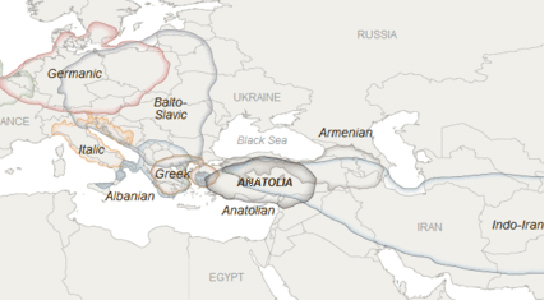
    disease-map-spread-indo-european-languages
    Researchers analyzed 103 ancient and contemporary languages, typically used to study disease spread, finding diverse languages, including English and Hindi, trace their roots back 8,000 years to Anatolia.

    Diverse languages, from English to Hindi, can trace their roots back 8,000 years to Anatolia (Asia Minor), a region that’s centered around modern-day Turkey. The study assessed 103 ancient and contemporary languages using a technique that’s normally used to study the spread and evolution of diseases.

    Languages such as English, Dutch, Spanish, Russian, Greek and Hindi might sound very different, but there are some similarities. More than a hundred languages from across Europe and the Middle East, stem from one progenitor.
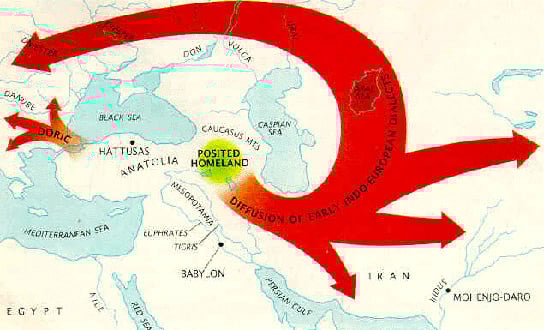
    language-diffusion

    It has been hypothesized that Indo-European languages spread thanks to the farming techniques from Turkey to Europe and Asia, 8,000 to 9,500 years ago. Other hypotheses state that nomadic horsemen brought the roots of the language from central Asia 6,000 years ago. While there is archaeological evidence to support both of these theories, genetic studies of Indo-Europeans have remained inconclusive, leading to a debate between linguists, anthropologists and cultural historians.

    Russell Gray and his then doctoral student, Quentin Atkinson, pioneered the use of disease maps for this kind of problem back in 2003. Neither of them are linguists, but the models used in evolutionary ecology could answer important questions about language prehistory.
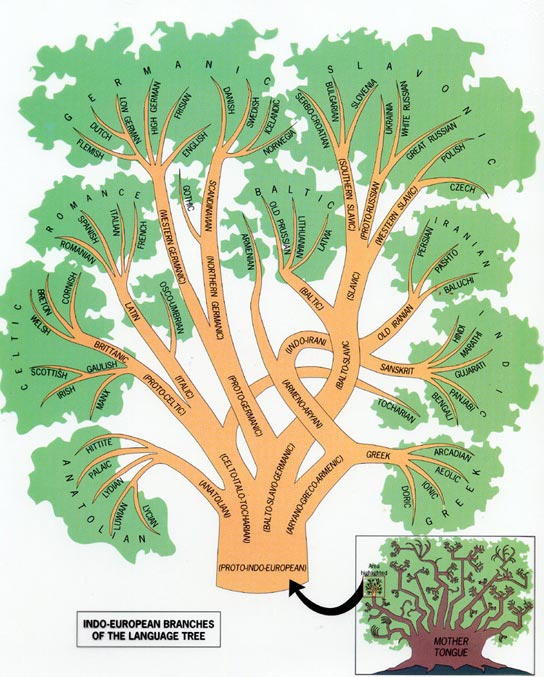
    language-family-tree

    There can be similarities drawn between genes and words, and while language evolution has traditionally been mapped using a tree format, Gray and Atkinson theorized that the evolution of words was similar to the evolution of species. They published their new findings in the journal Science.

    They theorized that the cognate of words could be modeled on DNA sequences and then lead to a measurement of how languages evolved. The rate that words mutated could be used to determine at what age the Indo-European languages diverged from each other.

    They traced the origins of Indo-European languages to 7,800 to 9,800 years ago. Then, using a type of geography-based computer modeling usually used by epidemiologists to track the spread of disease, they pinpointed the origin of Indo-European languages.

    Instead of acceptance, many linguists and archaeologists still favor the Kurgan hypothesis. There might be a bias in the underlying data that could have led to an erroneous conclusion. The model used could also not be the right fit for the complex linguistic and archaeological evidence.

    Reference: “Mapping the Origins and Expansion of the Indo-European Language Family” by Remco Bouckaert, Philippe Lemey, Michael Dunn, Simon J. Greenhill, Alexander V. Alekseyenko, Alexei J. Drummond, Russell D. Gray, Marc A. Suchard and Quentin D. Atkinson, 24 August 2012, Science.
    DOI: 10.1126/science.1219669

    Never miss a breakthrough: Join the SciTechDaily newsletter.
    Follow us on Google and Google News.

    Evolution Language Linguistics
    Share. Facebook Twitter Pinterest LinkedIn Email Reddit

    Related Articles

    Challenging Linguistic Assumptions: Size of Society Doesn’t Dictate Grammar Complexity

    New Hybrid Hypothesis Shakes Up Indo-European Language Origin Theories

    Why Do British People Sound So Smart?

    Primates Change Their “Accent” in Shared Territory to Avoid Conflict

    Screams of “Joy” Are Often Mistaken for “Fear” When Heard Out of Context

    Researchers Use “Artificial Grammars” to Show Building Blocks of Language Evolved 30–40 Million Years Ago

    Distinctive Primal Acoustics of the Human Scream

    Old World Monkeys Vocalizations May Be More Sophisticated Than Previously Realized

    Linguistics Research May Improve Future Internet Search Engines

    2 Comments

    1. Avni Ademi on April 26, 2019 5:13 am

      claiming to study indo-European languages and not mentioning Albanian as a language is like discarding your own theory.

      Reply
    2. maher on January 23, 2026 1:31 pm

      That place is amazingly where the Ararat mountain is… So the Noah myth was somewhat true…

      Reply
    Leave A Reply Cancel Reply

    • Facebook
    • Twitter
    • Pinterest
    • YouTube

    Don't Miss a Discovery

    Subscribe for the Latest in Science & Tech!

    Trending News

    Scientists Recreate a Nuclear Fireball and Uncover Fallout’s Hidden Chemistry

    These Tiny Gut Particles Could Be Accelerating Aging Throughout the Body

    Doctors Changed One Thing and Weight Gain Stopped

    Magnetic Fields May Solve a Longstanding Binary Star Mystery

    The Probiotic Breakthrough for Natural Anxiety Relief and Better Mental Health

    Animal vs. Plant Protein: Scientists Found a Surprising Nutritional Difference

    According to Scientists, This Simple Dietary Change Is Linked to Lower Depression Scores

    Researchers Discover a Hidden Vitamin D Problem That Persists Year-Round

    Follow SciTechDaily
    • Facebook
    • Twitter
    • YouTube
    • Pinterest
    • Newsletter
    • RSS
    SciTech News
    • Biology News
    • Chemistry News
    • Earth News
    • Health News
    • Physics News
    • Science News
    • Space News
    • Technology News
    Recent Posts
    • Scientists Uncover Why Walking Gets Slower and More Exhausting As We Age
    • 24 Hours Without Sleep Changes Your Saliva in Measurable Ways
    • A Major Update Just Hit Cholesterol Guidelines – Here’s What Every Adult Needs To Know
    • Scientists Tracked 4,500 Animals During COVID – What They Discovered Was Surprising
    • Hidden Phase of Matter Finally Captured After Decades of Predictions
    Copyright © 1998 - 2026 SciTechDaily. All Rights Reserved.
    • Science News
    • About
    • Contact
    • Editorial Board
    • Privacy Policy
    • Terms of Use

    Type above and press Enter to search. Press Esc to cancel.