
A groundbreaking soil-analysis method is helping investigators trace suspect movements with precision.
Scientists have taken the first steps in developing a new method of identifying the movements of criminals using chemical analysis of soil and dust found on equipment, clothing, and cars. The locating system allows police or security services to match soil remnants found on personal items to regional soil samples, to either implicate or eliminate presence at a crime scene. The work is presented as a Keynote Lecture at the Goldschmidt Geochemistry Conference, after recent publication.
Dr. Patrice de Caritat, Principal Research Scientist at Geoscience Australia, Australia’s public sector geoscience organization, said:
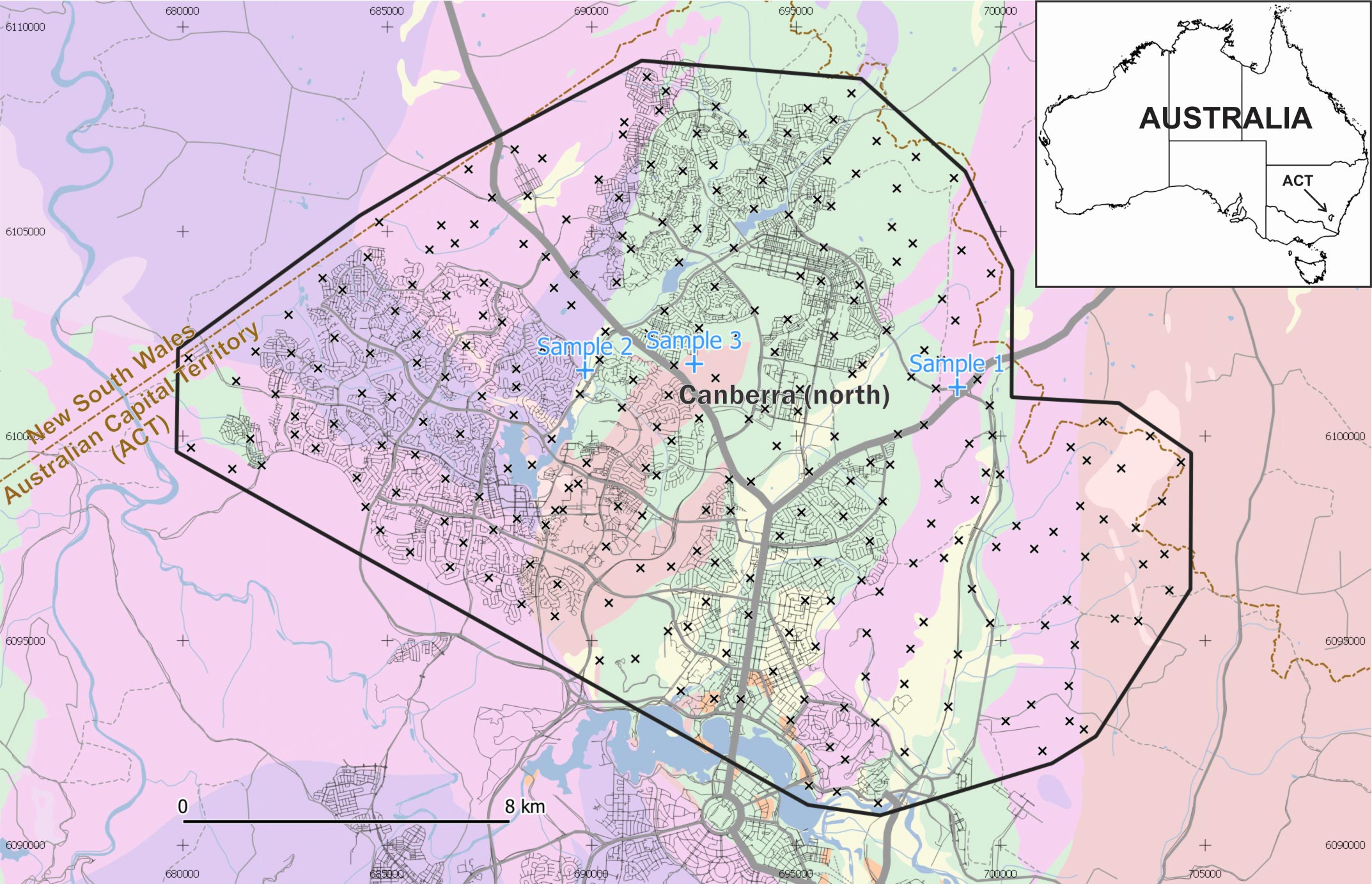
“We’ve done the first trials to see if geochemical analysis could narrow down a search area. We took a 260 km² (100 mi²) area of North Canberra and divided it into cells (squares) of 1 km x 1 km (0.6 mi x 0.6 mi), and sampled the soil in each cell. We were then given 3 samples from within the survey area, and asked to identify which grid cells they came from. This was a ‘blind’ experiment, in other words, we did not know where the samples came from until the end of the experiment. For comparison, Manhattan Island is around 60 km2, so that shows that we looked at a pretty big area.”
Using these methods, they were able to eliminate 60% of the territory under investigation.
Dr. de Caritat said “Much of forensics is about elimination, so being able to rule out 60% of an area is a substantial contribution toward successfully locating a sample. You can reduce the time, risk and investment of the ongoing investigation. The more parameters we look at, the more accurate the system is. We have reached 90% detection in some cases, although we think that would involve too many factors for real-world crime detection.”
High-Tech Instrumentation Boosts Accuracy
The team used a range of analytical instrumentation — Fourier Transform InfraRed Spectroscopy, X-Ray Fluorescence, Magnetic Susceptibility, and Mass Spectrometry to compare the 3 blind samples to the previously collected samples.
Dr. de Caritat, who is also Adjunct Professor at the National Centre for Forensic Studies at the University of Canberra, said:
“This shows that our systems work, and that we have a potential new tool for criminal and intelligence investigations. It’s the next stage which is potentially most interesting. Most developed countries have existing soil databases,* used for such things as mineral exploration or land use decision support. We’re plugging our methods into these databases to see if we can locate samples from the database information, rather than needing to collect samples specifically for each investigation.
Conventional soil analysis has already been used in Australia to identify and prosecute criminals. For example, soil analysis was used to identify the movements of a man who carried out a sexual assault on a young girl in Adelaide. There are several such examples. We now want to take this further.”
Expanding the System with Environmental DNA
Dr de Caritat worked with the Australian Federal Police in 2017-18, where he helped them develop their capability to analyze soils for forensic location. He said:
“Geoscience Australia is now working with the Australian Federal Police, the University of Adelaide, Flinders University, and the University of Canberra on a Defence Department project to incorporate environmental DNA (e.g. from local plants) and X-Ray Diffraction mineralogy into the soil and dust location system.”**
Commenting, Professor Jennifer McKinley (Queen’s University, Belfast) said ‘The breakthrough in Dr de Caritat’s work is that it integrates robust compositional data analysis of the multivariate geochemical data into forensic geoscience and applies this in an innovative way to forensic soil provenance’.
Notes
*See examples of soil databases at https:/
** See press notification at https:/
References:
“Predictive Soil Provenancing (PSP): An Innovative Forensic Soil Provenance Analysis Tool” by Patrice de Caritat Ph.D., Timothy Simpson B.Sc. (Hons) and Brenda Woods Ph.D., 16 April 2019, Journal of Forensic Sciences.
DOI:10.1111/1556-4029.14060
“Forensic soil provenancing in an urban/suburban setting: A sequential multivariate approach” by Patrice de Caritat PhD, Brenda Woods PhD, Timothy Simpson BSc (Hons), Christopher Nichols BAppSc (Hons), Lissy Hoogenboom BSc, Adriana Ilheo GradCert, Michael G. Aberle BAppSc (Hons) and Jurian Hoogewerff PhD, 6 May 2021, Journal of Forensic Sciences.
DOI: 10.1111/1556-4029.14727
Never miss a breakthrough: Join the SciTechDaily newsletter.
Follow us on Google and Google News.